
I.I’ve told you before of the short story that Ernest Hemingway memorably wrote called The Capital of the World, where he tells of a young Spanish son named Paco. Paco’s dream is to become a matador, so he does as many young aspiring matadors do, and runs away to the capital to discover himself and flee his father’s control.
And then Hemingway writes: “Madrid is full of boys named Paco … and there is a Madrid joke about a father who came to Madrid and inserted an advertisement in the personal columns of El Liberal which said: “Paco, meet me at Hotel Montana at noon Tuesday. All is forgiven, Papa.” The next day, Hemingway said, “a squadron of [the local police] had to be called out to disperse the 800 young men who answered the advertisement.”1
The humor, of course, is about the number of little Spanish boys named Paco. But the truth, of course, is much much deeper than that, a truth that tells of the human longing to be forgiven.
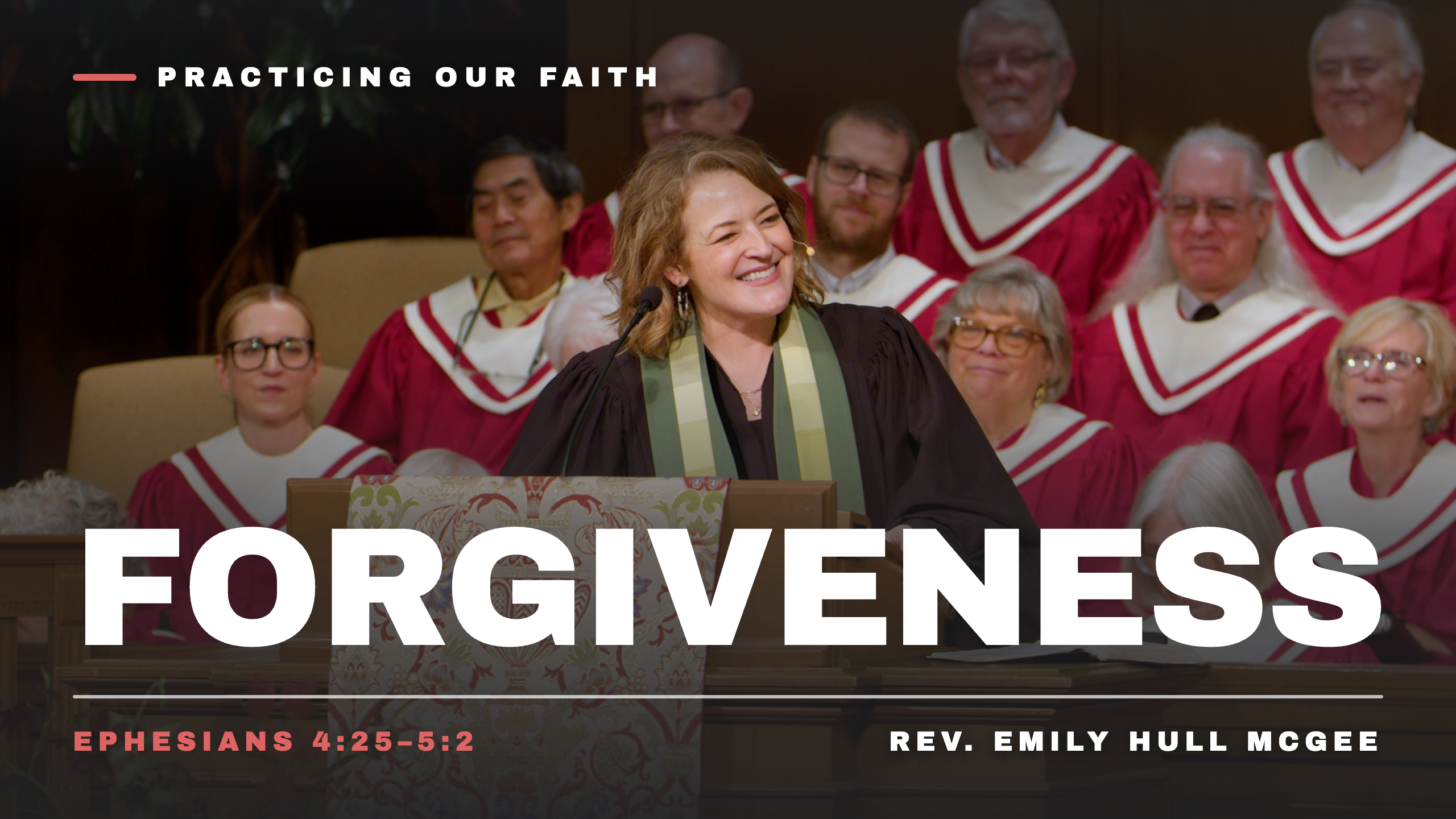
II.Our journey through the practices of the Christian faith brings us to a letter written to an early bunch of Jesus followers in a seaside town called Ephesus. In my Bible, “Rules for the New Life” is the heading for our passage today. But just before verse 25, we hear Paul encouraging the followers of Jesus toward a certain kind of living. “Put away your old self, “ Paul says, and instead choose humility, gentleness, and patience, bearing one another in love, maintaining unity of the Spirit within the bond of peace, speaking the truth in love – all beautiful reminders of what Christlike living could be. Paul continues that line of reasoning here with several instructions to “put away” an old way of living, so that we might “put on” what Christ makes new.
The contrasts are clear. Put away a vice, and take on a virtue. Put away falsehood, sinful anger, stealing, evil talk, Paul says. Why? Because we are members of one another, and we don’t want the shadows between us to have room to fester. These words of instruction culminate one final time with a laundry list: “put away from you all bitterness and wrath and anger and wrangling and slander, together with all malice.” That just about covers it, doesn’t it? No bitterness, stubborn grudges or resentment towards each other. No wrath or “throwing fits,” as we say in my house. No anger, that which is quick-tempered and definitive. No wrangling, or being perpetually ready to get into it with someone with whom we disagree. (Just look in any internet comment section for evidence of wrangling!) And no slander, or putting each other down with insults and harsh words. Don’t do these things, Paul tells us, but rather be kind to one another. Kind! Tenderhearted, or compassionate, forgiving, living in love, and imitating God! This is that new way of living Paul describes: one that leads a life worthy of the calling to which we have been called, one that honors the Jesus we follow.
III.Think with me about the human heart. Some of you think about your heart every day when you take blood pressure medicine, or when it skips a beat, or when it aches with the griefs of your life and this world. The heart, which beats slightly more than once every second, is at the essence and the source of life. Indeed, “it is the most single-minded thing within you,” as Bill Bryson once said, pumping more than 70 gallons of blood per hour all throughout your body.2 Its job is to attend to those connections, to keep things clear and moving and unimpeded.
If we’re to think of the Way of Jesus as the way of the heart – at the pulsing core of all of life, this new life Paul describes – then I want you to imagine that all the examples Paul names here – bitterness, wrath, anger, wrangling, slanger, malice – as the clogs in the arteries, the very things that interfere with the flow of love that God wants for our lives.
I know you know what that feels like.
We know the feeling of bitterness, when resentment rears its ugly head with frustration and envy. It infects us at just the place where we just want to be left alone with our corrosive anger or cold self-righteousness or prideful judgment. It crops up when a boundary hasn’t been held, when we haven’t asked for what we need, when expectations aren’t met because they’re not clear or can’t be.3 The longer we hold onto bitterness, the longer we’re distorted by it and bound to it. “Bitterness is like cancer,” Maya Angelou says. “It eats upon the host.”4 Or from Anne Lamott, who says “bitterness is like you’re drinking rat poison and then waiting for the rat to die.”5
We know the feeling of wrath, when we yearn for ultimatums upheld and penance paid. We want the prodigal children to be punished, the unjust managers fired, the foolish leaders humiliated.
We know the feeling of anger that clogs and crowds our relationships, where small resentments build over time like plaque, and contempt, gone unchecked, dehumanizes and hardens us against each other. Augustine understood this when he said “for anger habitually cherished against anyone becomes hatred.”6 And Frederick Buechner’s description of anger is my favorite:
“Of the seven deadly sins, anger is possibly the most fun. To lick your wounds, to smack your lips over grievances long past, to roll over your tongue the prospect of bitter confrontations still to come, to savor to the last toothsome morsel both the pain you are given and the pain you are giving back – in many ways it is a feast fit for a king. The chief drawback is that what you are wolfing down is yourself. The skeleton at the feast is you.”7
We know the feeling of wrangling and slander and malice… when quick and cutting comments about those irritants in our life serve more like an ego’s band-aid, rather than the verbal sutures that lead to healing.
We know what these things feel like, because we feel them here – in our hearts – and how they make life hard and hardened between us: how they clog and clot and block the freedom that the flow of Love brings to our lives. We know what they feel like to us on both sides of that flow, and how, as giver or receiver, we cut off the circulation of grace without even realizing it.
But forgiveness, you see, becomes the clot-buster. A statin for the soul. An angioplasty for the spirit. (Begging forgiveness to all the cardiologists in the room for my many heart metaphors.) Frederich Buechner says: “To forgive somebody is to say one way or another, ‘You have done something unspeakable, and by all rights I should call it quits between us. Both my pride and my principles demand no less. However, although I make no guarantees that I will be able to forget what you’ve done, and though we may both carry the scars for life, I refuse to let it stand between us. I still want you for my friend.’ And to accept forgiveness means to admit that you’ve done something unspeakable that needs to be forgiven, and thus both parties must swallow the same thing: their pride… For both parties, forgiveness means the freedom again to be at peace inside their own skins and to be glad in each other’s presence.”8 Forgiveness makes me think of the lyric to an old hymn with a slight twist: “because I have been forgiven much, I too must forgive.” Indeed, the forgiveness I need or the forgiveness I’m not willing to give is the same forgiveness that doesn’t even belong to me in the first place. It’s not mine to hoard or to give away, because it is God’s gift to us, and it doesn’t run out. God’s forgiveness of us is rooted in God’s extravagant love for us. So “be imitators of God,” Paul says. “Live in love.” Trust in the grace and “the buoyancy of God.”9 Keep what’s at the heart, at the heart. Forgive one another!
IV.The hardest part of this work is when we have to actually do it. So how do we practice forgiveness?
Well, it’s not an accident that I planned to preach on forgiveness this Sunday following the election, the Sunday before Veterans Day, and a few weeks before we all have to listen to the proverbial Uncle Ned rattle on about their politics at the Thanksgiving dinner table! Indeed, as we consider the personal and communal wrongs – wrongs both intimate and vast perpetrated by us, against us, with us, without us – it seemed like now’s as good a time as any to practice.
First, we give thanks to God for the grace to enter a lifelong journey of forgiveness, “a long obedience in the same direction,” John Claypool says. And we give grace to ourselves and others, because both asking for and granting forgiveness can be terribly hard, takes time to practice, and may never achieve the emotional satisfaction we seek.
First, we offer thanks. Then, we take our cue from Jesus, who taught us to pray, saying “forgive us our trespasses as we forgive those who trespass against us.” And that prayer is why we practice these words aloud each and every week in worship, so that when it’s our turn, we know what to do. It’s why we learn the words of Jesus about forgiving at offensive levels (“seventy times seven” he says in the gospels) and understand that forgiveness finds its apex on the cross. Learning deeply the words and actions of Jesus guards us from twisting his, “Father, forgive them for they know not what they do,” into our distorted alternative: “Forgive them not, Father, for they knew what they did!” And finally, doing so in beloved community becomes a way that we share these commitments of forgiveness within the sturdiness of trust.
Then we take these understandings out into the world. So let me encourage you this week to think about someone in your life who you just don’t really want to forgive. I bet you have someone in mind. Instead of rehearsing again all the conflicts, all the ways they’ve wronged you, all the ways they drive you up the wall, what might it take to acknowledge your anger and how it has served you, and then confess your desire to overcome it? What might you need to do to remember forgiveness is actually more about you than them, and that forgiveness doesn’t equal an endorsement of their behavior, but rather liberation from your resentment of it? As a counselor I love once said, forgiveness allows you to put that long-simmering anger in the proverbial trunk of your car instead of the driver’s seat.
Or maybe think about someone in your life from whom you’re desperately seeking forgiveness. Perhaps there’s an apology you need to make, or repair you need to initiate. You can’t change or control them, but you can do what is yours to do. And maybe forgive yourself along the way.
V.I want to end with another old story that deserves retelling when we’re talking about forgiveness. “I don’t know how long it had been since these two neighbors had talked to each other,” begins the story told by Asheville-based singer-songwriter David Wilcox. He goes on to describe these two neighbors, property divided by a creek, who somewhere along the way had a falling out about a stray cat. “Just the dumbest reason,” Wilcox said. Both men were taking care of this stray cat and after a while, one of the neighbors took the cat into his house. Well the other neighbor thought that it was his cat, and so whenever the two talked to each other, they’d quickly begin yelling and storming off until after a while, they just quit talking to each other at all.
One day a traveling carpenter came up to one of them out in the yard and asked if there might be any work he could do to help them out. And the man said, “Yeah, I’ve got something for you to do. You see that house over there? Well that’s my neighbor; his property starts down there at that creek. So I want you to take this here pile of lumber and build me a fence, all along the water so I don’t even have to look at him. Could you do that for me?” A little surprised, the carpenter says, “Yeah, I could do that but I’ll need some more wood. So why don’t you let me get started with what you have here, and you go on into town to get some more wood so I can finish the job?”
So the man goes off to buy more wood, and as he’s bouncing back down the rutted dirt road, new lumber clacking around in the back of his truck, he looks out over that field to see where his new fence oughtta be. Only when he looks out over his property line, he sees that the carpenter has built not a fence, but a bridge, with his wood. And before he can get down there, he sees his neighbor come out of his house and walk across that bridge, built with his wood, onto his land. Well that neighbor walks right up to him with
his hand outstretched with a big ole’ stupid smile on his face and says, “You’re a brave man. I thought you’d never want to hear the sound of my voice again. I feel like such a fool. Do you think you might forgive me?”
And then the man finds himself taking his outstretched hand and hears himself saying, “Aww heck, I knew that was your cat anyways.” Then he sees the carpenter walking away and calls out, “Hey, I’ve got some more work for you if you need it.” But the carpenter turns and says, “No, you’ll be fine, I’m needed elsewhere.”10
VI.Beloveds, may your practice of forgiveness give meaning and flow and movement to the beating heart of your faith. And may you live in love as Christ loved us! Amen.