
I.On that first night over pizza, our conversation turned to the church.
These were the early 2010s, the years I was serving as Minister to Young Adults among the 18-35ish year-olds at Highland Baptist Church in Louisville, Kentucky. We were building the young adult ministry plane as we flew it in those days. My beloved companions were the church’s original group of a dozen young adults – generous in their energies and visionary in their imagination.
Our first fall together, we decided to go on retreat, gathering at a working monastery and seminary called St. Meinrad’s just an hour from Louisville. (Added bonus that they served pizza at the campus pub on Friday nights!) That’s where we were mere hours into the weekend, when the frustrations about the church began to flow: the pace of change; the gaps in our public witness; the sense that, unless you’d been around for decades, no one really cared that much about your opinions; the fact that none of them were serving on the important committees; you name it.
I listened for a while – still learning all the dynamics – and then asked gently, “Well, did any of you say yes when you were asked to serve?”
Silence. Side glances. “Do you, you know, go to church business meetings?” I remember an, “ugh, not a chance.”
“Do you say yes when Kathy asks you to read scripture in worship?”
A chuckle. “Do you see how many introverts you have sitting with you right now?”
I grinned, and had a hunch that this next question might land. “Well how are you going to help your church become the church you hope it can be if you’re just sitting on the sidelines and refusing to participate in the process?”
Lots more conversation and a few more pizzas later, it was the last time this wise, creative, dynamic bunch of leaders sat out of the process to make better and more faithful the church they so loved. A couple years later, every single one was leading: elected as Deacons and representatives on the Ministry Council, teaching Sunday School, serving on search committees, offering stewardship testimonies in worship. One even volunteered to serve on the Bylaw Revision Task Force, for God’s sake! (And then promptly made the whole group “I survived the Bylaw Revision Task Force of 2013” t-shirts.) This group decided that the work of shaping their church community was their work to do too. We were a body, and in that season, they found their place as the righteous mouthpieces, the moving legs, the aching hearts. It changed the trajectory of their lives, and of mine, and of ours.
II.“Now you are the body of Christ,” Paul says to the church at Corinth, “and individually members of it.” Paul the apostle shares a number of different metaphors for the church throughout his writings: the church as building, as temple, as field. But when there are problems with unity (when, not if!), when the churches he works with have interpersonal challenges to address, it is to this image of the body that Paul returns.1 And notice here that he does so, reminding the hearers that they already are the body of Christ. This has already happened in their baptism. He’s not telling them they should be like parts in a body, but that they already are the body… with the not-so-subtle subtext: so act like it! Expect difference, don’t just tolerate it! Cherish all that adds to the vibrant color of a community, because you can’t function without it! Dietrich Bonhoeffer says of Christian community in his book, Life Together, “Christian community is not an ideal we have to realize, but rather a reality created by God in Christ in which we may participate.”2 God has already done the creating in all our rich diversity, so let’s act like it!
As the text continues, one scholar notes that a more accurate translation of the Greek would be, “Not all are apostles or prophets or teachers, are they?,” which underscores Paul’s acknowledgment that within the body of Christ that is already established, there is difference.3 It’s remarkably, relentlessly democratic, this image of community, where people of all kinds exercise all ways of being together and caring for one another.4
What else do we know about the church from this text? In the midst of difference, what is the same, no matter their part, or gift, or role? A close reading reveals themes of belonging, arrangement, need, respect, capacity, disagreement, suffering, gifts. Indeed, in all our difference, there is overlap – and that overlap is right at the heart of life together.
III.Can you imagine if we actually practiced this? Studies have shown us for years just how precipitous is the fall of people away from organized communities of faith, many for good reason. It’s not hard to guess why. Because have you noticed that churches are filled with people? And have you been around people recently?! We are messy and fragile and emotional and afraid. We screw up and fall short and disappear and disappoint and fail. We don’t all agree, and don’t all behave, and don’t always meet our best expectations of ourselves and each other. Thus, church can be full of bureaucracy and resistance and laborious business meetings at best, unjust exclusion and abuses of power and a failure of imagination at worst. It’s no wonder that millions want no part in it.
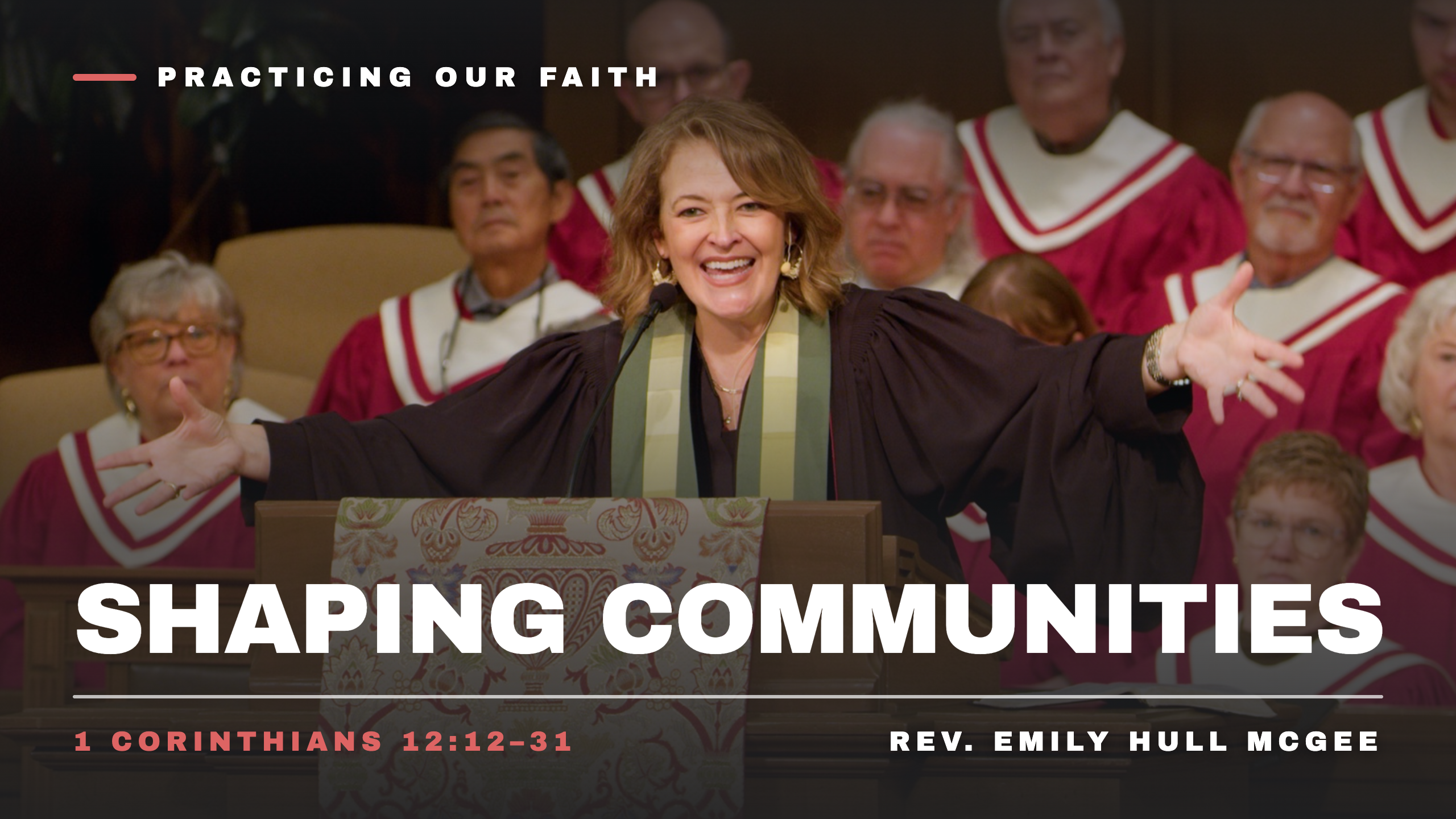
This is my pitch to get you excited about our next church business meeting on Tuesday night! Is it working? No, I tell you this because the work of shaping communities is right at the heart of experiencing community itself. In our fall study of Practicing Our Faith, author Larry Rasmussen names that “the shaping of communities is the practice by which we agree to be reliable personally and organizationally.”5 It happens in a variety of ways, he notes: roles and rituals, laws and agreements, shared commitments, institutional arrangements, all with the aim to order our common life.
This isn’t just for churches. Take our democracy, for example. More than 154 million people voted in the 2024 election, which seems like a staggering number until you level it against the 342 million citizens of the United States (huge!), or the number of voters who engage in the work of democracy in their local communities between elections (tiny!). As fictional President Jed Bartlett from The West Wing once said, “decisions are made by those who show up.”
Now apply that thinking to the work of the church. Ever since Jesus pointed to Peter and said, “upon this rock, I will build my church,” followers of Jesus have wrestled with how best to follow together. We do this in all sorts of ways. Catholics, Episcopalians, Lutherans, and the like try a top-down approach, with a priest or bishop or pope offering the direction. Presbyterians and Methodists and others go sideways through councils of leaders and elders to guide the decision-making. Baptists and other congregationalists like the Disciples of Christ and the United Church of Christ or non-denominational churches move from the bottom up, where the shaping of our common life is in the hands of the congregation. Over time, Christians form and reform, dissent and divide, cooperate and bless.
So despite all the many perspectives, positions, and postures of the people who constitute them, Baptist churches like ours form their own governance, call their own pastors, build their own budgets, choose their own ministries, and live out the distinct shape of their obedience to God, often in great contrast to another Baptist church down the road. I always tell folks in First Impressions that this is extremely confusing, and it’s no wonder people are frustrated by it! Indeed, it’s up to us to decide: who are we? What do we believe similarly, and what’s ok for us to believe differently? When and where do we gather? What should we do when we gather? How should we organize to do it? And how do we fund it? What rhythms of our life together are healthy and best? Who’s in charge? Who participates – all of us, or just some of us? What about the people who aren’t even here in the first place that are necessary parts of our body too? Where is power concentrated or dispersed, and should it be that way? How much of what we do reflects how we’ve always done it, and how much is adapted towards something new? What are the boundaries of our life together? Are they unnecessarily restrictive or helpfully defining? And on and on. Each member shapes the greater whole, and holds the potential for us to deepen our faithfulness and sharpen our witness.
It’s a beautiful vision, isn’t it? You might be surprised to learn that this church is full of people too! We all have different opinions about these things! At our best, we approach these questions with curiosity, not defensiveness, not holding on too tightly to our perspectives. But we’re humans, and sometimes we experience the emotional equivalent of when your inner ear is all out of whack, and we can’t exactly see each other clearly or put one foot in front of the other without stumbling. For membership in the body of Christ means all of us, all at once. We don’t get to choose an arm over a leg, or an eye instead of an ear. We can’t hand-select limbs or leave out appendages. We wouldn’t opt for a stomach one day and a heart another… and a liver every other Thursday! Honestly, it’s so much harder to be together in one body than it would be if we just went our separate ways.
In his book, The Company of Strangers, author Parker Palmer describes community as “that place where the person you least want to live with always lives!”6 Even in the church, even in this beloved community, we need reminding that Jesus’s call to love our neighbor sometimes means the Christian neighbor – those parts of the larger body of Christ we’d sooner reject, denounce, ignore, or disown for the ways their interpretation of faith is an affront to ours. But we’re members of one body! And loving our neighbor can even mean the neighbor right here, even closer to home: the neighbor down the pew who drives us crazy, or in the meeting that surfaced our hot anger, or in our Sunday School class that always talks about their problems. (Surely we don’t have that around here!) For you are the body of Christ, and individually members of it. And we are called to still a more excellent way, and that is the way of love.
IV.I hope you’re hearing ways in which you can and should and have and could continue shaping communities, this one in particular. But for today, I want to leave you with three assignments:
1 – Shape communities out there. Every couple of years, we have a chance once again to do a very specific task of ordering our common life. From right here in our city, to the state of North Carolina, to the United States as a whole, we express through our vote the kind of community we believe in. Want better education for our kids, or no data centers in our mountains, or more thoughtful spending of our money? Cast a vote. Participate. Show up and make this union more perfect with your voice.
2 – Be mutual in your efforts in here. Brene Brown once said, “vulnerability begets vulnerability. I cannot expect you to be vulnerable if I’m not willing also to be vulnerable.”7 Yes, and… I’d put a spin on that to say: community begets community. We cannot expect the kind of community we are unwilling to create. If we want the members of our community to care for us in a time of need, we have to be willing to care for members of our community in their time of need. If we want our community to be inclusive, creative, dynamic, and kind, we too must be inclusive, creative, dynamic, and kind. If we want our community to show up as advocates in the public sphere, you know where this ends. We have to show up as advocates in the public sphere. The kind of community we receive is the kind of community we give. Members of one another, remember?
3 – If we’re about the work of shaping communities, we ourselves have to be shaped, and we must be shaped in love. It’s at the heart of it all. Even when this body’s elbow creaks and nose itches and wrists break. Especially when the wideness among us stretches us past our comfort. God is already at work knitting us together! God is already at work building love among us! So our role, then, is to be shaped by that, to celebrate all the elbows and the ears, the knees and the nose, the legs and the livers, even – especially! – when we think sometimes that just a church full of hands would make things a whole lot easier. Life is at its richest together in our difference, when even still, we are bound up in love. It re-members what has been dismembered.
So friends, you are the body of Christ, and individually members of it. Thanks be to God for this body we shape! Amen!