
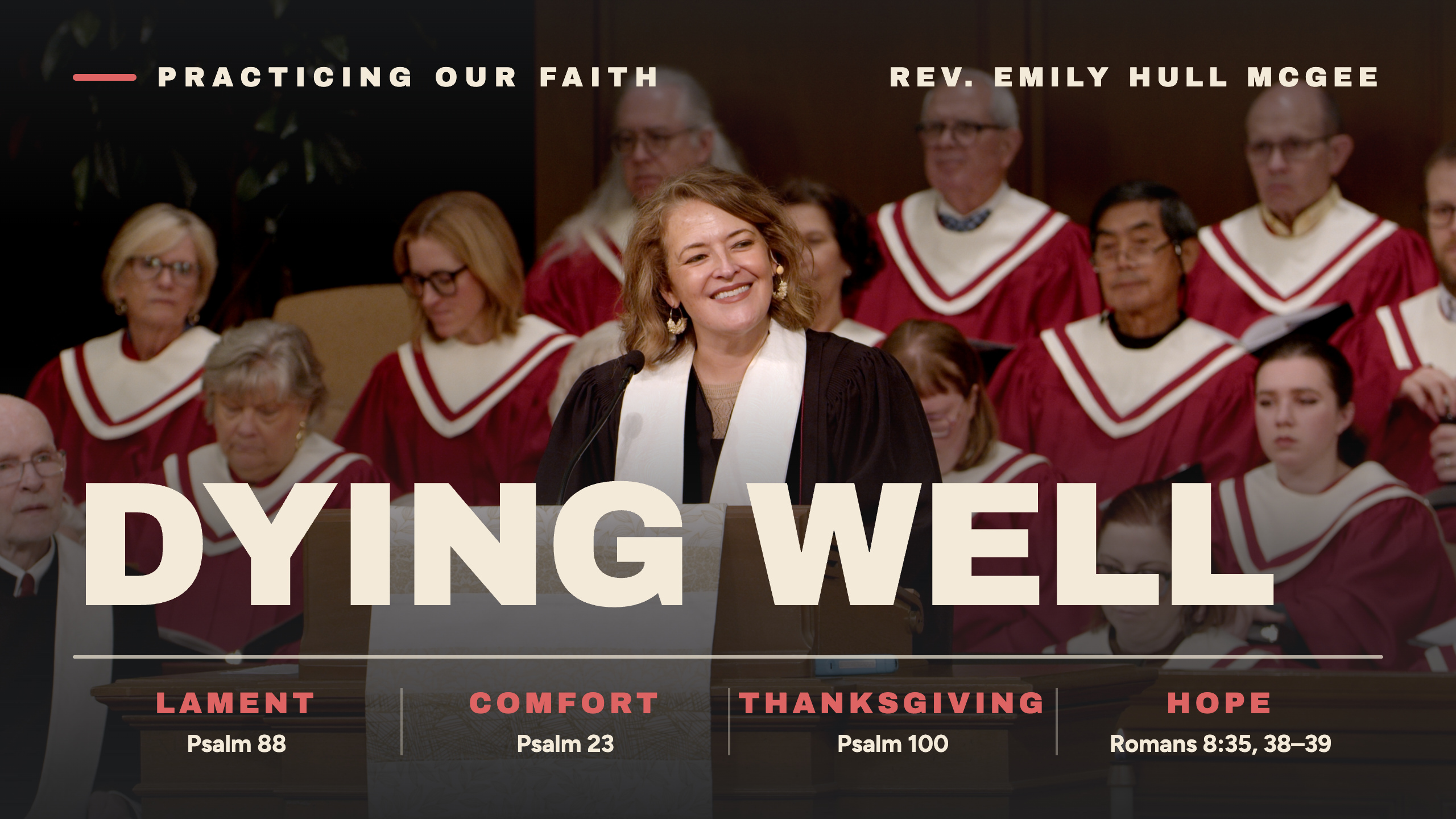
Lament / Psalm 88
The lamentation was unmistakable, landing in the ears of God and his friends with all the force of a terrible storm: “The upshot,” he says, “is that I had approached this stage of my life with the best agenda I could conceive, the best resources I could assemble, and the best relationships I could form to help me accomplish it. Then ALS struck and said, I’m going to take it all away from you! Living with that overwhelming sense of loss is about as dark as it ever gets this side of hell. How could God possibly shed any light in that total eclipse of my hopes and dreams?”1
For my Granddaddy Bill, his groanings of lament emerged from a failing body and suspended plans. The sighs too deep for words arose from a wellspring of relationships from which he never lacked a quenching drink and with whom he loved to toast. If, as Father Greg Boyle says, “the cause of death is birth,” Granddaddy Bill’s lament came because these two now pinched too closely together and squeezed the joy of a season between.2 ALS had suddenly made his life terminal, and his laments pierced the air like stormy waves crashing upon the shore, with all the sorrow of the Psalmist. The darkness for him was, quite literally, suffocating.
I suppose it’s no mistake that lamentations, particularly those of death and dying, bear the unmistakable signs of nature. “Tears that run down like a river day and night,” the Book of Lamentations calls them. “Your wrath … surround(s) me like a flood all day long.” “You have put me in the depths of the Pit, in the regions dark and deep.” Because when death only takes up sanitized residence for so many in hospital rooms and funeral homes, it should be no surprise that in the lonely hours of our pain, it is to the earthiest images that we turn. In our lament, no longer do “we speak of death in whispers.”3
But even when the Psalmist cries out, “O Lord, why do you hide your face from me?,” lament grows as our cries seem to go unanswered. Even Jesus, the “man of sorrows” knew that absence and was “acquainted with [that] grief.” For from the cross rang out a cry like a thunderclap: “My God, my God, why have you forsaken me?” Lament, you see, is as faithful as praise. And God can withstand it.
You and I know those laments; we’ve cried them for the dead and those of us they’ve left behind. We grieve because we value human life so fully; we grieve because we love so deeply. Augustine once said that his mourning tears, “streamed down, and I let them flow as freely as they would, making of them a pillow for my heart. On them it rested.” Perhaps our tears don’t echo in the deep, dark place alone, but rather reflect the anguished cries of a present God who weeps and suffers with us.
Comfort / Psalm 23
It is a Psalm of comfort in every line.
The Lord is my shepherd, I shall not want. The Lord is my shepherd. The Lord, not the president or the experimental treatment, the paycheck or the job, the retirement account or the calendar. So in the face of all that is fleeting – advertising and busyness and work and every other death-dealing thing that fools us into scarcity of time, money, relationships, or plans – we can trust the good shepherd that with God, there is and will always be enough.
He maketh me lie down in green pastures, he leadeth me beside still waters, he restoreth my soul. He leadeth me in paths of righteousness for his name’s sake. Indeed, no matter the road, no matter where it winds and ends and detours and falls away, God provides for the sheepfold, gifting us with rest and nourishment, with good places of hope and peace, joy and love, abundance and justice, and jubilee for us all, with a presence that never fails.
Yet though I walk through the valley of the shadow of death, I will fear no evil, for you are with me, your rod and your staff, they comfort me. This right here is at the heart of it all. For amidst all the fragilities of this life – the impossible frailties of these human bodies, the fear that remains a constant companion, the despair that settles into the inner lining of our minds – through it all, the most lasting and true promise of our God is made known. “You are with me,” the Psalmist assures us. God is with us, even in the valley of the shadow too. Nothing we face will be taken on alone.
Thou preparest a table before me in the presence of mine enemies. Thou anointest my head with oil; my cup runneth over. In the face of the world’s scarcities and conflicts, where war robs and steals, God’s table is set and available to us all. God heals our wounds with generosity and grace.
Surely goodness and mercy shall follow me all the days of my life, and I shall dwell in the house of the Lord my whole life long. From now until the very end, no matter what the days between may hold, it is God’s goodness and mercy that follow us, hound us, pursue us, chase us down such that we never know a day apart from them, apart from God, not even the last one. Be assured, beloved ones: your place is secure. You will never be alone. God is with you always, even to the end of the age.4
Thanksgiving / Psalm 100
Of all things, it was the memory of an old green Bendix washing machine that helped him through the valley of the shadow of death. Long-beloved pastor John Claypool began walking that valley when his young daughter Laura Lue was diagnosed with terminal leukemia at age eight. Her suffering had been intense, and his grief upon the end of her life, shattering. As he groped through the darkness, searching for a way out beyond the “road of unquestioning resignation” — where you don’t question God or try to understand, but simply accept silently and surrender — or the “road of total intellectual understanding” — where you explain everything away and tie up all loose ends with answers — John Claypool remembered that Bendix.
Those memories were of the war years, you see, when gas was rationed and laundry was several miles away. So when one of his father’s coworkers was drafted and his wife went with him, John’s father suggested that they store their furniture in the Claypool basement for safekeeping. The young wife suggested the Claypools use that washing machine while they’d be gone. “Use it,” she said, “better to be up and running than sitting and rusting.”
As the household laundry washer at the tender age of eleven, John nurtured quite a love for that Bendix washing machine and its presence in their home during those four years. Two days a week, John would come home from school, gather up all the dirty laundry, and delight in the soap bubble configurations, the rubber rollers, and the plunger that made it all happen. But when their young friends returned home from war and that Bendix left the Claypool basement suddenly and without warning one day, he was terribly upset, staring with futile anger at the gaping hole it left in their basement. “It seems I had forgotten how the machine came to be in our home in the first place,” he said. When he confided these feelings of anger in his mama (“we’ve been robbed! Someone’s stolen our washing machine!,” he cried), she wisely turned to him and said: “now wait a minute, son. You must remember, that machine never belonged to us in the first place. That we ever got to use it at all was a gift. Remember, John, you treat gifts differently from the way you treat possessions. When something belongs to you and it is taken away, you have a right to be angry. But when something is a gift and it is taken from you, you use that occasion to give thanks that it was ever given at all.”
In his first sermon back in the pulpit after Laura Lue died, John told that story and said this: “Here, in a nutshell, is what it means to understand something as a gift and to handle it with gratitude, a perspective biblical religion puts around all of life. And I am here to testify that this is the only way down from the Mountain of Loss. I do not mean to say that such a perspective makes things easy, for it does not. But at least it makes things bearable when I remember that Laura Lue was a gift, pure and simple, something I neither earned nor deserved nor had a right to. And when I remember that the appropriate response to a gift, even when it is taken away, is gratitude, then I am better able to try and thank God that I was ever given her in the first place.”5
Hope / Romans 8:35, 38-39
Heartbroken for the staggering loss his dearest friend John was facing, my Granddaddy Bill stood in front of his beloved community in the pulpit on that cold January day in 1970 as the one tasked with memorializing sweet Laura Lue. But we know as he did, that often in grief words fail us. When the earthquake of shock simmers down, when the thunder of anger has passed, when the rains of lament subside, when the fire of mourning cools, all that remains as the Lord passes by is quiet. “Alas, I am filled not with sound but with silence,” he shared with the gathered community of mourners at Crescent Hill Baptist Church, “as I stand mute before the mystery of the event which we here celebrate with such sorrow.”
Pico Iyer once said, “Is that kind of spiritual stillness not a denial of hope, but precisely an affirmation of its immense potential?” Earlier in Romans, Paul reminds us that “hope that is seen is not hope. For who hopes for what is seen?” Similarly, what if “hope that is heard is not hope. For who hopes for what is heard?” Instead of denying hope, might the sound of silence that remains be a portal that opens us up to the indescribable life beyond all we know and see and hear, a refuge where hope might be born anew?
Henri Nouwen once said: “If the God who revealed life to us, and whose only desire is to bring us to life, loved us so much that he wanted to experience with us the total absurdity of death, then — yes, then there must be hope; then there must be something more than death; then there must be a promise that is not fulfilled in our short existence in this world; then leaving behind the ones you love, the flowers and the trees, the mountains and the oceans, the beauty of art and music, and all the exuberant gifts of life cannot be just the destruction and cruel end of all things; then indeed we have to wait for the third day.”
Nearly 44 years after he struggled for words to remember Laura Lue, ALS began to silence again my Granddaddy Bill’s words. In the stillness Granddaddy Bill knew that “Jesus was right: tragedy is but the raw material of hope, the dark backdrop against which it is possible to glimpse the glory of God.” And within that hope, words began to flow, words that formed his penultimate book before his passing, entitled The Quest for a Good Death. But like the air in which he breathed even as each breath became harder was the promise of hope in dying, “hope,” he said, that was a “life-giving oxygen to a human spirit starved for meaning.” Hope that remained after the hardship and distress, persecution and famine, nakedness, peril and sword. Hope that steadfast love makes possible.
For Bill and John and Laura Lue — for Geraldine, Dale, Betty, Dot, Hilda, and Jay – for you and for me — we know that the laments of this life will not be the final word. The valley of the shadow of death will not be our resting place. The thanksgivings among our grief will not be our final song. Though the journey seems unending, we find our living and dying hope in the one who promises that neither death, nor life, nor angels, nor rulers, nor things present, nor things to come, nor height, nor death, nor anything else in all creation will be able to separate us from the love of God in Christ Jesus our Lord. Amen!