
I.Let me ask you – when was the last time you went looking for something?
Maybe you’ve looked for something lost: a misplaced set of car keys, orthodontic retainers camouflaged on a countertop (ahem, Liam McGee), that one book or blouse or bag you just couldn’t put your hands on. Maybe you’ve looked for something intriguing: a research interest that took off down a ChatGPT rabbit hole, a wiry ancestral branch in your family tree, grandma’s potato casserole recipe to make for Thanksgiving, or stats on how in the world Wake Forest has such a good football team this year. (Amen!) Maybe looking turned to tracking, as you checked in on your Ring doorbell footage for a Christmas package soon to arrive, or watched your teenage boys in Life 360 as they set off on their first road trip.
As of late, some of you’ve told me about your search for the thing that keeps spiking your blood pressure, a new home or a new calling, a solution for that issue at work, why your spouse keeps their distance or what would finally, finally help your kid not feel so much despair.
But maybe your searches have some heft to them. Perhaps you’re searching for a job or a friendship or a relationship, feeling sparked by an unexpected conversation or stuck in that ever-spiraling loop online as you click through posting after posting. Maybe you’re looking for optimization of your life: a better calendar system, or morning routine, or workout plan, or that one face cream that is going to fix all the aging that’s criss-crossing from ear to ear, forehead to chin. Maybe you’re seeking attention, muscling your thoughts through a noisy online world, or elbowing colleagues to catch the boss’s eye, or acting out to finally get your father to notice you. Or maybe you’re seeking success, your eyes and days perpetually scanning the horizon to see every possible way you can get ahead.
Depending on your season of life, you might be young and looking for all of life’s possibilities in an endless playground of them, or middle-aged and looking for yourself in a muddled heap of roles and relationships and responsibilities, or retiring and looking for what will define your identity now, or senior and looking for the legacy you’ll leave behind. Love and belonging, hope and community, security and purpose, surviving and thriving, all threaded through the search, no matter the season you’re in.
It’s not unusual that we go searching, for this instinct is as human as any of the rest; you can chart it back to the very beginning. It’s even the root behind why the human mind loves a good conspiracy theory, where we’re certain what we see can’t possibly be the full story. But I bet just as you can tell me about times you went looking for something, you can tell me about times you stopped. Times you got so fed up because you couldn’t find what you pursued. Times you felt so frustrated by the search that felt increasingly dehumanizing. Times you chose instead the pleasure of mindless distraction. Times you grew indifferent and complacent, insulated and isolated and alone.
II.Throughout the fall, we have explored twelve practices of the Christian faith: honoring the body, household economics, saying yes and saying no, keeping sabbath, testimony, hospitality, singing our lives, healing, shaping communities, dying well, forgiveness, and discernment. It’s not an exhaustive list by any stretch, but these things that Christians do together over time weave together with baptism and communion, prayer and Bible study, worship and Christian friendship, to form a way of living. In the subtitle of the book that has grounded our exploration, Dorothy Bass and Craig Dykstra call these practices “a way of life for a searching people.” We’re searching alright. But what are we looking for? What do we see as we seek? How is the search forming us along the way? How, then, shall we live?
I have to imagine these are some questions on Jesus’s mind in our gospel lesson for today. Remember, we’re nearing the end of Jesus’ life, and these are his final lessons, the lessons he’ll leave with his disciples before his death. Though the disciples are hyper-focused on when the end will come, Jesus gently yet urgently reframes their questions – from when to how… meaning, how, then, shall we live while we wait.1
Today’s text is the third of three parables of preparation and living that Jesus tells his disciples in this final week of life. It’s one of the gospels’ most memorable and significant, what one preacher likens to Jesus’ final exam: “a review, a kind of summary about what the course has been all about.”2 Jesus knew that his ministry on this earth was drawing to a close. This would be his parting word of instruction for those who desire to follow in his way.
For when the Son of Man comes in glory, Jesus says to his disciples, all the nations will be gathered before him, and there will be a separation: sheep on the right and goats on the left. Those on his right will inherit the kingdom, receiving the deepest abundance of God! Why?
I was hungry and you fed me,
I was thirsty and you gave me a drink,
I was homeless and you gave me a room,
I was shivering and you gave me clothes,
I was sick and you stopped to visit,
I was in prison and you came to me.
But those on his left will be cast out, left behind, royally renounced until the end of the age. Why?
I was hungry and you gave me no meal,
I was thirsty and you gave me no drink,
I was homeless and you gave me no bed,
I was shivering and you gave me no clothes,
Sick and in prison, and you never visited.3
And yet, with both sheep and goats, their question of the king was the same: when oh Lord did we see you? When did we see you?
III.Amidst all the searching – for curiosities and communities, for jobs and relationships, we could surely be forgiven for overlooking something along the way, right? I mean, did you hear that list, Jesus? Did you hear all the things we have to go looking for in this human life? We didn’t even mention all the scary things on the horizon that catch our eye: what’s growing behind our walls or under our skin, what’s geopolitical or technological, what’s threatening our livelihoods and living.
So what do we do when, among all the objects of our seeking, we attempt to find God too? Where do we go looking through all the halls and houses and humans around us, seeking after God? Sometimes I wish finding Jesus was like pulling up the Find My app, and waiting to hear the ping for the phone you’ve lost. We go out searching, but when God isn’t where we look, or when we get scared or distracted while on the hunt, we settle for a stand-in. And along the way, we may feel watched, but never seen.4
“The only way to tell if they are really Jesus’ eyes,” Barbara Brown Taylor says, “is to look into them, to risk that moment of recognition that may break your heart, or change your mind, or make you mad, or make you amend your life. Whatever effect it has on you, that seems to be the one thing the sheep know how to do that the goats have never tried: to look, to see, to seek Christ in the last, the lost, the least. I’m sure Matthew would not agree with me,” she continues, “but if you ask me, that is enough to start with. The food, the drink, the welcome, the visit – all those things will follow in their own good time. They are necessary for life; they are not optional, but by themselves, they are just quarters in a cup – [good deeds completed just to check them off a list and call it done]. Charity is no substitute for kinship. We are not called to be philanthropists or social workers, but brothers and sisters. We are called into relationship, even when that relationship is unlikely, momentary, or sad. We are called to look at each other and see Christ, who promises to be there where our eyes meet, and in that glance to teach us something we need to know.”5
I love her take on this passage, for it calls me to the truth of Christ our King – that at the end of the day, the question is not if we did enough or if we did right, how much we spent or how uncomfortable we got, how many cups of water we offered or how many visits we made. Rather, the question Jesus asks is when did you see me? It’s why Jesus knew we needed the reminder that he is always found in the last and the least. It’s why the Pope knew when creating Christ the King Sunday, that Christians needed a reminder of Christ our King, because we would look for a king every which way, and would claim to find it in the loudest gilded strongman who promised us the world. It’s why Christians over the years knew that we needed to practice our faith, even and especially our seeing, to know how and where to look.
Because to Jesus, no matter who you are, I see you, he says. I come looking for you. I’m with you. I’m everywhere you are. There’s nowhere you can go that I won’t be, no hunger pains or dry mouths I won’t share, no streets I haven’t walked or refuge I haven’t been turned away from, no illness I can’t feel or bondage I can’t understand. I am with you. Do you see me?
IV.So how do we do this?
Let me tell you a story. When famed Olympian swimmer Michael Phelps went searching for his first gold medal, the pressure for him was as loud and high as the hype. Michael’s coach knew he’d need something to ground him when he’d show up at that Olympic pool: cameras trained on him, surrounded by the competition, and cheered on by adoring fans. So Coach Bowman came up with a routine for Michael to do that became instantly iconic. Arriving at the arena two hours early. Stretching and loosening up according to a precise pattern. Then jacket on, earphones in, game face ready. Seated: towel on one side, goggles on the other. His race called, walking to the blocks, two stretches — straight leg, then bent, left leg first. Right earbud out. Name called, then left earbud out. Stepping onto his block from the left side. Drying the block. Then came the flapping that became the signature move he was known for, arms out and in and out and in, slapping his shoulders and back for the final warmup. Rinse and repeat, every single time he enters the pool. When asked about it, Coach Bowman said this: “If you were to ask Michael what’s going on in his head before competition, he’s say he’s not really thinking about anything. He’s just following the program. But that’s not right. It’s more like his habits have taken over… the actual race is just another step in a pattern that started earlier that day.”6
Now I’m not aware of any Olympic swimmers in the room, but I think Michael Phelps and others like him have something to teach us. For when the stress is high and the pressure mounts, it is the things that we do that ground our monkey brains that can ruminate and churn and spiral in anxiety. So too is it with the Christian life. We may not be flapping our arms and stretching our legs, but we are keeping sabbath and honoring our bodies and singing our lives. In the face of all that could keep our minds spinning, and our hearts heavy, and our eyes scanning and surveilling and searching for God amidst the ruins, it is the rhythms and practices that return us to God, to one another, to ourselves, and ultimately lead us to spiritual transformation.
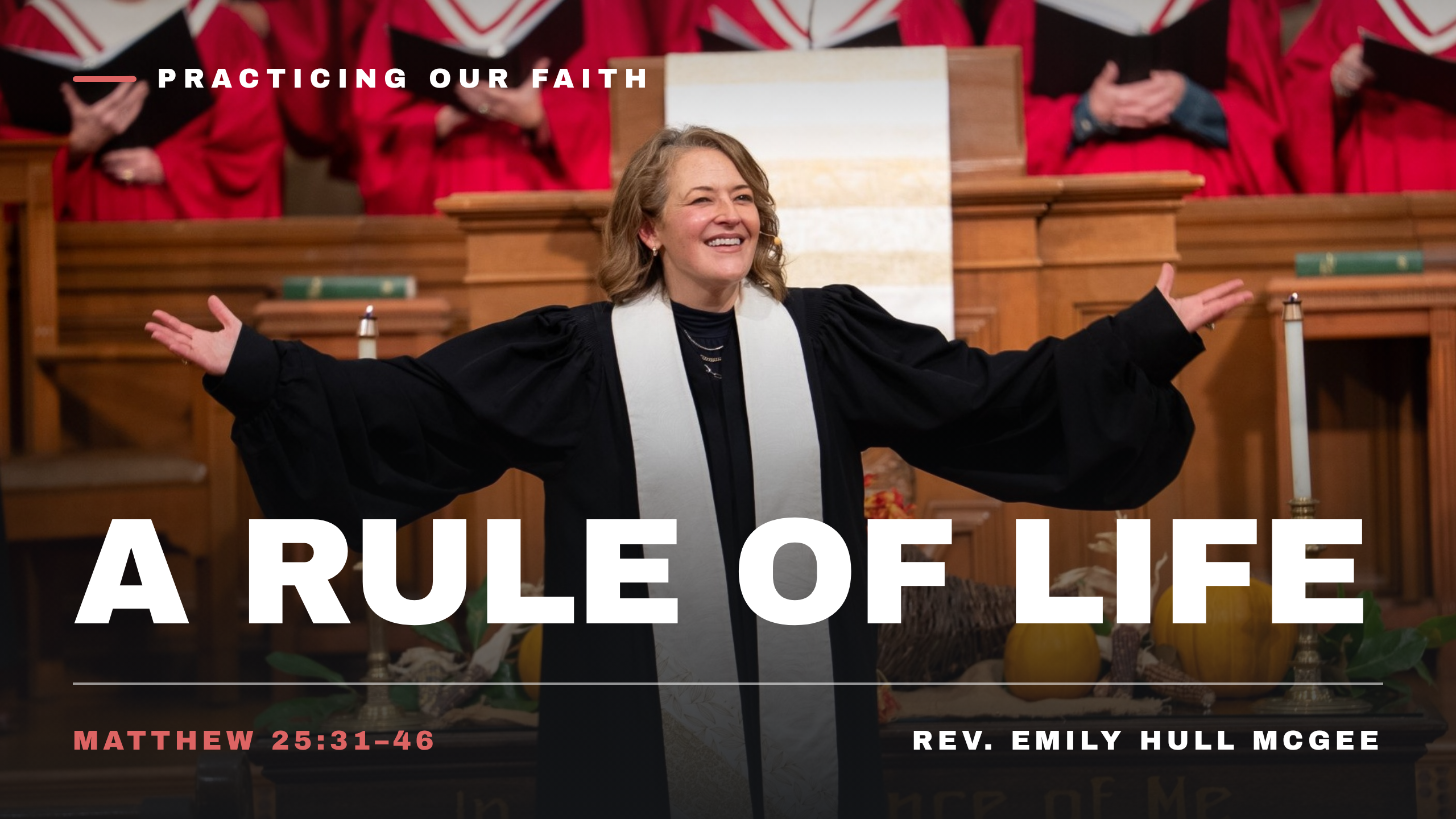
St. Benedict understood this as the first to develop what he called “a rule of life,” helping the monks living in community to order their days around three simple elements of their life together with God: prayer, study, and work. For many, St. Benedict’s rule of life became one way of answering the questions that life prompts: who do I want to be? And how do I want to live? Ruth Haley Barton names those questions more directly: “how do I want to live so I can be who I want to be?”7 And of course we think of Annie Dillard, who said, “how we spend our days is, of course, how we spend our lives.”8
Here’s where the practices show up when we go looking for answers to these questions. And this is your last homework assignment in all our fall together talking about them! I want you to think about how you would answer that question: how do I want to live so I can be who I want to be?
But differently from an Olympian in a pool, the rhythms and practices of our lives have to meet us where we are: personal, realistic, seasonal, flexible, and balanced. It takes time to discover what rhythms work best for you, what practices both comfort and challenge you. And like most things, it’s best to start small.
Let me give some examples. If you are a quiet person who is apt to stay at home, perhaps a rule of life for you might involve a daily prayer or reading of scripture and a weekly commitment to be in community with others. If you’re juggling the demands of work, caregiving, and parenting and feel the stress coming out every side, perhaps a rule of life for you might begin with a sabbath practice and time in silence. If you’re struggling with distraction, perhaps a rule of life for you might involve paying attention through a weekly examination of how you are showing up. If you’re struggling with despair, perhaps a rule of life for you might include daily naming places of your gratitude. If you never feel like you have enough and scarcity hovers over you like a shadow, perhaps a rule of life for you might ask you to find a place to give something away – like a bit of your time when you think you couldn’t possibly, or a bit of your money when you need the nudge to open your hands just a bit. (And if you need a good community in which to place that gift, I know a good one.)
You get the picture. There’s no right answer to this assignment, rather there’s your faithful response to it. Find a rhythm that you can sustain, that grounds you in the invitation to see and be seen. Feel the flexibility to adapt it when your season demands something different. Fill that rhythm with practices that give you both perspective and vision. Let the Spirit of Christ our King rule in your hearts, such that you are changed from the inside out.
When did I see you, Jesus? Can you see him? Amen.