I.How often in your life do you find yourself saying with a sigh, “it’s complicated”? Maybe you’re dodging an awkward question (or 17!) from your children, or sliding through a hard project at work, or venting to a friend about your aging parents, or just reading the news on yet another day, or realizing you keep doing something that you really don’t want to be doing. “It’s complicated” covers all manner of messes with the simple diagnosis of the complicated human condition.
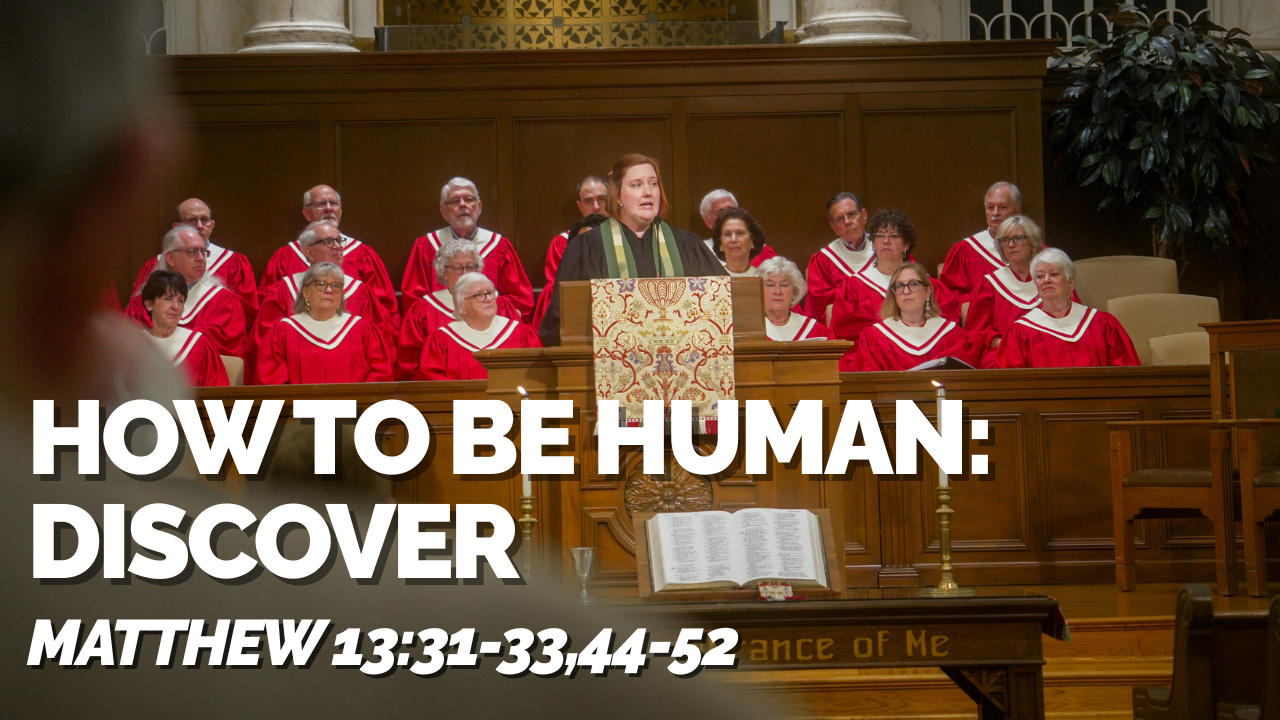
II.We pick up from where we left off last week, in a stretch in Matthew chapter 13 where the writer groups together a number of Jesus’ parables, particularly ones with an agrarian bent to them. Last week, you might remember, Rayce taught us about the parable of the sower, and the invitation to be like that farmer flinging seeds indiscriminately upon the soils, no matter what happens next. And today, we hear a parable of weeds and wheat.
On its face, the story is rather cut and dried, right? “The kingdom of heaven is like one who sowed good seed,” Jesus begins, “but then one came along and sowed weeds all together with the wheat. The workers were perplexed and asked the master where they came from, and what they were to do about it. ‘An enemy did it,’ the master replied, ‘but let both of them grow together, for in gathering the weeds you’d uproot the wheat along with them. At harvest time, I’ll have the reapers gather wheat in the barn and bind up the weeds for burning.’” Just in case his hearers didn’t get it the first time, Jesus offers an explanation: the sower is this, and the field is that, the wheat is good, the weeds are bad. It’s all neat. Tidy! Cut and dried like the crops at harvest, you might say. Matthew, who never met a situation he didn’t want to straighten out or simplify, makes sure we’re clear, as Jesus’s explanation ends with those bad weeds tossed in the furnace of fire, “where there will be weeping and gnashing of teeth.” Let anyone with ears, listen!
I have to imagine that Jesus’s hearers were a whole crop of farmers themselves. They’d understand his imagery and his stories; some would even think about the weedy spots in their own fields. But letting the weeds grow among the wheat? That’s nearly as foolish as sowing seeds in the briar patches and on the concrete! “Life just doesn’t work like that, Jesus,” I imagine them protesting in their minds.
But as much as they and we long for the cut and dried life, an unambiguous path where things stay in their lane and a landscape which only grows what we plant, you and I know that life just isn’t that clear. It’s complicated, this human way of living. To all of us, Jesus offers not a cut and dried story, but rather a complicating story.
It’s a story with a number of different interpretations. We can think of the church like that field, weeds and wheat pressing up through the ground side by side, and feel appropriately admonished never to assume we’re the wheat lest we be found to be a weed instead! Or we can think of the world like that field, our diversity of perspective and people showing off the field’s dazzling colors and humbling followers of Jesus from thinking any field control is within our list of responsibilities. But for today, I want us to think about the interior field that’s right here within each and every one of us humans.
III.That was our topic of conversation this morning, when I had the joy of spending the Sunday School hour in conversation with those who gathered for our churchwide exploration of “how to read the Bible.” The churchy word that described my teaching topic for today is hermeneutics, or the principles and methods used for interpreting scripture. But among the many personal and relational ways there are to interpret scripture, we spent our time together digging into two in particular: perspectives and seasons.
Perspective is a fairly self-explanatory way to interpret scripture, as we considered what particular views of the world that each of us bring from our own location. Seasons are where I’d like to linger with you for a minute. Among the many ways of describing the seasons of one’s spiritual life, the seasons of our relationship with the Bible, we focused our energies on seasons that convey a journey, that describe the movement forged by a variety of experiences in the human life, a movement with similar contours despite all our variety. Theologians have similar ways of describing this pattern. Walter Brueggemann calls this movement orientation, disorientation, reorientation. Richard Rohr calls it order, disorder, reorder.1 Both draw from Paul Ricoeur’s description of the first naivete, the desert of criticism, and the second naivete.2
In that first naivete, belief is unquestioned, simple, direct, and inherited. We’re taught stories and principles of our faith, and with no reason to doubt their veracity, our experience of faith is rather black and white. Literal. Wheat or weeds. Cut and dried, you might say. We’re never surer of our rightness than when we’re in this season! “The Bible says it, I believe it, that settles it!”
But then life happens. A loss you cannot square. A doubt that wiggles in and takes root. A suffering that causes you to question the possibility of goodness and light ever again. A trauma which rearranges your insides. A new identity that you never thought possible. Questions that dog you, that nip at your heels. A truth that once you know, you can no longer ignore. There’s now tension between what you’ve always believed and what you’re now experiencing. Tension leads to conflict, and conflict leads to an unraveling, and the unraveling acquaints you with cynicism, and anger, and fear, and suspicion, and deconstruction, and distance, all of which seem at times to swallow you whole. The “desert of criticism,” Ricoeur calls it.
Somewhere inside that distance, you might find that the desert isn’t where the story ends. That criticism and cynicism and tearing it down isn’t all there is. Rather, that desert season becomes a doorway for you to step into a deeper place, truer and wiser and more beautiful than you could ever have imagined. The “second naivete,” it’s called. No longer do you feel the need to explain away or designate or separate every last thing, person, or idea. Permission here seems ample and generous. These inherited truths of God revealed in Jesus set loose by the power of the Holy Spirit – those truths have run through the fires of suffering and now take on a new shade. Facts and figures give way to mystery and symbol. Nuance and complexity become welcome friends, not strangers to be feared. The unknowing and the knowing, the doubts and the beliefs, the good and the bad – they all grow together in you now. A mixed field, you might say. You’ve wrestled with God through the dark night of your soul, and now you walk with a limp, yes, but with a blessing too. There is texture and friction now in your faith where once all the edges were smooth. It’s complicated, to be sure. But nothing has ever felt truer or more alive.
IV.Let me tell you a story that began when Bryan Stevenson arrived late on his first trip to Africa.3 As the founder of the Equal Justice Initiative, author of Just Mercy, noted lawyer for men on death row, Bryan was used to traveling. He was giving a speech in Abuja, Nigeria, but delays in flights meant that instead of renting a car and taking himself to the hotel as was his custom, a guy was sent to take care of him.
It was a young lawyer who met Bryan at the airport in Lagos, greeting him and quickly getting down to business. “I’ve canceled your hotel room,” the lawyer tells Bryan. (Just what you want to hear when you’ve arrived, jet-lagged from the 16-hour flight, and surely ready to crash!) “You’re not going to stay in a hotel, you’re going to stay with me and my family. My son is excited to meet you.” So committed was this young lawyer to giving Bryan an authentic experience, he began showing Lagos to Bryan. Never mind that it was 11:00pm. They went all over the city – especially into neighborhoods, where he would start shouting, “hey everybody, come out and meet this Black American lawyer.” In his retelling of the story, Bryan laughs generously, remembering how women would meet him that night and then try to sell him shea butter and other products they’d made. “It was rich,” he remembered. “I was tired, but it was rich.” This young lawyer took Bryan all around the city, until Bryan finally said, “man, I have to get a little rest. Can we just go on home? I have to get up early tomorrow.”
“OK, just one more place.”
When they pulled up at the beach, Bryan remembered that there was nothing pretty about it. It was dark. There were concrete slabs, and soldiers with machine guns, and fast food. “Nothing beautiful about it,” Bryan said. But the young lawyer urged them on. “Come on, come on,” he said as they climbed over the concrete slabs and down to the shores below.
The moon shone all over the ocean in the darkness, and for the first time in hours, this gregarious and talkative guy grew silent. “I was standing there, and I looked over at him,” Bryan recounted, “and he was crying. He had a tear running down his face. Then he looked at me, and he said: ‘I brought you here because I wanted to tell you I’m sorry. This is where we lost you.’”
“I love the beach. I grew up on the Atlantic Ocean,” Bryan said. “[But] for the first time in my life,” Bryan said, “I realized I was standing on the other side of this ocean that separated me from everything that’s important to me. My identity, my culture, my history was all taken from me by the Atlantic Ocean.” It changed him, this experience.
So when Bryan returned home to his work with the Equal Justice Initiative in creating and curating The Legacy Museum in Montgomery, finding ways to tell the truth about 400 years of American history beginning with the trans-Atlantic slave trade, he knew that the story of the Atlantic Ocean had to be told more honestly. “We’ve spent millions of dollars looking for trinkets from the Titanic in the Atlantic,” he said, “and we haven’t spent hardly anything to reckon with the two million bodies buried at the bottom of that ocean. A story can help us understand things about who we are and our relationship to the things around us that are important. I still love the beach. I still see it as a place of beauty. But I also see this need to help others understand the harm that was caused by moving millions of people off their land, their place, their space. It was really unprecedented in human history.”
Now I heard this story in a podcast conversation with Bryan Stevenson I listened to about 10 days ago, just before my family’s annual sojourn to the South Carolina coast. And I confess to you – not once in my 45 years have I looked out at the beauty of the Atlantic Ocean and thought of this part of its history… until now. It’s complicated. But it’s true.
V.That’s the thing about the mixed field. That’s the thing about all the complexity it represents. The witness of the mixed field is truth. The truth that nothing is as cut and dried as we’d make it out to be. No matter how much our world would try and straighten out, sand down, and simplify things, the truth is found in the paradox of the ‘and,’ not the either/or. Doubt and faith. Good and evil. Beauty and pain. Sinner and saint. God’s dream here and not yet. Death and resurrection. Weak and strong. First and last. Surrender and power. Justice and mercy. Revelation and mystery. Weeds and wheat.
A faith of the mixed field, a faith of the “and,” is one of contradictions of our lives to be sure. Complicated? Absolutely. Maddening even at times! But this type of faith grants a spaciousness that gives us all room to grow. It is a credible faith, one that has heft and a muscular way behind it, one that can live in the actual world, not the artificially-idealized one of our imagination. This world is dissonant and messy. It is ambiguous and hard. Living in the Way of the mixed field, the Way of the second naivete, the Way of life by way of death asks us to acknowledge all that makes life complicated. All the people who are hard to love. All the parts of ourselves we’d rather not look at. All the contradictions we experience in our loves and our relationships and our griefs. Indeed, the way of Jesus invites us into the deep waters, into the dissonant harmonies, into the mixed field.
“Much of this feels impossible,” Debie Thomas says. “But maybe that’s the greatest paradox of all: that God can accomplish in us what we can’t accomplish in ourselves. Left to myself, I will never love as I ought to. That’s why I’ve come to cherish the Way of Dissonance. God is okay with the many both-ands I carry around inside of me. God can work in my in-between spaces, creating possibilities that are invisible to me but not to God.”4
Friends, may this Way of the “and,” the way of the paradox, the way of integrating the first naivete with the desert of criticism and finding your way to the other side, the way of the mixed field, become a way that astonishes you for all that God can do. May it become for you a space of truth-telling and true-living. And may that truth set you free. Amen!