Over the past several weeks, we’ve been asking a deceptively simple question: How do we be human? Not how do we become more successful. Or more productive. Or more efficient. But how do we become the people God created us to be? Because if we’re honest, while being human is beautiful, it is also messy. We laugh and we grieve. We celebrate and we worry. We fall in love. We lose people we love. We carry hope and heartbreak at the very same time.
This series reminds us that God isn’t waiting for us to become something other than human. God meets us right here, where we are, not where we pretend to be or aspire to be. God meets us in all the complexity, all the questions, and all the ordinary moments of our lives.
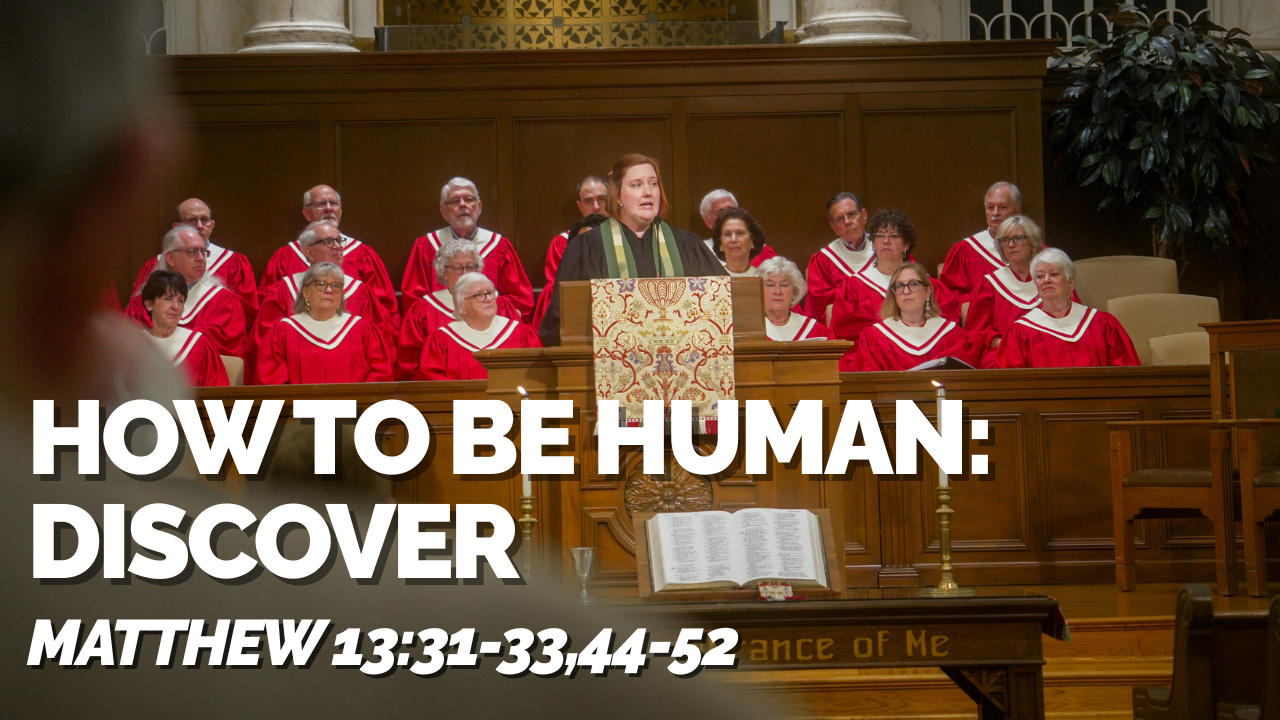
Today we continue answering the question, “How do we be human?” by tackling the idea of discovery. Discovery, that act of finding or learning something for the first time. The idea that has driven generation after generation to dig deeper and travel further. Remaining open to discovery is maybe one of the most deeply human things we can do. Or maybe another way to say it is this – one of the most faithful things we can cultivate is a holy curiosity.
This holy curiosity looks like the willingness to believe that God is still speaking. Still surprising. Still creating. Still inviting us into something larger than we’ve imagined. Because the opposite of faith isn’t always doubt. Sometimes it’s the quiet assumption that we’ve seen it all. That we’ve already figured God out. That tomorrow will simply look like yesterday.
Throughout Scripture, Jesus never lets people settle into that kind of certainty. Again and again, he invites them to be curious, to look again. Listen again. Imagine again. Discover again. And that’s exactly what he’s doing in today’s Gospel lesson.
SCRIPTURE READING HERE
There is something magical about watching a child discover something for the first time. I love watching Sylvie explore the world around her; it’s all new and she just drinks it all in. It doesn’t matter whether it’s a lightning bug, a rainbow after a storm, a ladybug crawling across her arm, or a tiny shell on the beach.
She, like all children, stops. She kneels down and she stares. She points excitedly, “Look! Look!” or without caution picks up the thing in triumph. And because she notices, I notice too. Somewhere along the way, many of us lose this capacity to view and experience the world as a child. Not because the world becomes less beautiful. But because we become busy. Our calendars fill. Our phones buzz. Everything else demands our attention.
We rush from one obligation to another, and unbeknownst to us, we stop expecting surprise. We’ve stopped looking for it. Not because God has stopped speaking. But because we’ve forgotten how to pay attention. I think that’s one of the reasons Jesus taught in parables. Not because they’re puzzles to solve. But because they teach us how to see.
Jesus says, “The kingdom of heaven is like a mustard seed.” “The kingdom of heaven is like yeast.” “The kingdom of heaven is like treasure hidden in a field.” “The kingdom of heaven is like a pearl.” “The kingdom of heaven is like a fishing net.”
Notice what Jesus doesn’t say. He doesn’t say, “The kingdom is exactly this.” Instead, he keeps saying, “It’s like this thing or that thing…” As if every image he uses gets us a little closer to understanding, but never all the way there. Faith isn’t about mastering God. It’s about remaining open to discovering God.
When I was in elementary school, in the late 1900s, I looked forward to the Scholastic Book Fair all year. I wasn’t so much interested in buying books to read as much as I couldn’t wait to see what kind of speciality items that year’s fair would feature. The scented pencils and erasers, a sticker book featuring the latest Disney movie characters, a colorful poster of a dolphin for my bedroom wall, the bookmarks that would reflect all my current interests and so on…
It was the day of the book fair my second-grade year. Again, I was so looking forward to all the cool new items that would be set up in the library at school. I couldn’t wait to spend my money and boy did I find something good! That was the year Magic Eye: A New Way of Looking at the World made its debut at our book fair. Some of you might remember this book. It was a collection of images that upon first glance look like nothing more than colorful, repeating patterns but reveal 3D images as you continue to look at them. (There’s an example on the worship guide this morning. Let me know after worship if you’re able to see the 3D image.)
Of course, everyone was buying this book. It was the hottest item that year! And we were all competing for who could see the most images. Let me tell you, I was not great at it. I would stare and stare at the pages, willing myself to see something other than the colors and squiggles. I spent hours going from image to image. Then one day, I saw the heart and the dolphin and the peace sign. I could finally see the 3D images hidden in the pictures! Nothing had changed about the book, the images had been there the whole time but my eyes had finally learned how to see the complete picture of what was right in front of me.
I think faith is like those Magic Eye images. God has not disappeared. Grace has not disappeared. Hope has not disappeared. Our eyes simply need to learn to notice.
Jesus begins with the smallest thing imaginable. A mustard seed. A mustard seed is tiny. It’s forgettable. It’s easy to overlook. Yet somehow it becomes a place where birds find shelter. Then he talks about yeast. Something that dissolves and becomes invisible but is quietly working away until everything is changed.
I don’t know about you, but I want God to work in obvious ways. I want a big miracle. I want clear answers. I need the road sign that clearly tells me what lies ahead. But that’s not what we get. Instead, God shows up in small acts of courage. One difficult conversation. One apology. One unexpected friendship. One person deciding to choose compassion over resentment. One church deciding that everyone really does mean everyone. The kingdom grows in these small ways, slowly enough that we often don’t notice it until we look back.
As most parents of little ones these days we are conscious of the amount of time Sylvie spends in front of a screen. When we do set aside some time to watch something on TV, one of the shows we love is Mr. Rogers’ Neighborhood. We’ll pull up the episodes on YouTube and choose one we haven’t seen. The other day, we watched an episode that originally aired on May 9, 1969.
In this episode Mr. Rogers is cooling his feet in a kiddie pool he’s set up in his yard. Officer Clemmons, a police officer played by Francois Clemmons, comes by his house and Mr. Rogers invites him to sit down for a rest and cool off his feet in the pool. This doesn’t sound like a big deal, right? But it was. You see, Francois is a black man, and when this episode aired, although segregation was no longer the law of the land, black Americans were not being treated as equals. One of the ways this mistreatment was seen throughout the country was in black people being banned from using community pools.
So while it’s not as shocking to watch a white man and black man cool off their feet together in a kiddie pool today, this act by Fred Rogers and Francois Clemmons exposed the bigotry that permeated society at the time. Years later, looking back on that episode, Francois said he came to understand that Fred wasn’t making television. He was showing what the kingdom of God looks like and he was doing it in a very simple, quiet, small way.
Jesus continues by telling the crowds two more parables. One about a treasure buried in a field. The other about a merchant searching for pearls. In both stories, someone discovers something that changes everything else. Notice that Jesus isn’t talking about earning the kingdom. He’s talking about recognizing it.
Discovery rearranges priorities. Have you ever had one of those moments? Maybe you didn’t discover actual treasure; maybe it was holding your child for the first time. Maybe it was sitting beside someone you love as they took their final breath. Maybe it was receiving forgiveness you didn’t think you deserved. Maybe it was finding a community where you could finally stop pretending. Some discoveries don’t just teach us something new. They make us new.
One of my favorite writers, Barbara Brown Taylor, says that new life often comes disguised as something else. I think she’s right because God rarely arrives the way we expect. God shows up as a baby lying in a manger. At the dinner tables filled with friends and family. In your weekly errands run around town. God shows up at Pride. In classrooms. At the farmer’s market. In committee meetings. In conversations with strangers. If we’re paying attention, every place becomes holy ground.
Jesus then offers the crowd a final image of the kingdom. A net that gathers fish of every kind. Every kind. That little phrase matters. Because left to ourselves, we sort people long before God does. We decide who belongs. Who fits. Who deserves welcome. Who is “our kind.” Jesus says the kingdom keeps gathering. And gathering. And gathering. Every kind.
That’s one of the reasons I love our congregation so much. Over the years, we, together have learned, sometimes joyfully and sometimes painfully, that following Jesus means allowing our understanding of God’s love to keep expanding. Every time we think we’ve reached the edge of God’s welcome, Jesus nudges us a little farther. Every time we think we’ve found the boundary, we discover there isn’t one.
That isn’t because our convictions have become weaker. Or that we’ve given in to the culture around us. It’s because our confidence in God’s grace has become stronger. And isn’t that exactly what discovery does? It stretches us. It enlarges our hearts. It reminds us that God is always bigger than our assumptions and our human understanding.
Friends, I don’t know what you’ll discover this week. Maybe you’ll discover God in the laughter of a grandchild; in the kindness of a stranger. Maybe in a conversation with someone you’ve disagreed with. Maybe in someone you’ve overlooked. Maybe in a quiet moment on your porch with your morning coffee. Maybe in a moment that changes your heart. Maybe you’ll discover that God has been patiently at work in your own life long before you recognized it.
The kingdom is still growing. The yeast is still rising. The treasure is still waiting to be found. The pearl is still beautiful. The net is still gathering. God is still speaking. The question has never been whether God is present. The question is whether we will remain open enough to discover what God is doing.
Because that’s part of what it means to be human. To live with curious hearts. To expect holy surprises. To believe that grace can still interrupt an ordinary Tuesday. To trust that every person we meet bears the image of God. To wake each morning praying, “God, help me notice. Help me pay attention. Help me discover where you are already at work. And then give me the courage to join you there.”
May we never lose the wonder of children. May we keep looking until we can see that 3D image hiding in the colors and patterns. May we keep discovering. And in discovering God again and again, may we discover ourselves becoming more fully the people God created us to be.
MOVE TO FLOOR – COMMUNION TABLE
Perhaps there is no better place to practice this kind of holy discovery than at the table. Because at this table, ordinary things become extraordinary. Bread and cup become signs of grace. Strangers become neighbors. A gathering of imperfect people becomes the Body of Christ. We come not because we have seen everything clearly, but because Christ continues to open our eyes.
On the night he was betrayed, Jesus gathered with his disciples to share a meal. After they had finished, from the table he took the bread. He gave thanks for it and broke it, saying, “This is my body given for you.” Let us now give thanks to God for this good gift: PRAYER
AFTER CUP & PRAYER
Siblings in Christ, this is God’s table, not our table. All who hunger for God are welcome. We’ll celebrate communion as is our custom, by exiting your pew to the left, coming down front to receive the bread and take the cup, and returning to your seat by way of the side aisle. Folks in the balcony can simply walk down the stairs and join a line. If you’re unable to or uncertain about coming to the table, simply lift your hand, and one of our servers will come to you with a compact communion set. All our bread is gluten-free, and all are welcome.
So come to the table with curious hearts. Come expecting holy surprise. Come ready to discover that the One we have been searching for has been waiting for us all along. Come, for there is still more to discover.