I.As the story began, when all creation was poised on the precipice of beginning, there were some angels who grew bothered when they learned that God was planning to make human beings in God’s own image. “How can something so precious and powerful be entrusted to this creature?,” they wondered. So they plotted to hide the image of God where no one would ever think to look for it. “Let’s put it at the bottom of the sea where no one ever goes,” one angel suggested. “No no, let’s go to the top of the highest mountain that no one will ever scale,” another said. Suggestion after suggestion came in, but none felt right. Then the voice of the shrewdest of them all rang out, “Let’s hide the divine image in the face of every human being. That is the last place in the world they will look for it.” So the angels hid the precious divine image within human beings, where it has resided ever since.1
II.In our daily lives, we might experience God in the mountains or on the shoreline. We might catch a glimpse of the Divine in certain coincidences or patterns, in events or holy moments. But like that story of the angels indicated, it is only, uniquely, in the human body that God created in God’s image. Unlike gods who are cast in stone and fixed in bronze, our God says that the human is where God is most easily captured.2
None more fully than in Jesus, of course, but not just in what he looked like, more so in what he did. Healing the sick, giving sight to the blind, releasing the demons, raising the dead, feeding the hungry, blessing the children, straightening the crooked — Jesus’s ministry was as earthly, embodied, fleshly as his life. He knew that we humans needed practices to remember him after he departed, so it’s no accident that as his life on earth neared its end, he chose to wash feet and have a meal and give his disciples things to do with their bodies to remember him by. “This is my body,” he said, not “these are my best thoughts, or these are my right beliefs.” “My body,” he said, “given for you. Do this – practice this, enact this, live this in your bodies – in remembrance of me.” The earliest Christians will take this idea and run with it, for it is the body they look to to describe the church, the body they call the temple of the Holy Spirit. So what does this long story of God in the world have to teach us about why bodies matter?
III.This fall, we’re spending our Sundays exploring together the practices of the Christian faith revealed all throughout scripture. Drawn from Dorothy Bass’s excellent book, Practicing Our Faith: A Way of Life for a Searching People, she defines Christian practices as, “things Christian people do together over time in response to and in the light of God’s active presence for the life of the world in Christ Jesus.”3 Of the twelve practices she describes, we start with honoring the body.
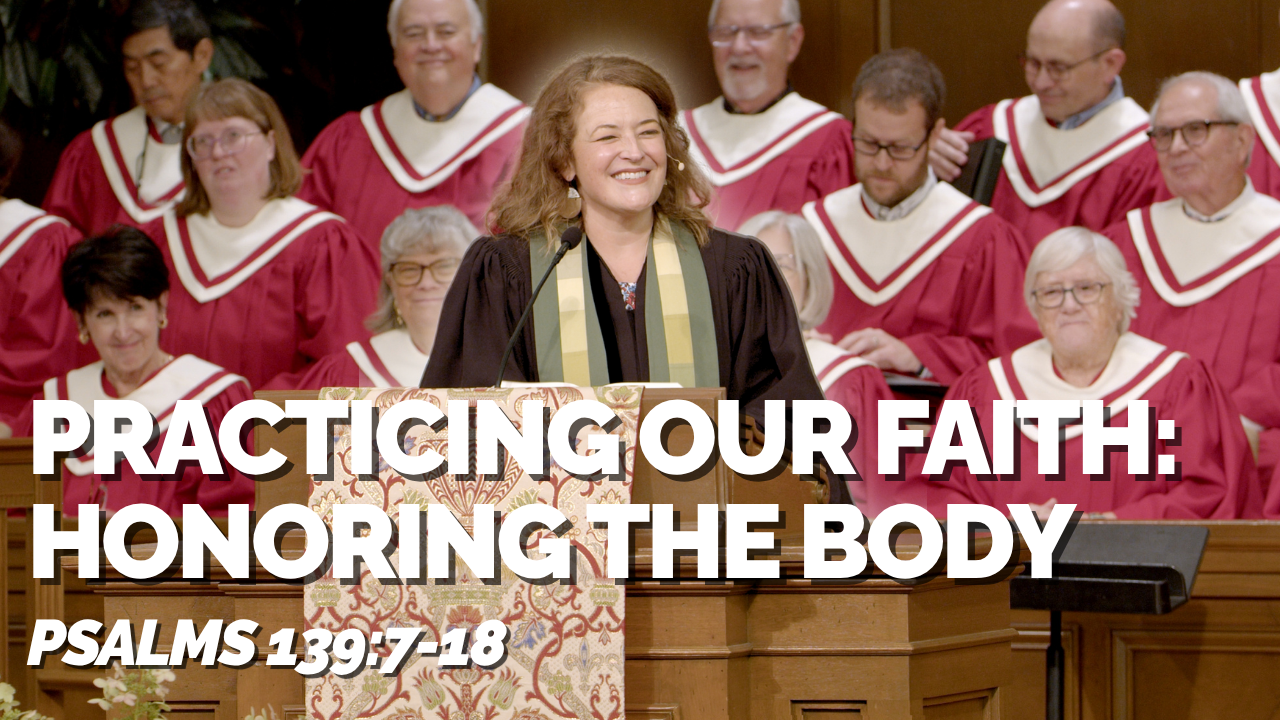
Now any page in the Bible that you turn to bears witness to the body, but today, I wanted us to spend a minute with the familiar words of Psalm 139 where we hear of the intimacy between God and humans.
“O Lord, you have searched me and known me,” the psalmist says. You know when I rest or rise, when I walk or talk. You know the words I speak even before I do, and the deepest corners of my inner life, even my enemies. Sometimes this passage to me feels so intimate and comforting, but other times, it feels to me like a divine full-body and soul check like the kind your skin gets at the dermatologist each year! God knows us far better than we know ourselves.
Despite that examination, despite all God knows about us, the Lord remains steadfastly present. Present in the hemming in, present behind and before. Present in the farthest reaches of the earth, present from heaven to Sheol, from morning to night, from darkness to light, from the very beginning to the very end.
My word, it’s vulnerable to be seen and known like that, right? In the spirit of the Psalmist, there is no corner of human life that God does not know, no place in human living that God is not already there. God knows everything and is everywhere. This, you see, is not a God to try and run and hide from, no. This God is like the mother rabbit whose runaway bunny wants to test the limits of her presence – like going up the mountain, away on a sailboat, swimming through a stream, flying through the air to leave her. “I’m going to become a crocus in a hidden garden,” the bunny declares to his mama. “If you become a crocus in a hidden garden,” his mother responds with a wink, “I will be a gardener and find you.”4 And despite our leaving and our failing and all our unformed places, God remains relentlessly with us, together with the fearfully and wonderfully made, all claimed as beloved of God.
IV.Even as we hear the reminder that our bodies are known and beloved, temples that bear the image of God, honoring these bodies can feel impractical, impossible even. Culturally-subversive? Certainly.
Because each and every day, headlines scream about bodies who have been exploited, deported, murdered, bombed, harassed, abused, harmed, ignored, and left behind. Bodies are legislated and regulated, demeaned and devalued, neglected and humiliated. Used for pleasure, for anger, for fear, for fun, for sport, for politics, the body of another becomes an outlet for one’s own issues, too often stripping away our God-given dignity and replacing it with a heap of shame instead.
Bodies aren’t just mistreated one to another, because so often – intentionally or not – we hurt our own. What might begin innocently as a glass of wine each night at the end of a long day, or a painkiller to take the edge off, or a bag of chips binge-eaten in despair, or an exercise routine rigidly and increasingly maintained could easily slide into a full blown addiction to numb the body. Maybe it becomes a slow-moving pattern of indifference, laziness, or negligence. What could start as one nip here and one tuck there could warp our mind into seeing every line or crease or spot as bad or unworthy. What originates as a desire to express one’s God-given sexuality can devolve into an endless cycle of pleasure and shame.
Even if we have lived lives free of harm inflicted to our body by another or by ourselves, every one of us experiences some measure of suffering in our bodies. It’s as certain as death and taxes! We age, we get sick, we break a bone, we lose a function. Things change in here after surgery, after illness, after birth. What once came easy to our bodies suddenly are tasks belabored or beyond our capacity. Poet Jane Kenyon says it best, describing “our long struggle to be at home in the body,” and “this difficult friendship” we try to maintain with it.5
V.Which is why I don’t think it’s an accident that the first practice Dorothy Bass asks the reader to explore is “honoring the body,” because arguably it’s the hardest. Living in human skin informs it all: how we’re in relationships with each other, how we live, who we are. So let me ask you today: what are some tangible things we can do to practice a way of life of honoring the body?
We don’t have to look far. For throughout our Christian story, we’re a people who honor the body in all its mysteries and specificities. We honor our bodies when we bathe them in the same extravagance that the woman once bathed Jesus’s feet in oil, or in the same intention that Jesus modeled in bathing his disciples feet. We honor our bodies when we clothe them in the same spirit displayed in Colossians, “with compassion, kindness, humility, meekness, patience, and love.”6 We honor our bodies when we nourish them with food that strengthens and delights, connecting us to the earth from which we were formed and to the table where we receive the grace of God. We honor our bodies when we exert and rest in rhythms of joy, remaining ever mindful of that connection between mind, soul, and body. We honor our bodies when we affirm the goodness of our sexual selves in relationships of mutuality, respect, and love. We honor our bodies in worship, where as a gathered, beloved community we rise and sing, pray and pass peace, kneel and anoint, lay hands on the ordained and immerse the baptized, come and see.7
That’s what we do together, and that’s what we’ve done for millennia. But what about when you’re just going about your living and struggling with that difficult friendship with your body. What can you do then? What of this carries over?
Here’s one example. When you look at yourself in the mirror in the morning, instead of conjuring the laundry list of every last thing about your body you wish you could change, what if instead you looked at yourself and said, “I am a child of God, made in the image of God, full of grace and beauty.” Does that sound possible? If you need an advanced-level challenge, Barbara Brown Taylor takes it a step further and suggests that you pray naked in front of a mirror sometimes, especially when you can’t escape whatever loathing you have for your body. Instead of trying to hide from yourself so you don’t have to face the very thing causing you pain, she says, “there comes a time when it is vitally important for your spiritual health to drop your clothes, look in the mirror, and say, ‘here I am. This is the body-like-no-other that my life has shaped. I live here. This is my soul’s address.’ After you’ve taken a good look around,” she laughs, “you may decide that there’s a lot to be thankful for, all things considered.”8 Many years in my life, this practice would sound like just about the worst possible thing, which is precisely why I would have needed to do so.
Here are some more examples, and yes, they’re hard, which is why they take practice. Think about one way that you don’t honor your body, either in physical action or inaction, in your diminishing words or negative thoughts. What if when you did that deep look in the mirror, you looked upon your body with gratitude, and let that gratitude inform whatever harm you’re causing? Instead of hating the extra pounds, the growing wrinkles, the shaking hands, how might gratitude reveal the remarkable ways this body is allowing you to live? You could take your cue from beloved saint Dolly, who once said: “Not everybody’s supposed to look like a movie star. You should be comfortable in your own skin, no matter how far it stretches.”9
Or think about the kind way you treat another’s body – the encouragement you give to an insecure friend after chemo, the help you give your teenager going through puberty, the tenderness you show toward an elder in your care. What if you treated your own body with as much gentleness and compassion as you do another’s? What might that change for you?
Maybe you need an intentionality refresher, finding new ways to connect with God through your arms and legs, eyes and ears and nose. So instead of hurrying through the care you give yourself – the bathing, dressing, freshening, tending – what if you prayed with attention and intention through them? Or instead of grumbling as you do with all the tasks that punctuate your day – washing the dishes, or watering the plants, or cooking the meal, or caregiving for a family member – what if you gave thanks to God that your body can do these things? Or instead of ruminating on whatever is rolling around in your mind and causing you anxiety, what if you do something to get back into your body, like putting your feet in the grass or singing and dancing around to a song you love. (I do this every Sunday morning on my way to church!)
My guess is that you might have a new experience of the mystery of the God in whose image you were created, the intimacy of God who sees you and knows you like no one else, and the love of the God whose face you bear.
VI.I’ve shared with you a thousand times about my Dear Friends, the pastor colleagues of mine whose companionship on this long road of ministry has anchored my life over the past decade that we’ve been sharing life together. We’re gathering later today for our annual “preacher camp” get together, beginning with a most meaningful installation service this afternoon for our sister Courtney, who has become the new senior pastor at our sister Knollwood Baptist Church. Garrett’s already made it into town from Texas for the occasion.
Let me tell you a story about one of these Dear Friends. Ten years ago, when we first met for a few days in the mountains of Western North Carolina, Scott shared a story with us that none of us have forgotten. You see, Scott’s father was in the final stages of cancer, which had ravaged his once-strong body and devastated them all. He knew he wouldn’t get to watch Scott’s three young sons grow tall and strong in this life, but thought of a gift that would allow his very finite body to carry on in relationship even after it had given out. And so he found a copy of the children’s book Goodnight Moon that had a recordable component to it. So as Scott and his three boys would pile up in the bed for the final story before drifting to sleep, they’d open the book and hear the gruff and raspy voice of their father and grandfather, bidding goodnight to the house and the mouse, the room and the moon, leaving with them a final piece of his human life that would echo from generation to generation.
Friends, may we honor these bodies, beloved of God, blessed by God, living this life with God. Amen!