I.Today begins the longest season of the church year called “Ordinary
Time,” so named for the lack of big splashy church holidays in the near future.
In ordinary time, the church house isn’t filled with poinsettias or lilies. Rarely
is anyone going to show up in their brand new dress for the 12th Sunday after
Pentecost! Ordinary time is, well, ordinary, much like the many days of our
lives stretched between peaks and valleys. But among the gifts of ordinary
time are the gifts of listening to how Jesus lived between the manger and the
tomb – in the long, daily middle where a life is built every single day. Learning
to live in ordinary time is an act of faithfulness.1
But learning to live in ordinary time is also learning to live as a human.
Perhaps you think – I’m a human, how else would I be living? This summer, we’re
taking the prompt “how to be human” and listening through the stories of
Jesus in Matthew to hear common threads and encouragements within. For
in an age where all manner of tech overlords, and inventions, and greedy
politicians, and angry people on the internet would have us to outsource our
humanness – dulling it down, and squandering it away – we must remember
why God saw fit to become human, why these ordinary matters of flesh and
bone and head and heart allow us to move through the world together, fully
human, fully alive.
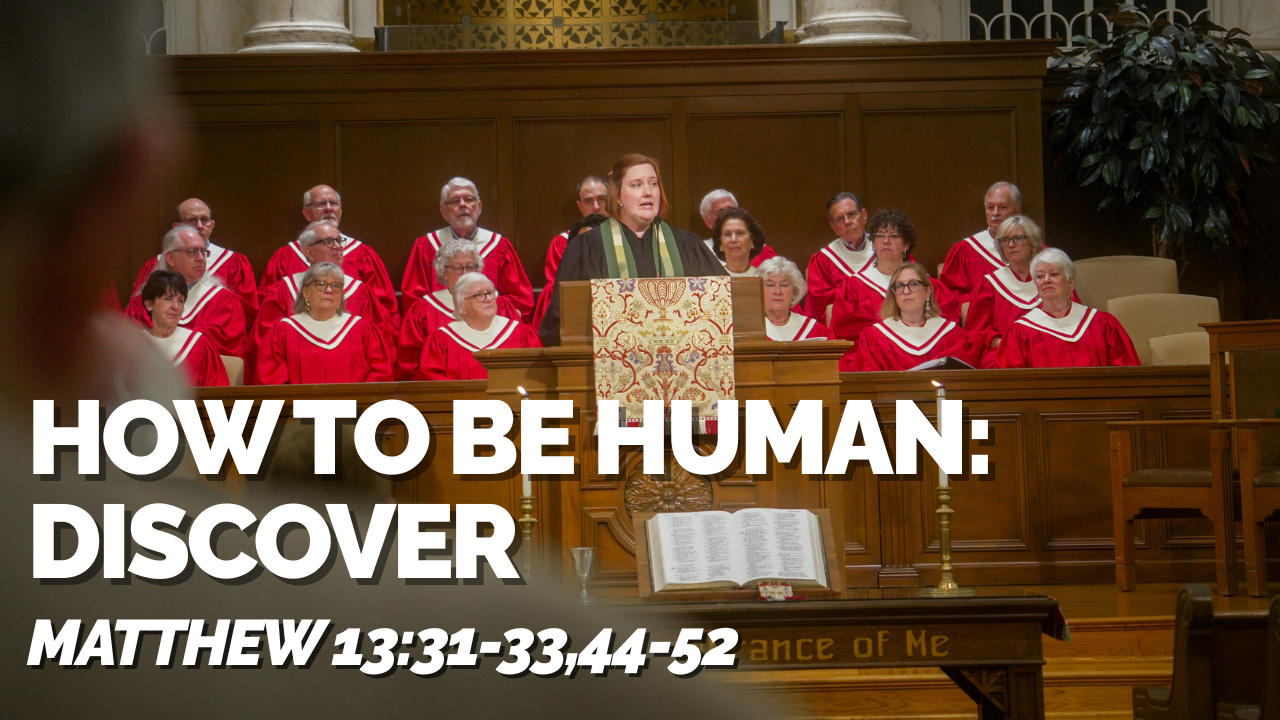
II. Now I knew that starting the series with a sermon title, “How To Be
Human: Suffer,” might not be the softest launching point, am I right? You may
have read that and assumed that to be human is to suffer, that one can’t know
humaning if they’re not suffering. Or perhaps you read it like a question –
how to be human? Suffer!
But we all know that suffering is a fundamental part of the human
experience that comes for us all. Like death and taxes, so too is suffering
unavoidable in this life. Your legs don’t work like they used to. Your eyes blur,
ears muffle, speech slows. A trauma to the heart or injury to the body forces
you to relearn how to exist in your world through this here flesh.2 Your
suffering may take place in silence, dislocating you from community, or
perhaps suffering ushers you ever more deeply into relationship with others.
Or perhaps both resonate with you, just depending on the day.
Suffering has a way of dis-integrating us. Not just physically, but
mentally, emotionally, and spiritually. As Barbara Brown Taylor noted, “the
questions people ask about God in Sunday school rarely compare with the
questions we ask while we are in the hospital… pain makes theologians of us
all.”3 She notes, though, that while pain happens in the body, suffering
happens in the mind – making meaning of that pain, wrestling with its impact,
its wreckage, its aftermath.4 Why is this happening to me or the person I love?,
we cry out. Where even is God?
If there can be good news amidst suffering, it’s that we’re not alone in
those questions. For perhaps the most persistent question humans have had
for God since the very start is why there is suffering when God is so good. So
what are we to learn about our humanness while suffering? How might we
resist the urge to avoid it, deny it, numb it, run from it, or fight it, and rather
sit with it, learn from it, engage with it, let our suffering integrate us instead?
III.
As our story begins today from the Gospel of Matthew, we meet Jesus
performing wondrous acts of all kinds. “As Jesus was walking along,” the
writer tells us, “he saw a man called Matthew sitting at his tax booth, and said
to him, ‘follow me.’ And Matthew got up and followed him.” It’s an astonishing
story of call, for we don’t know what Matthew thought of Jesus’s command,
why he followed, what he thought he was getting into, and why Jesus called a
tax collector of all people – as shady and smarmy a character as any. We don’t
know, we simply know that at the command of Jesus, the word that stilled the
sea and healed the sick, also compelled Matthew to leave behind his tax
booth and follow the Messiah.
More miracles await in a pair of stories where one starts, another
interrupts, and the first concludes, a pair informed one by another. For a
leader in the synagogue rushes to Jesus with terrible news that his daughter
has just died. “If Jesus would come and but lay his hand on her,” he begs, “she
would live again.” In this precise moment of need, in all his agitation and
distress, any norms or pretenses that would keep a respected, reserved
leader like this in his expected place have been all but abandoned. The man
presses his way to Jesus up front, collapses at Jesus’ feet, and pleads with
Jesus to come to his daughter’s aid. There is no limit to what a loving parent
will do to save their beloved child’s life, you see.
Jesus came with him, but the story is interrupted. Another act of
desperation, this time from a woman who for 12 long years, had suffered
bleeding. Her suffering was not just physical, but emotional, mental, and
social. As one considered ritually unclean, it meant no entering the temple, no
touching others or being touched without attaching her uncleanliness to
another. Isolation and loneliness were her daily truth, and not one of the
physicians she spent her years and her money to see could stop the
hemorrhaging. So overlooked, Matthew doesn’t even give her a name. And
yet, in this precise moment of need, in all her agitation and distress, any
norms or pretenses that would keep the woman in her expected place away
from others have been all but abandoned. Instead, she presses her way to
Jesus from behind, risking the crowd and reaching for just a brush of her
fingers to his cloak. There is no limit to what a distressed and weary one will
do to finally find relief, you see.
To both of the suffering daughters, Jesus spoke words of power. “Take
heart, daughter,” he says to the woman bleeding, “your faith has made you
well.” “Go away,” he says to the people crowding the leader’s daughter’s
deathbed. “For the girl is not dead but sleeping.” Human suffering gave way to
human healing. With every opportunity to ignore, turn away, brush off, Jesus
leaned in, looked, and touched, honoring their suffering with the dignity of
love.
IV.
I’ll tell you when I first sat with today’s text, I wondered why the
lectionary writers paired Matthew’s call with the two suffering daughters.
But it’s not an accident; there’s a link here, articulated beautifully by author
Sara Miles. “Jesus calls his disciples,” she says, “giving us authority to heal and
sending us out. … He doesn’t show us how to make a blind man see, dry every
tear, or even drive out all kinds of demons. But he shows us how to enter into
a way of life in which the broken and sick pieces are held in love, and given
meaning. In which strangers literally touch each other, and in doing so, make a
community spacious enough for everyone.”5
It forms us, this call among the suffering. It makes me think of the
church, and how church must not only be a school of love, but it must be a
school of humaning, a place of remembering who and whose we are, a people
of seeing and knowing and loving all the same. Or, as Brene Brown has said, “I
went to church thinking it would be like an epidural, that it would take the
pain away… but church isn’t like an epidural; it’s like a midwife… I thought
faith would say, ‘I’ll take away the pain and discomfort, but what it ended up
saying was, ‘I’ll sit with you in it.’”6 We, the church, are given the sacred task of
going into a suffering world – not to get specific with the healing (that’s
Jesus’s job!), but to see, to be with, to midwife, to let our own suffering knit us
to the suffering ones we encounter. To look towards the daughters on the
margins. To see the human in the desperate eyes of the overlooked. To resist
the trap of allowing a number – the number dead in a war, the number racked
with cancer, the number wounded by abuse, the number deported and
detained – to obscure the individual human lives behind each 1 or 2, 6 or 7,
100 or one million. The body called Jesus went to the suffering, so must we
who are the body of Christ do the same.
It might just be the hardest call we have, though, the kind that feels like
a cross taken up to follow. I don’t know about you, but this seeing and
midwifing and humaning for others as disciples of Christ can feel distant,
hard, downright impossible when we ourselves are in a suffering season.
When our health fails, and our bodies age, and our wounds seem never to
heal, and all we can muster is to beg Jesus for relief. When the forests of fear
and rage form a canopy of despair so thick, it feels futile to find the light
filtering through. When thickets of patriarchy and oligarchy, facism and
racism, global warming and global reckoning all press so tightly around us, we
reach for the hem of a cloak we’re not even sure is there to grasp.
V.
Toni Morrison’s exquisite novel Beloved has a scene that is
unforgettable to all who read it. Baby Suggs, the matriarch, gathers all her
people in what’s called the Clearing: “a wide-open place,” as Morrison
describes, “cut deep in the woods nobody knew for what… Every Saturday
afternoon, Baby Suggs would pilgrim to the Clearing. On this day, she was in
its center, perched on a huge flat-sided rock, head bowed and praying. All the
people with her watched quietly from the trees, watching for the signal.”
“Baby Suggs lifted her eyes to the treeline, and in Morrison’s words,
shouted, ‘let the children come!’ and they ran from the trees toward her.
‘Let your mothers hear you laugh,’ she told them, and the woods rang. The
adults looked on and could not help smiling. Then ‘Let the grown men come,’
she shouted. They stepped out one by one from among the ringing trees. ‘Let
your wives and your children see you dance,’ she told them, and groundlife
shuddered underneath their feet.”
Finally, in Morrison’s words, “Baby Suggs called the women to her. ‘Cry,’
she told them. ‘For the living and the dead. Just cry.’ And without covering
their eyes the women let loose. It started that way: laughing children, dancing
men, crying women and then it got mixed up. Women stopped crying and
danced; men sat down and cried; children danced, women laughed, children
cried until, exhausted and riven, all and each lay about the Clearing damp and
gasping for breath. In the silence that followed, Baby Suggs, holy, offered up
to them her great big heart.”
“She did not tell them,” Morrison says, “to clean up their lives or to go
and sin no more. She did not tell them that they were the blessed of the earth,
its inheriting meek or its glorybound pure. She told them that the only grace
they could have was the grace they could imagine. That if they could not see
it, they could not have it.”
“‘Here,’ Baby Suggs said, ‘in this here place, we flesh; flesh that weeps,
laughs; flesh that dances on bare feet in the grass. Love it. Love it hard.’ And
one body part to the next, she tells her community of Black folks around her –
eyes, back, hands, mouth, feet, shoulders, arms, neck, liver, lungs, womb,
heart – ‘love them,’ she says. ‘They won’t love them, but you do. Love them
hard.’ Saying no more, she stood up then and danced with her twisted hip the
rest of what her heart had to say while the others opened their mouths and
gave her the music. Long notes held until the four-part harmony was perfect
enough for their deeply loved flesh.”7
VI.
Friends, may the church be a Clearing for you to bring the fullness of
your human selves toward Love and one another. May the way of discipleship
for us be a way of midwifing that accompanies the suffering toward healing.
May the gift of being human in this ordinary time draw us all ever nearer to
Jesus who goes into the dead places to take our hands and pull us back to life
again. Grace unimaginable, you might say, but nothing short of love.
Amen!