


I. “There’s no place like home, There’s no place like home, There’s no place like home” She clicks the heels of those ruby slippers. You know the story – the Kansas girl dreamt of somewhere beyond the farm and before she knows it one of those terrible midwestern twisters sweeps across the plains, gathers up Dorothy and her little dog, too, and drops her right there in the technicolor land of oz, with her house on top of a witch no less. With the anger of the wicked witch following her, she sets off with haste to figure out the way back to Kansas, gathering up friends along the way who are also seeking great things: a heart, a brain, some courage. They follow that yellow brick road all the way to the great Emerald city and to the wizard who should have all the answers. After all their trials, at the moment of great intensity – Toto pulls back the curtain and dreams are dashed, the wizard is just a man.
It seems that all hope is lost, and in floats Glinda- in her bubblegum pink bubble. “You’ve always had the power to go back to Kansas” the good witch tells the girl. The scarecrow protests “Well, why didn’t you tell her before?” “She wouldn’t have believed me, she had to learn it for herself.” Dorothy, contemplating what it is she has learned on her journey tells her companions “If I ever go looking for my heart’s desire again I won’t go looking any further than my own backyard.” It all clicks into place. Dorothy closes her eyes as Glinda waves her wand and wakes up back in her bed- Auntie Em hovering over her. “There’s no place like home,” echoes once more.
II.The parable from Luke’s gospel has gone by many names – The parable of The Prodigal Son, or of the two sons. The Parable of the loving Father, or the dysfunctional family.1 We’ve heard this story many times. While familiarity can be helpful, it lets us come in with a lot of preconceived notions. “Like the velveteen rabbit,” Barbara Brown Taylor says, “it can lose its eyes, its whiskers, and a lot of its stuffing, until it conforms to the arms of whoever picks it up.”2 If we are not careful, we’ll squish the story right into a model of ourselves, leaving any space for surprise behind.
This is a story we often hear in the throws of the lenten season. When we’ve been well prepped and primed for a story about forgiveness, about reform and return- a couple weeks in already to our fasts from or taking on of new practices, we’re wide open for the the story of acceptance and so we quickly zero in on that theme – how the sons each might need to repent, to practice a new way of living- that they might truly experience this resurrection moving from death to life. It really fits very well as a lead up to Easter. And like a title, the time, the season, the context all start to form our ideas of what the best outcome of the story should be- what the “right” lesson to learn is, and our velveteen rabbit risks losing more of its stuffing.
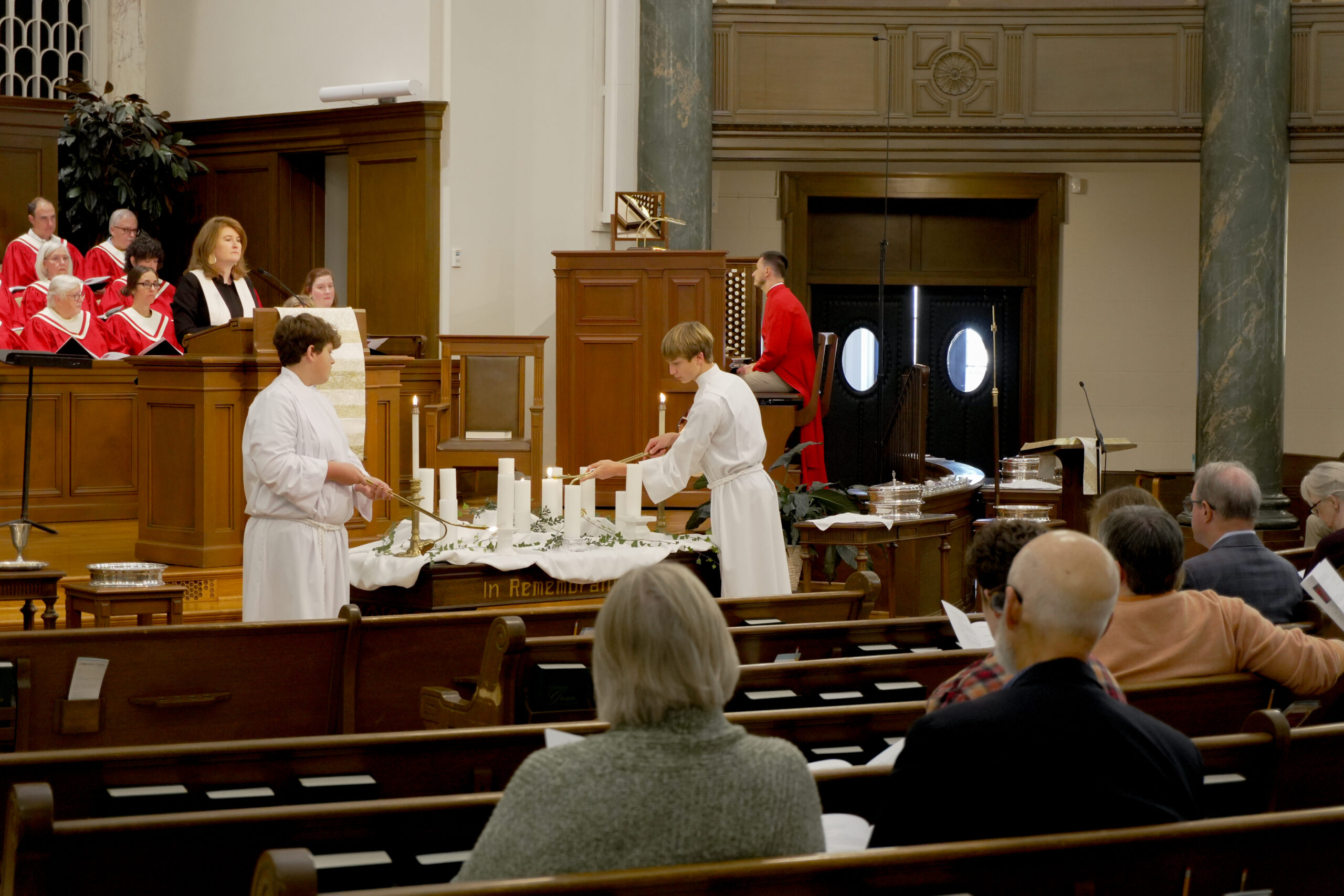
But we don’t find ourselves in Lent today. Here we are, the first Sunday in November, All Saints. Already this morning we’ve spent time speaking the names of our beloveds, lighting candles, carving out the space in our lives to pause, to remember those who have left this physical life and have been received home in to the love and presence of God. And yet we honor that once known, once loved, a person is never completely gone from us- they travel with us in spirit, teaching and guiding us even now. So we hear this parable about homecoming in a new light.
In the midst of Luke’s gospel, this story is set up right in the midst of these back to back vignettes of teachings and parables. Jesus has been with the Pharisees, and they have an idea of what home should look like, who should be welcomed, how folks should behave. Yet by now the whole town wants to hear what Jesus has to say – the tax collectors and sinners were joining around, which made the scribes and pharisees a little uncomfortable- “This fellow welcomes sinners and eats with them” they grumble. Did you know he hangs out with people like that? And the storytelling begins…
Jesus starts with the the lost sheep. “Would a good shepherd leave even one behind?” he asks. Then the lost coin- could something so precious be cast aside without a care? Twice over he reinscribes for all who are gathered- rejoice at the widening of God’s kingdom – there is space for all in God’s kingdom. The righteous are so intent on drawing lines around what is “right” that they box themselves in and shut others out. But Jesus, through his stories, creates space for everyone to see themselves- if they are willing.
To drive home this point, Jesus tells a third story – There was a man who had two sons- it begins- one left for awhile, one stayed, the father loved them both. Because we know and love this story so well, already we might be jumping to assumptions about where we fit in. “Which brother do you resonate with the most?” we ask. Are you the one who leaves or the one who stays? Are you prone to bouts of wandering? Do you keep to the straight and narrow? Do you struggle with resentment? Would you run out to meet your kid after all that? As we look for what resonates with us, we naturally start to draw lines with what doesn’t. We love to pick sides- it’s easier! We like to cast off any type of uncertainty – “This is who I am”. And we pretend that we are only one type of person. We search for clarity and identity this way: I’m an athlete or a bookworm, I’m a tar heel or a demon deacon. I am an extrovert or introvert, a homebody or adventurer. Before we know it these oversimplifications are quickly extended to each other: I am responsible, they are flighty, I am a disappointment, they are the golden child, I am gone, they are stuck, they are gone, I am stuck….. We swiftly revert to an us versus them mentality, as if we are one-dimensional characters beholden to a role we have no control over.
“Perhaps it is because of the competitive rather than the cooperative spirit of our society” Fred Craddock muses, “but the common thought is that there must be losers if there are winners.”3 Like those Pharisees and scribes grumbling about Jesus, we feel discomfort at the otherness of those seen as different. We want it to be more neat, more fair, more defined. Us. Them. We hear this in our news, in our social media, in our hearts. We denigrate and devalue- prioritizing what we know, what is comfortable, what is the “right way” of doing things. We say, “well, little brother, you’ve been pretty rude, should’ve been more prudent- asking dad for your inheritance and then wasting it all- not my problem that you’re hungry, not my problem you need shelter, not my problem, not my problem, not my problem…” We get so used to saying not my problem that nothing is ever our problem…. as long as we are comfortable, why should we bother? And so we hear this story and feel a little on edge with the grace of it all.
Jesus and his parables refuse to play by the rules of competition here. It is not a story where my guy comes out on top, and the other guy goes down in flames- or where I go down in flames and have to get my act together to be accepted.
We’ve spent the past few weeks traveling through themes of home – exploring what it means to make one, how it comes to be broken, how we might tend and keep one, we begin to see that we are not simply – the homemakers or breakers, the homekeepers or the home -leavers, but instead as we go through the seasons of our lives we find ourselves weaving in and out of these experiences like the threads of the great blanket making up our living.
The story Jesus tells is a story for scribes and sinners, for us and them, because at the end of the day – we’re all some mixed up combination of both.This story is for all of us- and in it each of the characters offer us lessons of homecoming.
III.So what do you think of when you imagine home? Food, Comfort, People? Maybe it’s the home of your childhood, or where you moved to college? Maybe it’s your first home as an adult or where you raised your kids?
Do you ever get a craving that is particular to that place? Maybe it’s your mom’s casserole or pizza from a specific restaurant that has since closed down. Do you wish you could return to a specific day with particular people just as it was? We get all wrapped up in imagining just how perfect a day we could have if we could just be there right now, eating those foods or being with those people. I wonder about the younger son – when he is out with the pigs- what part of home he is dreaming about when he has the realization? After all his adventures, he’s hit rock bottom and resolves to go home- but we don’t really get to hear his internal monologue that causes such a resolution. We wonder if he realizes- like Dorothy- that his heart’s desire is and has always been right in his own back yard? Or does he simply wish to wipe away his wandering time and pretend it never happened, go back to things just as they were?
Of course – none of us can ever go back to things exactly as they were- exactly that place we are imagining, can we? Things have changed. We have changed. The home we like to ponder is an illusion of itself in our nostalgic recollections – “memories, like witnesses,” one author says, “do not always tell the truth, the whole truth and nothing but the truth.”4
In our remembering we tend to skip over the hard parts, and intensify the good memories. And our longing for a home unattainable only seems to increase our loneliness, our ache. The word “nostalgia” was coined as medical term in the late 1600s precisely because of this. Patients who were living far from home were obsessed with returning to their estranged locations and became physically, sometimes fatally sick. Thus a young doctor coined the term “nostalgia” by combining the greek words nostos (homecoming) and alga (pain).5 Wrapped up in our nostalgia we can often mislead ourselves- simplifying home into only the good parts. But actually coming home bumps into that illusion – we are met with the real people and real life, good and bad. Coming home asks us to let ourselves be seen, to not only reckon with the way others have changed, but the way we have changed. Returning home risks dimming those good memories, for fear that it will never be the way it once was.
From the younger brother we learn this, that homecoming requires risk. The younger son risks losing his illusion – both of himself as the one who leaves and of what might await him at home. He risks homecoming with the hope of acceptance, but he risks embarrassment or disgrace. He risks being seen for where he is. Homecoming is a risk because he can only control how he shows up. Yet at the end of all his wandering he knows now what it seems he could only learn on his own, home just might be worth coming home to.
And while he is a long way off- his father runs to meet him. Throughout the parable the father is subverting our expectations. A man of his station wouldn’t run, wouldn’t show such a dramatic display of affection. A kiss on the cheek? Sandals for his feet? Ring on his finger? These are signs of reconciliation, honor, and immediate forgiveness. Shouldn’t he hold his son to some level of penance? Where is the fairness? Where is the justice? Where is the firm lecture? Sure – let him come home, but shouldn’t he have to earn his way back into your good graces?6
This father doesn’t prioritize his own pride, or his station, or teaching a lesson. Instead he reveals the gospel’s priority, life amidst death, lost being found, love without prerequisites. In christian community we want so desperately to make a home, to settle in, to support and be supported. We love that old adage, “it takes a village” – and we are trying to be good villagers- but shouldn’t we all just agree that we’ll behave? We wonder, If you could just sign this contract then we’ll know we’re on the same page and then we can have an awesome potluck. But the father doesn’t teach us a lesson of behaving – he teaches us a lesson of love.
The father had two sons, loved two sons, and went out to meet two sons. His love for the eldest brother is not any less extravagant than his love for the younger. Leaving a place of honor at a party was not to be done, but he sees his child standing outside and again he goes to meet his boy right where he is.
You see both sons had a choice to make about home. The younger, made the choice without certainty of what he would face. He had to risk what he could not control for the hope of home. But the oldest, he had been there the whole time- and he could see the celebration right in front of him.
We hear the anger. “After all I’ve done?” Day in and day out I do exactly as I am supposed to and then “this son of yours” comes home and you throw a party? The outrage. And what does the father say? “Son you are always with me and all I have is yours… but this brother of yours was lost and is now found, we had to celebrate.” The father reminds him – that son of mine is a brother of yours- we belong to each other, not us and them, but we.7 And so the eldest brother, too, is faced with a choice. Could he let go of the requirements for reconciliation as a prerequisite for acceptance? Would he come home to all the messiness and joy and relationship right in front of him? Or would he live like a stranger in his own home? Refusing to connect with the expansive love right there in front of him?
Indeed, from the eldest we learn that homecoming is a choice even for those who feel they’ve never left. We can live in a place all our lives- but refuse to make it a home. It’s like that quote on the front of your worship guide “I had made a significant change in my relation to the place;” writes Berry, “before, it had been mine by coincidence or accident; now it was mine by choice.”
Church, community is all about homecoming, we remember and return, day after day, week after week, year after year. At our best, we realize that we are not ever, always just playing one role in the story – but we take turns, risking, loving, choosing to return. We keep vigil for one another, and run out to meet each other, celebrating as many times as we can that home might still be found here together. We risk cracking open our ideals of our perfect situation for the grace of real community together, we bump into one another with our reality and practice the Way of Jesus that overturns the narrative that there must be losers if there are winners. We risk showing up, like the younger brother, being seen for who we are. Like the Father, we have a choice between protecting our pride, our carefully cultivated resources- or risking foolishness that we might run to meet each other right where we are, leading with love, joy, celebration. We have a choice, like the eldest, will we stay a stranger in our own home – or will we allow ourselves to join in the imperfect party accepting that the expansive love is for us too?
We’ve always had the power to come home. We simply must wake up from our dreams of what might be better over the rainbow, and join in the celebration of what we have right here, of who we are right now, grateful for the home we make, and keep, and tend together. Risking the choice of love.
Amen