
I.Welcome to the week of seasonal confusion! You know this week – happens every year when the rotting pumpkins on your porch take up residence next to the Christmas lights, when the Halloween skeletons barely get shoved in the closet in time for the Christmas tree can come out, when you deflate the turkey inflatable while putting up the Santa one in its place. This is an odd week, you know.
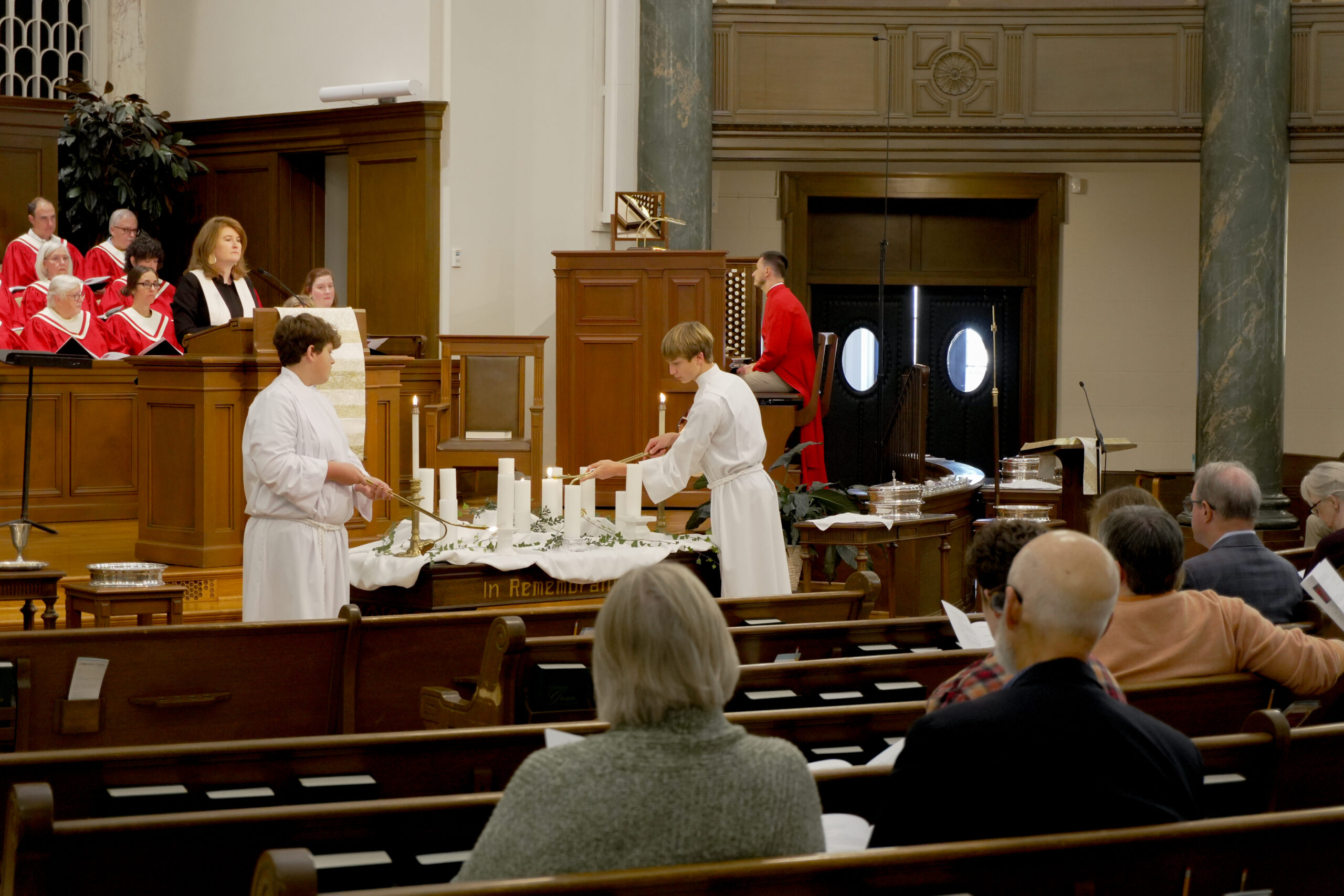
Add to the cultural change-of-seasons the liturgical change-of-seasons, and today finds us in this most interesting Sunday of the church year we call Christ the King Sunday. Christ the King Sunday concludes the long season after Pentecost and ends the liturgical year before Advent’s beginning next week. Positioned where it is, this day orients us to the One who comes in ways we do not expect, whose power is made perfect in weakness, who enters not as a warrior but as a babe. We’ve tracked with Jesus throughout the year: Christ as babe, Christ as wilderness-wanderer, Christ as teacher and storyteller, Christ as table-turner, Christ who died, Christ who’s risen. But on this day, we train our eyes on Christ the King, and we do so with Jesus’ last parable – last lesson, really, for his disciples, in the story of sheep and the goats. Perhaps it’s in the awkwardness of this mashup of themes and seasons, that the truth of Christ the King can pierce through the veil.
II.Let’s locate Jesus and the disciples in the story as we begin today. Remember, we’re nearing the end of Jesus’ life, and these are his final lessons – or “Advent parables” as some scholars call them – the lessons he’ll leave with his disciples before his death. And where the disciples are hyper-focused on when the end will come, Jesus gently yet urgently reframes their questions – from when to how… meaning, how, then, shall we live while we wait.1
Today’s text is the third of three stories that Jesus tells his disciples in this final week of life. First, a parable about the ten bridesmaids who weren’t prepared. Then, a parable about the master who left money, or talents, with his servants to manage while he was away, and their response was mixed. Underneath those two stories, do you hear what Jesus is trying to say to his disciples, the preparation for life in his absence that he’s inviting them to consider?
The third story is one of the gospels’ most memorable, one of Jesus’s most significant, what one preacher likens to Jesus’ final exam: “a review, a kind of summary about what the course has been all about.”2 He knew that his ministry on this earth was drawing to a close. This would be his last lesson, his parting word of instruction for those who desire to follow in his way.
For when the Son of Man comes in glory, Jesus says to his disciples, all the nations will be gathered before him, and there will be a separation: sheep on the right and goats on the left. Those on his right will inherit the kingdom, receiving the deepest abundance of God! Why?
I was hungry and you fed me,
I was thirsty and you gave me a drink,
I was homeless and you gave me a room,
I was shivering and you gave me clothes,
I was sick and you stopped to visit,
I was in prison and you came to me.
But those on his left will be cast out, left behind, royally renounced
until the end of the age. Why?
I was hungry and you gave me no meal,
I was thirsty and you gave me no drink,
I was homeless and you gave me no bed,
I was shivering and you gave me no clothes,
Sick and in prison, and you never visited.3
And yet, with both sheep and goats, their question of the king was the same: when oh Lord did we see you? When did we see you?
III.As I said earlier, so much of the human story can be described as an attempt to find God, to go looking through all the halls and houses and humans around us, seeking the glory that God surely displays. We go out searching, but when God isn’t where we look, or when we get scared or distracted while on the hunt, we settle for a stand-in.
But lest we think this is a secular problem, not a sacred one, we have only to remember what the Israelites did in our scripture passage Joe read for us a few moments ago. The elders of the faithful gathered and came to Samuel the judge with a demand: “give us a king to govern us, like other nations.” Let us be ruled like everyone else! Let power reign down like everyone else! Make things black and white, and tell us what to do like everyone else! To which the Lord says, “the people have not rejected you, Samuel, they’ve rejected me from being king over them.”
Would that this not seem so familiar. For so many people, the witness, often, of American Christians in this contemporary context echoes the witness of the Israelites. “Give us a king,” they-and-we cry out, letting citizenship of country override citizenship within the kingdom of God. “Give us a king,” they-and-we bathing actions in God-talk and blessing them as good. “When did we see you, Jesus,” they-and-we ask, selling out the lowly for a tax break or tighter security. “When was it that we saw you hungry or thirsty or a stranger or naked or sick or in prison and did not take care of you,” they-and-we wonder, when bypassing Jesus on the highways and byways.
When did we see you Jesus? I don’t know about you, but I see no service of Christ our King that abandons practices of servanthood and sacrifice. I see no belief in Christ our King that sacrifices the witness of love at the altar of political power. I see no loyalty to Christ our King that prioritizes the easy and the self-advantaged over the true and the good. I see no love of Christ our King that allows any room – any room at all – for disgust or hatred or indifference toward the hungry, the thirsty, the stranger, the naked, the sick, the imprisoned.4
What I do see is the invitation of a Good Shepherd to lie down in green pastures and graze beside still waters. What I do see is the Healer freeing us from the toxicity of ignorance and fear and giving us a deep drink from the waters of life. What I do see is the Vine gifting his branches the abundant life that comes from abiding in him. What I do see is the beckoning of a King to submit to the way of Love above any other way, any other commitment, any other promise.
When did we see you, Jesus?
“The only way to tell if they are really Jesus’ eyes,” Barbara Brown Taylor says, “is to look into them, to risk that moment of recognition that may break your heart, or change your mind, or make you mad, or make you amend your life. Whatever effect it has on you, that seems to be the one thing the sheep know how to do that the goats have never tried: to look, to see, to seek Christ in the last, the lost, the least. I’m sure Matthew would not agree with me,” she continues, “but if you ask me, that is enough to start with. The food, the drink, the welcome, the visit – all those things will follow in their own good time. They are necessary for life; they are not optional, but by themselves, they are just quarters in a cup – [good deeds completed just to check them off a list and call it done]. Charity is no substitute for kinship. We are not called to be philanthropists or social workers, but brothers and sisters. We are called into relationship, even when that relationship is unlikely, momentary, or sad. We are called to look at each other and see Christ, who promises to be there where our eyes meet, and in that glance to teach us something we need to know.”5
IV.Just this past Thursday, I met over at Winston-Salem State with hundreds of others in our community, particularly those who work within nonprofit or helping spaces in our city, for a gathering called Thriving Together. Thriving Together is “a community-driven movement rooted in belonging, justice, and possibility, together building a Forsyth County where thriving isn’t the exception—it’s the expectation.”6 And among the many meaningful conversations we shared that day was one we shared with Somaya Saha, a doctor at Harvard who now is President and CEO of Well-Being and Equity in the World.7 In her keynote address, she shared statistics that would break your heart, like noting that 22.46% children in Forsyth County live below the poverty line, and that number only increases when divided by racial lines. In North Carolina, the further you drive away from a city and into rural communities, the shorter an average adult’s life span becomes. During the years just around the pandemic, the life expectancy for a child born between 2019 and 2021 drops nearly three years. And so on, and so on.
I had this text on my mind, hearing the echo of the question sounding up through the generations, “when did we see you, Christ the King?” As I listened to her about all the other possibilities and challenges facing our county, I added a dozen others, like “how do we meet the needs when they’re so vast and the path so thorny? How are resources best leveraged? How are energies best directed?” The questions seemed endless, and the despair easily reached.
But to this crowd of helpers who I bet were wondering the same, Somaya told stories of individuals, not just systems or statistics. She then concluded her words with a fierce look in her eyes and laughter on her lips as she said this: “a crisis is a terrible thing to waste. But if I might say this, the good news is that there are a lot of crises around here!!”
V.Friends, as I look into your eyes, I see your worry. I see your worry in these troubled times in which we live. I see you concerned for our neighbors and fearful for their safety. I hear your righteous anger that the last and least aren’t being tended in so many spaces. I see your weariness, the days you just want to bury your head in your hands and weep. I feel your sense that these crises of our common life together only grow. But “a crisis is a terrible thing to waste.” And in Jesus’s words, “truly I tell you, just as you did it to one of the least of these who are members of my family, you did it to me.”
So friends, my invitation to us today as we meet under the leadership of Christ our King, is that you, and we, and together our church, might meet this moment with clarity and conviction. May we rise to the way of Love and broaden into the community of our care. May we refuse the lie that separates us from each other and convinces us that power is out of our hands. May we lift our heads. May we train our eyes on one another. May we insist on looking. May we see one another with the eyes of Jesus.
I read this week about a captain of a boat that became shrouded in fog, perhaps like you noticed this morning. He couldn’t see, couldn’t tell what was happening around him, couldn’t make sense of what was shrouded and unclear. Despairing, the captain said to his crew, “I think we are done for. It’s all over.” He left the helm of the boat and went to lie down in his bunk. One of his crew members found him below and said, “Captain, we’ve decided that you might be done for, but we are not. We are going to keep on sailing, because we know that we can get through this passage somehow.”8
VI.Beloved in Christ, as we go into the week ahead, the season ahead, this life ahead, amidst all the challenges we face, let us not grow weary in doing good. Let us look to the least of these so that we can see Jesus. For we are never alone. Christ our King saw hunger and felt it too, saw thirst and tasted it too, saw an outcast and stood with them too, saw nakedness and stripped bare any pretense too, saw sickness and stayed close too, saw oppression and bore it too. Yet for the hungry, he became the bread of life. For the thirsty, he became the water of life. For the outcast, he became the Good Shepherd who seeks after every lost one. For the vulnerable, he walked willingly to the end of his life. For the infirm, he died their death. For the bound, he rose again for their sake. Can you see him? Amen.