


I.It all began on a walk. Well, it was more like a hike. Traversing the Kachkar Mountains just east of the Black Sea between where Turkey and Russia now sit, their group came upon the ruins of what once was a Byzantine church unparalleled in its beauty.
Local rock had been fashioned into the arches and stonework that dot architecture textbooks the whole world over. Those buildings became the canvas of artists whose religious frescoes defined sacred artwork for generations. Thousands of years ago, these cathedrals were once built amidst the flourishing spread of Christianity to the region, its walls and spires reaching into the heavens as a beacon for the Christ they professed.
As centuries have passed, the centrality of these churches waned from core to peripheral to afterthought. Civilization moved and grew past them, and the religious landscape shifted right in their backyard. The most beautiful parts of the stone have been sold, as have the carvings and doors and floors and even the roof. In their place are now all manner of spaces— some are museums, but others are soccer fields or abandoned lots or farms. All that remains of such ruins are their walls, maybe an arch or two, and if you’re lucky enough as they were that day, the slightest hint of a fresco that has survived the wear of years. Faded but unmistakable is the face of Christ — eyes wide and arresting, arm raised, fingers curled in blessing to a church nowhere to be found.1
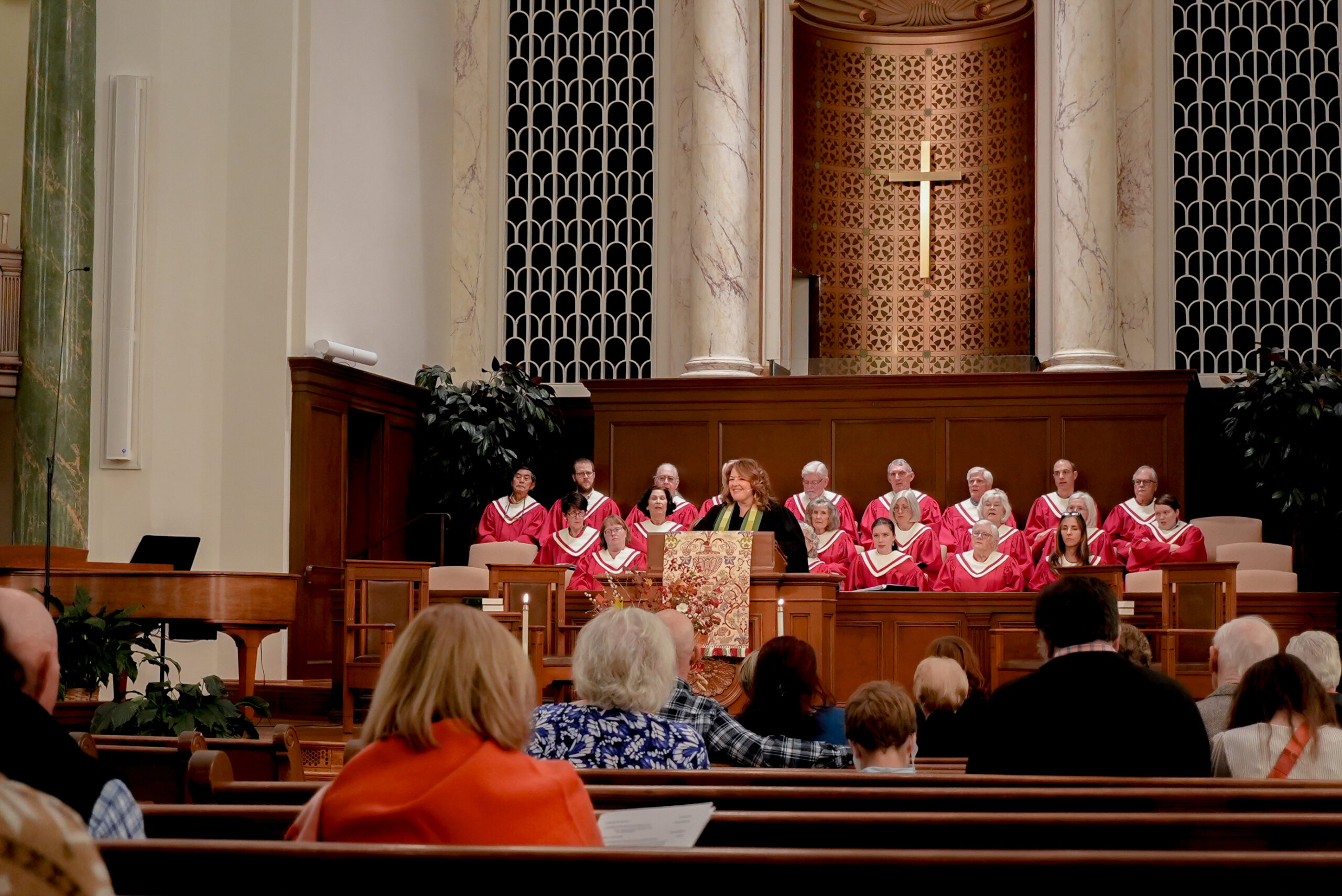
II.As we’re beginning our celebration of the 100th anniversary of our church house, I’m preaching through its theme: “home in the heart of the city.” You’ll see that phrase on our banners and publications, but what does it mean to be home in the heart of the city? Last week, we talked about the experience of home. And next week, we’ll situate ourselves within our downtown context in the city. But for today, we have a location to consider that is a bit more spiritual and metaphorical than physical. For we are a congregation whose place is “in the heart.”
Today, we take our place with Jesus in the Gospel of John. Here in chapter 14, we’re at a part in the story when Jesus knows that his hour is drawing near and his life here on earth will soon end. With compassion, Jesus offers some final words and rituals to the friends closest to him, giving them anchors upon which to hold when he departs. A towel and basin for their feet. A scrap of bread and sip of wine at the table. “Little children, I am with you only a little longer,” Jesus tells them, just before today’s text begins. “But I give you a new commandment,” he says. “Love one another. Just as I have loved you, you also should love one another. By this,” he concludes, “by this, everyone will know that you are my disciples, if you have love for one another.’
The disciples begin to question what Jesus means, and along with their questions, do you hear what Jesus is offering to them? To their worries, he offers tenderness. To their anxieties, he offers assurance. To their displacement, he offers home. To their fears, he offers his heart.
Don’t be troubled, Jesus says. In my father’s house there are many dwelling places. Spaces I’m preparing for you. I’ll bring you with me. I’ll fold you into my heart. I’m here, I’m with you, you have a place, a home, one prepared with hospitality and intention. You don’t have to try and find the answer, or solve the mystery, or figure it all out. No, just stay close to me. Share the spaciousness of the holy with me. Abide with me. I’m departing but not leaving. When you draw near to me, you are near to the heart of God.
III.Last Sunday, we kicked off our season of celebrating the church’s 100th anniversary of place in this beloved church house of ours. It was such a good day, thanks to all the incredible, creative work that brought it all to life! And I did have to chuckle at one point, because in the lunch line, from our speakers, talking with you all, I think I heard a half a dozen times, “ohhhh if these walls could talk…”
If these walls could talk, what stories they would tell, right? We heard several last week, and will hear many more throughout the season ahead. But there’s one in particular that speaks to why a space of this grandeur is the one we built.
You see, after the members of First Baptist had made the decision to build a new church house, after they were clear of God’s call to move deeper into the city, after they’d secured the land, the Building Committee secured assistance from the Southern Baptist Convention’s Sunday School Board to prepare the architectural plans. A design was created and then presented to the building committee, many speaking in favor of it and excited for what they had in mind. All signs pointed to this plan moving toward adoption, when one of the church’s members, D. Rich, stood up to speak. Mr. Rich, as the recorded history is clear to note, was “always a generous contributor” and had already pledged a significant amount to the project.2
“Gentlemen,” Mr. Rich began, “I am opposed to that whole plan. You are planning too small. I will have nothing to do with little planning. I want something my Lord will be proud of.” The church’s historian at the time narrates the reaction in the room, saying “silent consternation overwhelmed them.” But out of this meeting, the original plans were scrapped. Plans quickly fell into place to purchase the rest of the block. New designs were sought out. Construction began soon thereafter, and on September 3, 1925, the church moved into this new house.
A cynical read on Mr. Rich’s motivations might suggest that this wealthy benefactor wanted his church to occupy the grandest space of all the rest, and for his dollars to make it possible. But did you hear his call? “You are planning too small…. I want something my Lord will be proud of.” If these walls could talk, they might tell us about the sharp inhales at that moment. The building committee members annoyed that their months of work were being criticized. The treasurer who wondered how they’d ever raise the money. A kind senior who worried if the church’s ministries and missions would be seen as secondary to its space. A pastor who considered how to call the people to God’s dream for their church.
Indeed if these walls could talk – and frankly if any church house’s walls could talk, they’d tell of Christians throughout the years who wondered and worried and fretted. What if our beliefs have been wrong? What if we aren’t doing it right? What if the very people we’ve been taught to reject are the ones closest to God? If one thing changes, is our belief like a house of cards that will tumble when one card is pulled out?
I think D. Rich was onto something when he said “you are planning too small.” For when Christians fret and worry and hem and haw like the disciples there with Jesus, sometimes without even realizing it, we narrow our imagination. We shrink our vision. We limit our reach. We put the blinders up. We play it safe and soften the risks and stay in line and follow the rules. We can hardly imagine a God whose love is so boundless, and so deep, and so wide, and so tall, and so grand, and so vast, that the whole world is included. The plans are too small? No, when we do this, we make our Christianity too small. We make our capacity to imagine God’s dream for this world too small. We make our dwelling place for God too small. And all we do is count all the pieces of the building like the Israelites did in the passage from Exodus earlier – the gold and the bronze, the crimson yarns and goats hair – instead of focusing on the God whose boundless love dwells here. “In my Father’s house,” Jesus says, “there are many dwelling places.” Indeed, the God we love and serve is wide enough, and deep enough, and tall enough, and vast enough for a roomy dwelling place.
Friends, what would it take for us to inhabit this grand space as the branches of Jesus’s vine, with the wideness of God’s mercy, with the many dwelling places of God’s care, with love – expansive love, grand love, “love that bears all things and believes all things, and hopes all things, and endures all things” – with that kind of love at the heart of any space we occupy, of any time we’re given, of any energies we share?
IV.Indeed, what happens here in this grand space, year after year, day after day, is rather ordinary. But it’s what one longtime pastor calls “a weekly miracle.” “Church is a weekly miracle,” he said. “Every Sunday, the only way church happens is if somebody shows up to teach fourth graders, or sing in the choir, or collect the offering, or serve communion. Even though we have some paid Christians who tee it up for you, church is essentially a makeshift, voluntary operation. We either take our places, or our places will not be taken.”3
Remember that story about the group who came upon the ruins in the mountains of Kachkar? Barbara Brown Taylor was in that group, and reflecting upon the experience, she said this, “God has given us good news in human form and has even given us the grace to proclaim it, but part of our terrible freedom is the freedom to lose our voices, to forget where we were going and why. … [for] If we do not attend to God’s presence in our midst and bring all our best gifts to serving that presence in the world, we may find ourselves selling tickets to a museum.”4
What keeps our church a miracle and not a museum happens when we keep what’s at the heart of God at the heart of this place and these people. You do that! In every card you write, every Sunday School class you teach, every meal you serve, every song you sing, every prayer you pray, every justice you proclaim, and on and on, the ways you love God and neighbor in and through this place could fill every square inch from here to the decorative plaster up top. So how will we continue to pass this encouragement along to those who will sit in these pews decades from now? How will we encourage them, like D. Rich did for us, to never love too small, for we want a church that our Lord will be proud of? Even though we’re not building a new church house, what will it take for us to continue building a home where love can dwell?
V.Just after our text for today ends, it is Thomas, who tradition has called “Doubting,” who interrupted Jesus with a question, “Lord we do not know where you are going! How can we know the way?” “I am the way, and the truth, and the life,” Jesus responds.
We don’t know how Thomas responds to Jesus. We don’t have a clue as to what Thomas did with this answer, how he made sense of it, how it steeled him in the ache of absence. You see, Thomas doesn’t show up again in the Gospel of John until after Jesus’s death, when the disciples gathered in that tiny upper room filled with their fear. Thomas wasn’t there. “Unless I see the mark of the nails in his hands, and put my finger in the marks and my hands in his side, I will not believe.”
But one stream of Christian tradition tells us the story of Thomas after that day he encountered the resurrected Christ that changed everything for him.5 You see, in this story, the disciples gathered again in that upper room after Jesus had ascended into heaven. They cast lots to see who would go where, and how they’d carry out Jesus’s great commission to go into all the world. Thomas drew the short straw – India – and said, “anywhere but India.”
We don’t know precisely why he resisted, but perhaps it was due to the language barrier, the cultural difference, his desire to remain kosher in a foreign land, or his wish to be successful. And here, many different oral traditions fill in the gap. There was a North Indian king named Gundaphores sent a merchant to Jerusalem to find and bring back a skilled carpenter willing to build him a magnificent palace. The merchant was guided by Christ, whose divine intervention helped with a grumbling Thomas. At long last, he decided to travel reluctantly to India, where Gundaphores gave Thomas that large sum of money from the royal treasury to build a palace, and then gave him a deadline to do it.
Tradition doesn’t tell us how Thomas begins the work, but one might imagine that he approaches it with good faith, finding companionship with Jesus, the carpenter’s son, and getting on with his craft. But when he saw the vast poverty and suffering and oppression in Gundaphores’s kingdom, outrage and grief swallowed him. How could he construct that opulent palace while surrounded by the destitute? He couldn’t do it, and gave all the king’s money away to the poor.
So certain was Thomas of this decision that he remained resolute and calm upon the king’s rage when he returned to find his palace unbuilt. “I have built your palace,” Thomas said to the king, “and it is lavish and beautiful, but not for you to inhabit until your death.” As you might imagine, Gundaphores was not reassured by Thomas’s description, and livid with his actions. In a fit of anger, he threw Thomas in prison and scheduled his execution.
But right around that same time, Gundaphores’s brother, Gad, fell ill and died. Gad was welcomed into heaven by the angels, who invited him to walk freely among all the heavenly mansions and choose one for himself. Gad searched and settled on the most beautiful among them, but the angels said no. “That one,” they said, “is reserved for your brother, Gundaphores. It was built specifically for him by Thomas, who loved and labored among those the world called ‘least’ but who are right at the center of God’s heart.”
The story concludes with a fitting climax, as Gad is allowed to return to earth to tell his brother the news. In a whirl of emotion, an astonished Gundaphores accepted Christ, freed Thomas from prison, and received the gifts of baptism and communion that day from Thomas before Thomas departed for a broader mission beyond India.
And what ties it all together? Wide, spacious love. Love from Thomas who follows the call of God despite his protestations. Love modeled by Jesus that Thomas watched and learned and shared and lived. Love of the world God so loved that churned within Thomas’s heart. Love built, even as the questions and worries persisted. Love that makes room and place. Love, right at the heart of it all.
“By this, everyone will know that you are my disciples,” Jesus says, “if you have love for one another.” Amen.