In my first week of preaching class in seminary my professor gave us the outline for what he called a brief exegetical method for preaching. For those who may have never heard the word before, exegesis is the academic word for carefully and intentionally analyzing a text, in this case, a biblical text. Dr. Younger’s method started with the instruction to “engage the text.” The first few times we read the scripture we would be preaching on, he wanted us to ask several questions including:
- What stands out to you in the passage?
- What sounds do you hear?
- What do you smell?
- How does the passage make you feel?
- Where do you find yourself in the passage? What are you doing? How are you reacting to what is happening around you?
As I read our gospel lesson this morning, I want you to engage the text in the same way. As I read chapter 9 of John, what stands out to you? And really pay attention to who you find yourself identifying with in the story.
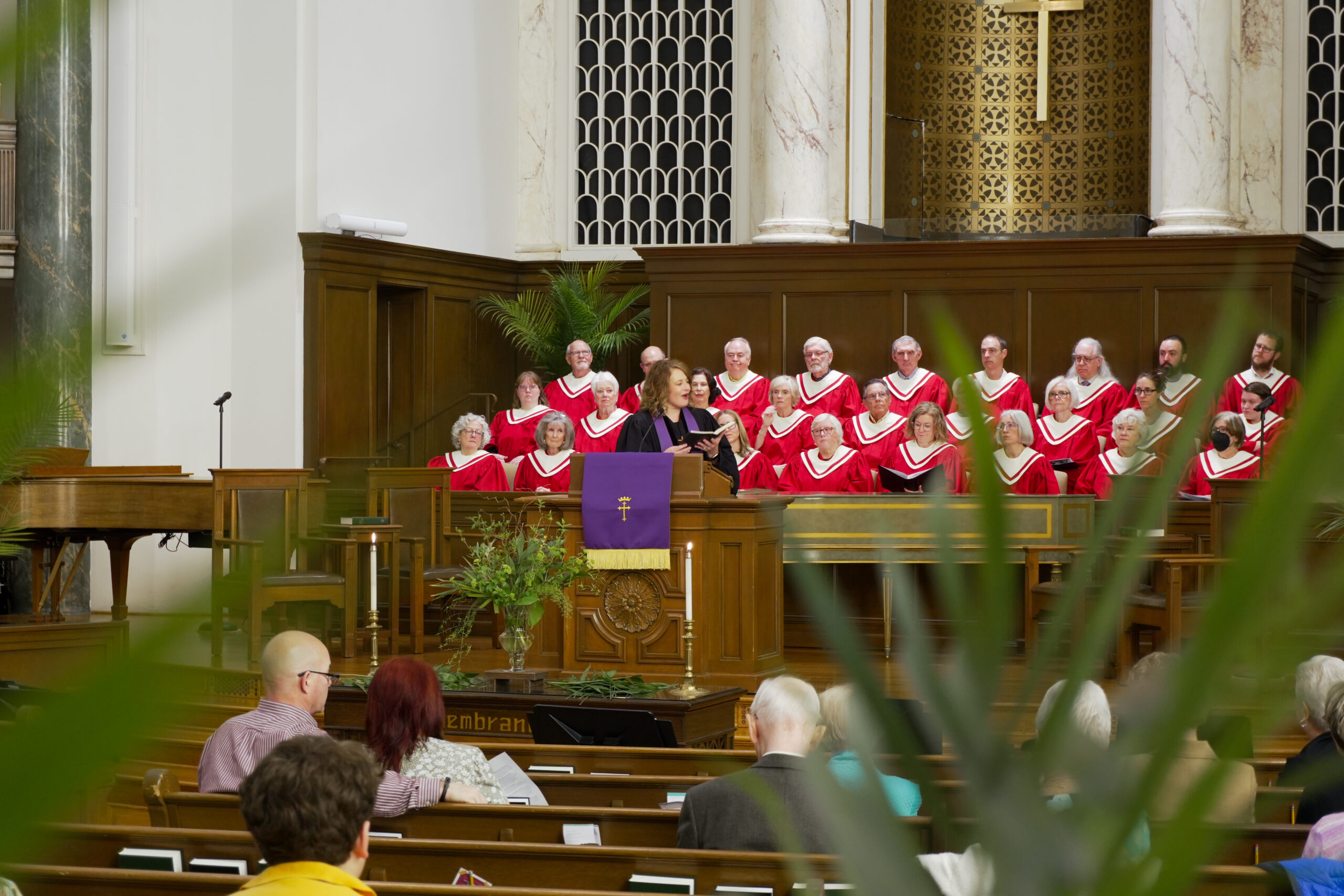
This morning I will be reading our scripture from the New Revised Standard Version. This specific Bible might look familiar to the kids in the room as it is the Bible the church gifts to our 2nd graders. If any of you have your Bible with you this morning, turn to page 1,240 to follow along as we read all of chapter 9 of the book of John. Remember as you hear the story or read along with me, notice what stands out to you and pay attention to where you see yourself in the story.
The reading of John 9
The Word of God, for the people of God. Thanks be to God.
When we did this exercise in Dr. Younger’s preaching class he asked us to share our insights with the class. Don’t worry! I’m not going to ask you to share your answers aloud but I do want us to take a minute to reflect. As we read the text together, what stood out? What sounds did you hear? What smells did you smell? What emotions did this text bring to the surface for you? Which character did you find yourself gravitating toward or identifying with most?
If you are one who sees yourself in the man born blind—the one who finds healing, the one who stands firm in your beliefs upon challenge, arguably the “hero” of the story—you are not alone. As human beings this is our nature. According to many psychological studies, we want, perhaps even need, to identify with the hero for many reasons. Heroes serve as models for overcoming adversity. Their stories provide us with a sense of security and help guide moral, social, and personal growth. Our desire to identify with the hero allows us, in a way, to experience the hero’s journey—the facing of fears and achieving goals—which can make us feel hopeful and provide inspiration for us during challenging times.
Really, who wouldn’t want to be that man in this story? He’s spent his life forced to be a beggar merely because of how he was born, often facing questions like the disciples ask: “So who sinned to make this man blind?” Then one random day a man comes by, rubs some spit and dirt on your eyes, tells you to wash it away and you can see! Suddenly you’re able to see the world you’ve been missing your entire life. You are overwhelmed with the colors, the brightness, the shapes and movements. There is so much to see. You are excited and nervous and unsure. You feel a lightness that now there are more opportunities open to you.
You want nothing more than to celebrate this amazing miracle with those in your life. But you are stopped short when everyone around you, your neighbors, the leaders of the synagogue, even your own parents, start questioning you.
Who did this? How did it happen? Are you really even the blind man they remember?
What in the world?! How could everyone be acting this way? Why can’t they see that something amazing occurred? Why can’t they see that the man who performed this miracle has to be from God because how else could this happen?
How are these people so blind?
In 1847, a young Hungarian doctor named Ignaz Semmelweis began working in the maternity ward of the Vienna General Hospital. What he saw there troubled him deeply. In one ward, where doctors and medical students delivered babies, a shocking number of women died from what was then called “childbed fever.” In another ward, run by midwives, far fewer women died. Semmelweis became obsessed with the question: Why?
After months of observation, he noticed something no one else had taken seriously. Doctors and students would perform autopsies and then walk straight into the maternity ward to deliver babies without washing their hands. Semmelweis had a radical idea: invisible particles from the autopsies were being carried on the doctors’ hands and transmitted to the new mothers. So he instituted a simple rule. Everyone had to wash their hands in a chlorinated lime solution after performing autopsies and before entering the maternity ward. Almost immediately, the death rate plummeted.
You would think the medical community would have celebrated this finding and easy fix to the problem. Instead, most people rejected his findings. Doctors were insulted by the suggestion that they themselves might be the problem. Simmelweis’ idea didn’t fit with their understanding of disease. Germ theory had not yet been widely accepted. So many chose to dismiss or ignore what was happening right in front of them.
The tragedy is that the evidence was right there. Lives were being saved. But accepting the truth would have required those doctors to change their perception. They would have had to admit that the world might work differently than what they believed. And they just couldn’t do it. It took decades before the medical world finally accepted what Semmelweis had seen. And now, as we know, handwashing is standard practice. Today, one would be thought absurd to question its necessity.
Sometimes the hardest thing for us is not that grace is absent. It’s that grace disrupts the stories we have told ourselves about how the world works. To quote the great Southern writer Flannery O’Connor printed on your worship guide, “All human nature vigorously resists grace because grace changes us and change is painful.” That is why doctors rejected Semmelweis’ theory. To admit they were the problem was too painful. It is also why this gospel story and its characters—the neighbors, the Pharisees, the parents—might feel more familiar than we’d like to admit. A blind man can see. A life is transformed. And instead of celebrating, the people around him start arguing and calling his witness into question.
In his commentary on this text, R. Alan Culpepper writes, “New truths are particularly difficult for those who live within traditions that reach back centuries. What do we do when God works outside our theology, our tradition and our structures?” That is exactly the struggle we see in today’s story.
Although sighted, the man’s neighbors, parents, and the Pharisees were blind to the work of Jesus that had taken place right in front of them. This miracle of spit and dirt being washed away to restore a blind man’s sight was outside their understanding. They couldn’t wrap their heads around it so they tried to explain it away. The neighbors insisted this wasn’t the same man. The parents distanced themselves from their son. The Pharisees focused on the fact that the miracle had taken place on the Sabbath. Rather than see God in Jesus, they tried to force God to fit what they already believed.
This week I listened to a man named Rob Schenck on a podcast. He is a former evangelical minister. I first became aware of Rob from a TikTok. You may have the video as well. It shows a bundled up Rob, wearing a fur hat, big coat and red pastoral stole, speaking about his presence at the protests in Minneapolis earlier this year served as a way of making amends for the harm he felt he had done earlier in his life. On the podcast, Rob tells the story about his past, the harm he caused and the ways in which his eyes were opened. For decades Rob had been deeply involved in the religious right. He organized political campaigns, cultivated relationships with powerful leaders, and worked tirelessly to shape public policy according to what he believed were Christian values. He believed with absolute certainty that he was doing God’s work. But later in life he began to see things differently.
Looking back, Rob shared that he realized that somewhere along the way his faith had become less about following Jesus and more about gaining political power. What struck him most was how long it took him to see it. He had been surrounded by sincere believers. They prayed together. They studied Scripture together. They believed they were defending God’s will. But the assumptions they carried about how God must work and who God must favor had become so fixed that they struggled to see when something didn’t fit their expectations. They struggled to see the wider works of God.
Most of us do not hold the positions of power of the doctors in that maternity ward nor do we find ourselves in the halls of Congress, the Supreme Court or the White House but we do all have areas in our lives where we enjoy certain positions of power. It is when we choose to function out of these positions of power or privilege or control or even fear that the world begins to look darker and darker. It’s like the line I often find myself singing from an Indigo Girls song:
“Darkness has a hunger that’s insatiable and lightness has a call that’s hard to hear. I wrap my fear around me like a blanket. I sailed my ship of safety till I sank it. I’m crawling on your shores.”
But, thanks be to God, there is good news. In every one of the stories shared this morning, someone begins to see something others cannot yet see. A man born blind suddenly sees the world for the first time and he is the only one in the story who seems to see clearly. A doctor sees that washing hands could save lives, even when others refuse to believe it. A minister begins to see that faith and power had become tangled in ways he could no longer ignore. In each case, the hardest part is not that the truth is hidden. The hardest part is that seeing it requires humility. Seeing it requires change. Seeing it means letting go of the certainty that once made us feel safe. And that is where this gospel meets us today.
If we are honest, we probably move through life a little like those neighbors and Pharisees, trusting what we already know, protecting what feels familiar, holding tightly to the stories that make the world predictable and safe. But the good news of the gospel is that God is always doing something we do not expect.
Grace keeps showing up in strange places. Light keeps breaking through the cracks of our certainty. And Christ keeps asking us the same question he asked that blind man: Do you want to see?
Friends, this is the invitation extended to us this Lenten season. May we be displaced from our positions of comfort and fear. May we have the courage to loosen our grip on certainty when the light of Christ begins to show us something new. May we choose to do our life’s work with eyes wide open to the light all around us. And may we live in such a way that those who are searching, those who are struggling, those who cannot yet see hope or love or mercy in this world, see Jesus because of us.