

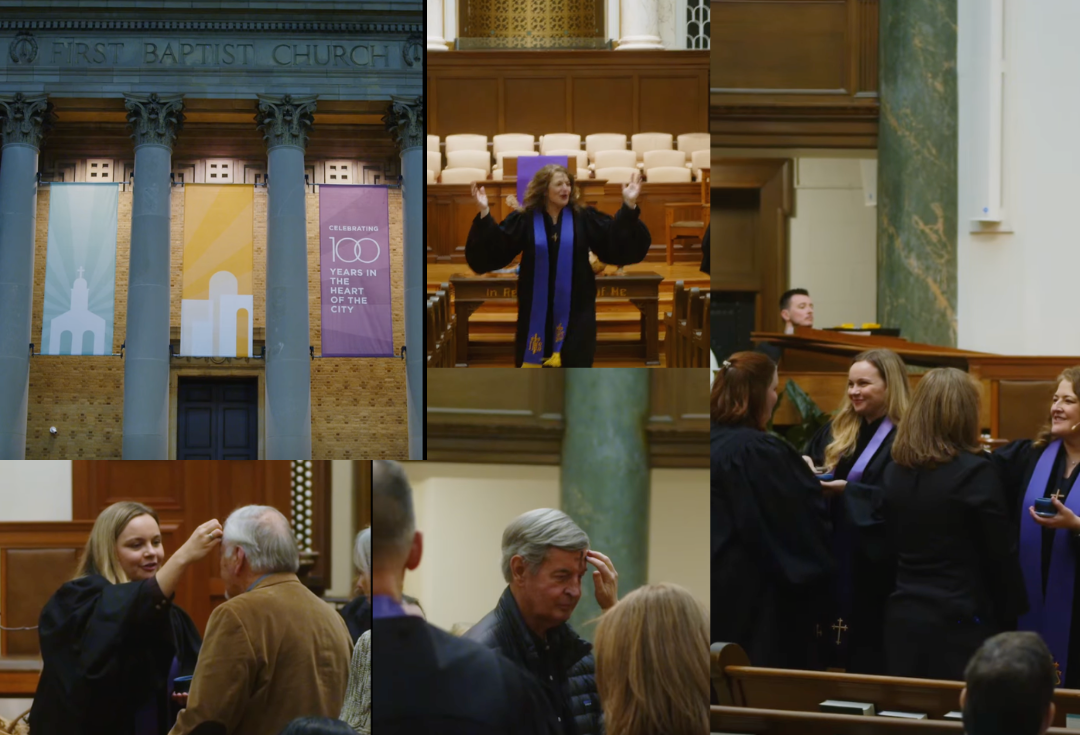
I.“Tell your children of it,” Joel says as the book begins, “and let your children tell their children, and their children another generation.” It was a crisis in rural life so severe that no living generation would relate, of such magnitude that no one should forget. A plague of swarming locusts had come along and completely destroyed the people’s crops, devouring them, in his words, like a ferocious lion or an attacking nation. Gone were the vineyards and orchards providing fruit to eat and sell. Decimated were the harvests, and empty were the granaries. This plague seemed to spare nothing, no one, no corner of their experience free from the new reality of loss. Joel hears the cries of his people, the groans of starving cattle, the suffering of the children as if in the throes of war. “Blow the trumpet in Zion,” he calls out. Sound the alarms. The emergency is here.
You might think Joel is writing to the people of God in the United States in the Year of our Lord 2026, not thousands of years ago when he said these things. For who among us hasn’t looked around our common life together and heard the alarm bells sounding? Who among us hasn’t seen the swarm of injustice and indifference, the racism and sexism and classism and ableism and Christian nationalism like the devouring locusts that they are? Who among us hasn’t heard the ferocious snarl of the power-hungry and known all that will be chewed up and spit out in its wake?
And that’s just a fraction of our common life! But what of our inner lives and all that surges and cascades through it? What of the debt of resources or hope or dignity that picks away at every ounce of security we hold onto? What of the self-criticism that never quiets, the anger that engulfs, the overwhelm that touches it all? What of relationships that always spark dread, or the regret that never lets you go? What of the melancholy that just won’t abate, or the fear that invades every corner of our living? What of a churning gut, a restless mind, a broken heart?
Together or apart, each of these experiences can feel – have felt! – like a plague – touching everything, sparing nothing, displacing us from all we’ve known. Though locusts aren’t raining from the heavens (at least not yet!), these days can feel like a five-alarm fire. What are we to do?
II.I read this passage from Joel every year on Ash Wednesday, but I’ve never noticed until now the little three word turn that Joel offers. Did you? After he describes the emergency his people have faced, he’ll call them to return to God, to rend their hearts, to create the room for God to enter in. But before all that, before the promise, the assurance, the deliverance, three simple words: “Yet even now.”
The locusts are swarming, yet even now, return to God. Everywhere you look is decay and suffering, yet even now, rend your heart to God. The ground is shifting, the people are displaced, and the life you know is under siege, yet even now, blow the trumpet. Things fall apart and the center cannot hold, yet even now, sanctify a fast. Nothing will remain the same, yet even now, gather the people. Fear for the future, for our livelihoods, for our children, for our world consumes and devours, yet even now, consecrate the congregation.
Of this text, one scholar says this: “this is a text for the difficult times, for the time when a community or an individual has experienced a crisis and may be anticipating another in the future. This is a word addressed to a people who are at the end of their rope and who do not know where to turn.”1 A word as timely as it is timeless.
Yet even now. Yet even here. Yet even this. Open your hearts. Return to God. For God is gracious and merciful, slow to anger, and abounding in steadfast love.
III.I’m certain you all have been as moved as I have by the Buddhist monks offering their Walk for Peace pilgrimage to us all. All 2300 miles from Fort Worth, Texas to Washington, DC that concluded just a week ago have captivated a nation. Through ice and snow and rain, with injury and blisters and weariness, mostly barefoot and spare, and of course with their dog, these monks have offered their witness of nonviolence and peace and harmony to a country at war with itself. Right here in the midst of the five-alarm fire that surrounds us, even as they intentionally displaced themselves from their home, somehow, yet even now, this simple act has given so many of us a glimpse at something real and true.
I thought of these monks as I read this week that in some Christian monastic communities, monks receive their ashes on Ash Wednesday barefoot.2 Why? Because it is a joyous thing to feel the earth under your feet, even when receiving the reminder of finitude. There they are – life and death, the hard and the hopeful, sisters of paradox, yet even now.
IV.Beloved church, you know that we’ve journeyed through themes and stories of home this school year. And during Lent, we’ll be considering all the ways in which we’re displaced. Displaced from health. Displaced from home. Displaced from identity. Displaced from trust. All of it. So I want to invite you – invite us – into a season of considering what has displaced you – what is displacing you still – and how yet even now, you can open your heart and return to God. I don’t know what displaced part of your life needs this examination, but you do. You know it, though you may wish you didn’t.
Maybe the displacing part for you is found in your actual, physical places – all that jumbles up your home, your desk, your car, your office, the landscape of your daily life with the items you think are bringing you safety and comfort but are actually exhausting you with lingering memories or unmade decisions or the perfection you yearn for but never find.3 Yet even now, what if you examined these spaces and how they are dislocating you from the essence of who you are and who God dreams you to be?
Or maybe the thing that is displacing is a habit that has just grown up over time without intending too, like the weeds that creep into a garden in the hazy days of summer. The daily doomscroll to numb and distract. The never-ending rush through your days with an endless desire for productivity. The way you snap at your spouse because you’re tired and scared at the state of the world and it’s easy. The calls you silence, the texts you ignore, the invitations you don’t follow up on, all because it just all feels like too much. Yet even now, what if you examined these practices and how they are dislocating you from the essence of who you are and who God dreams you to be?
Relationships displace us too, and perhaps you’re thinking of one in your life that needs reconsidering – the work colleague who diminishes your sense of self-worth, the person who wounded you in the past such that you’re still painfully affected in the present, the member of your family whose drama somehow crowds into your everyday conversations, the elected leader who has invaded your spirit with rage and despair. Yet even now, what if you examined these relationships and how they are dislocating you from the essence of who you are and who God dreams you to be?
As you consider the displacing spaces, practices, and relationships in your life, you might find that there’s something worth “giving up” for a season, that common Lenten practice of refraining from an indulgence for the sake of piety, discipline, restraint, and solidarity. Though I doubt God cares one hill of beans about that extra chocolate you sneak at night, there might be something in your life from which you can refrain over the weeks ahead, a kind of fasting to empty yourself of one thing so that you can be filled more meaningfully with God. Giving up an item or practice during Lent is not about deprivation for deprivation’s sake; rather, it’s about remembering that I’m a whole person without it, that my heart and my life are more able to thrive when it isn’t present. Yet even now!
But maybe you find what’s displacing by “adding in.” Perhaps there’s a practice, an item, a rhythm, a commitment that you can add this Lent that relocates you to who and whose you are. Maybe that looks like an extra five minutes outside – bare feet in the grass (remembering its joy!), heart open, head back, eyes alight in the glory of creation. Maybe it’s a daily walk for re-embodiment or a weekly conversation with friends for reconnection. Maybe it looks like anything that may feel frivolous, even irresponsible in these trying times, and by that I mean joy. Laughter. Humor just for fun. Creating art, and singing and playing music, and enjoying experiences, and playing games, and shooting hoops with teenage boys, and making space for joy to grow, unabashedly, fully, vibrantly, rejoicing always in the Lord who is good.
Whether giving up or adding in, these Lenten practices are not a second try at some New Year’s resolutions, or a chance to experiment with a new spiritual self-improvement plan! Rather, the work of attending to what displaces you this year connects you to something larger than yourself and your life. Sacrificing something small may feel small in the grand scheme of things. You do so, not just for God, but for you. As writer Emilie Griffin says, “When we choose some exercise for Lent, daily worship, daily prayer, abstinence from one thing or another, it is not so much the practice that transforms us. It is our willingness to change.” 4
Therefore, you might tell yourself: I’m passing on this purchase, or that drink, or this passive aggressiveness, or that gossip, or this habit, or that desire, or this dopamine hit, or that tranquilizer, or this obsessive worry, or that fearful action – to remind yourself that you can live without it. Instead, place yourself once again with the God who is gracious and merciful. Trade what binds you for the liberation of the God who is slow to anger. Treat the wounds of scarcity with the healing of the God who is abounding in steadfast love. Let the mystery and wonder that God is revealing take root, re-place you with the Holy One, and make way for resurrection.
Yet even now. Well, for 40 days, at least. And then, of course, perhaps for a lifetime. For this love of God restores and returns us right into the sweep of God’s dream. It rests in the very dust of which we were formed, carries us through the living of these days, and returns us to God at the end of this life. It sticks and stays, far longer than these ashes will on our brow.