I.Lawyer and theologian William Stringfellow once said that “Christians go to church on Palm Sunday because they love a parade.”1 As I read one pastor said in response, “I used to resent Stringfellow’s saying that. But now I conclude that he was partially right. I do love Palm Sunday.” Add my voice to his: I love Palm Sunday so much, last year I figured it was a good enough reason to treat myself to some palm leaf earrings to be liturgically appropriate for the day.
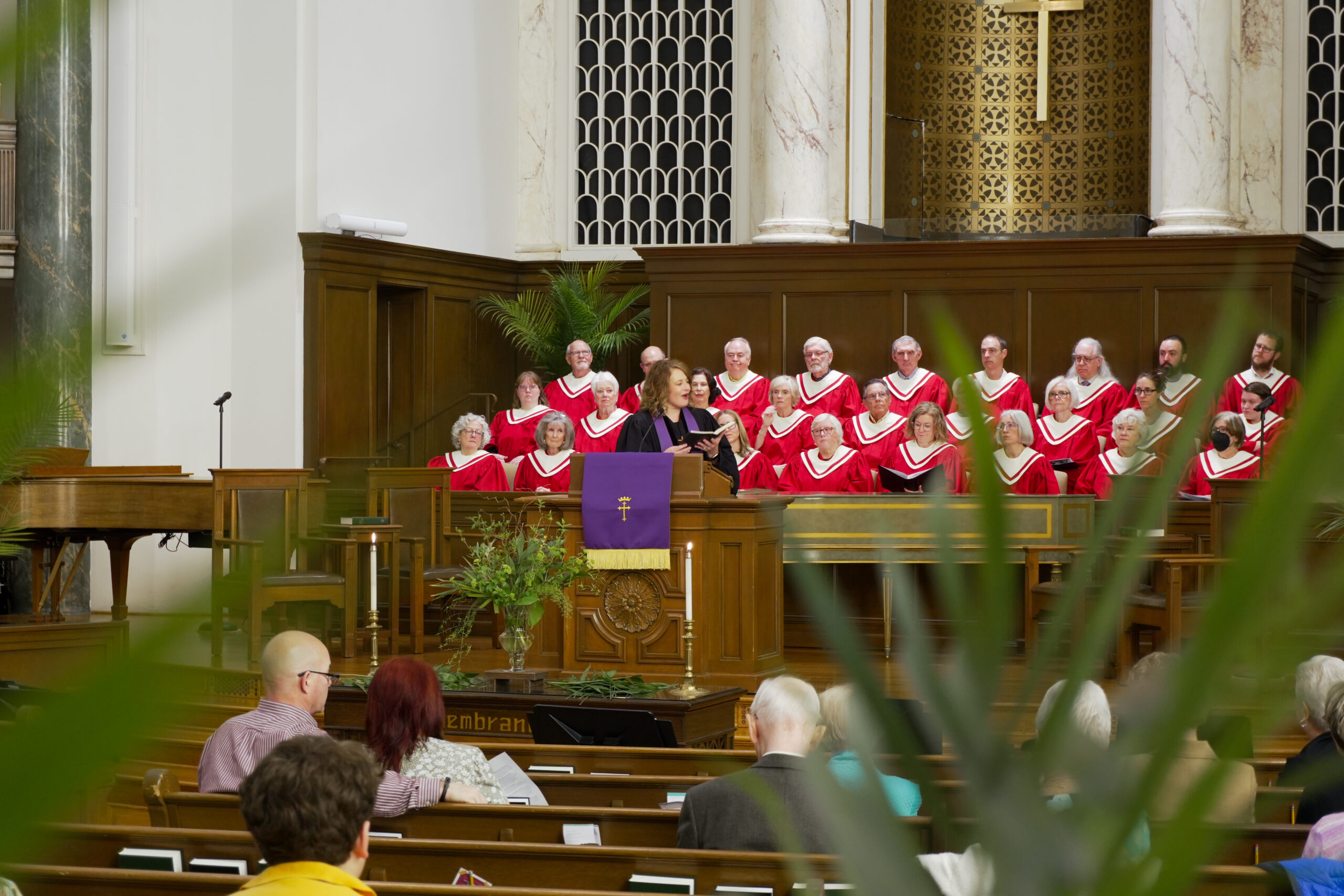
What’s not to love? The greenery fills the room. The choir works up an extra special anthem for the occasion. The bells ring out, and the room fills with “All Glory, Laud, and Honor.” And best of all? The children and youth lead us in with their palms. In the church I served in Louisville, it was their tradition for the children and youth to line the aisle and wave the palms as ministers and choir members walked in. It wasn’t Palm Sunday until you’ve been whacked in the face with a frond! Palm Sunday became all the more special for me when my own children made their way into the processional, and the parade took on a whole new joy. It’s like a mini-Easter with its festivities and particularity and story.
Indeed, Palm Sunday has all the elements of a good drama, doesn’t it? There are interesting characters, a specific landscape, a thickening plot, power in full view, and the tensions political, national, religious that clash in a rowdy climax in the Holy City. But right in the midst of the swirl, right in the midst of it all, right in the heart of that city is a young man moving toward his certain death.
II.We know that as we gather this day, palms in our hands and hosannas on our hearts. We know how this story ends, where the road winds, what that young man will endure along the way. It’s as if we have a bird’s eye view to it all, like being on the 18th floor of a city’s skyscraper or flying up overhead like a drone to take it all in. This can’t help but to change how we experience that palmed path though, coloring it with a slant of urgency and dread. For if we look a bit further out, we spot that hill far away, the garden just nearby, the tomb still covered in shadows. But in order to sink into the experience, in order to inhabit it and not just enjoy a nice parade on a shiny spring day, we must locate ourselves right in the teeming center of it: before knowing and seeing what’s next.
And that’s the invitation that takes us to Jerusalem today. Ah Jerusalem, the Holy City, the place of power and the home to the great King, as Jesus referenced to his listeners on the mount. Although this would be Jesus’ first trip there, the presence of Jerusalem had loomed large throughout his life. Matthew tells us Jerusalem had shaken with the birth of Jesus and would be thrown into turmoil with his arrival now. Thousands of people have arrived into Jerusalem for Passover, the city swelling from some 50,000 to more than 200,000 people, as observant Jews gathered there to make their sacrifice to God. The city was charged with energy. It’s here that opposition to Jesus was building, and here where he will lament: “oh Jerusalem, Jerusalem, the city that kills the prophets and stones those who are sent to it. How I’ve wished to gather your children like a mother hen gathers her brood, but you were not willing.”
And with a keen eye looking back into Jewish history and directly upon the long-awaited Messiah before them, Matthew makes the links clear. Two disciples are sent to fetch a donkey and a colt. Why? Because the prophet Zechariah said “your king is coming to you, humble and mounted on a donkey,” and because “the Lord needs them.” The crowds met him there, raucous and ready. That the humble Messiah atop a donkey would ride into a tumultuous, electrifying city looking unlike any king they’d ever known was sure to cause a stir. But these people, the crowds, spread their cloaks on the road, and waved the branches they’d grabbed from the trees, and ran alongside Jesus with a cry: “hosanna! Hosanna to the Son of David! Blessed is the one who comes in the name of the Lord!”
Two thousand years later, and our hosannas look as joyful as a toddler delighted to be carrying a branch in church. But we must remember the original meaning that in just a word, “hosanna” juxtaposed praise and deep need. Hosanna meant “save us!” Hosanna meant “help us now!” All together in the simmering energy of Passover with Pontius Pilate and his empire breathing down the necks of his people, the crowds shouted hosanna to their humble hero, save us to their meek Messiah, liberate us to their weak-yet-strong king. About this clash, Frederick Buechner wrote: “Despair and hope. They travel the road to Jerusalem together, as together they travel every road we take — despair at what in our madness we are bringing down on our own heads, and hope in him who travels the road with us and for us and who is the only one of us all who is not mad.”2
III.You know, when you have this bird’s eye view to the story, despair and hope become harder to see. They’re harder to see, because all things are harder to see from high up, from that vantage point of the city. You can’t really tell which buildings are which. You sure can’t make out individual faces, not to mention which persons have nicer clothes, well-lotioned skin, the best rings. The cloaks on the road look like the palms from up here. Can you even make out the protest signs from above? You certainly can’t hear the cries, which is why the hosannas sound like alleluias with the distance of time and space.
But when you get down on the ground, when you place yourself on the roadside, all of it comes into sharp relief. Their smells and sounds and sights swirl into cacophony that only the city can provide. The hosannas take on a new frame. At this vantage point on the ground, the crowds sound less exuberant and more dire. “Save us,” they shout! “Help us, please!” The faces of the people look ragged and weary: impoverished due to the crushing economic systems of Rome, demoralized by the grip of power under which they lived. The throngs press in, triggering even more Roman troops – even the Roman governor himself – to crash in and keep the peace. When you’re on the ground, you see all that. You see the angry religious leaders there in the corner. You see the nervous Romans over there..
“The whole city was in turmoil,” Matthew says of Jerusalem. “In turmoil,” calling back to Jesus’s birth, when the whole city quaked with fear alongside Herod. “In turmoil,” foreshadowing the moment on Friday ahead when Jesus will breathe his last and the “earth will shake and the rocks will split.” “In turmoil,” after his rising when yet another earthquake causes the centurion to proclaim, “Truly, this man was God’s son.” The city was “in turmoil,” because when the stone that the builders rejected becomes the cornerstone of a whole new world, not even the stones will remain silent, for nothing will ever be the same.3 In turmoil, this disturbance, this seismic activity, this displacement, follows Jesus into the Holy City, echoing destiny from his birth through life to death and resurrection. No wonder they asked, “who is this?”
But that first Palm Sunday of Jerusalem isn’t when we meet the only city “in turmoil,” is it? Jerusalem on that first Palm Sunday isn’t the only city shaking with the displacement of shalom. What of Tehran or Tel Aviv? What of Beirut and Beit Shemesh? What of Gaza or Kyiv? What of Minneapolis or Chicago or Los Angeles or New York? What of Winston-Salem?
Beyond the bombs and boots on the ground, what of any city where suffering echoes from building to building or where alleyways line with the hungry? What of any city where the streets fill with protests and homes are crowded out by loneliness? What of any city where people look for a king, someone to lead them, and save them, and make the pain stop, someone to set things right? What of any city where people hunger for justice and thirst for righteousness? What of any city where people are held captive by their fear, shackled by their hatred, bound by their regret? What of any city where its residents long for someone to bring some good truth that, in the end, hope can bear, does bear, will bear the crushing weight of despair?
What of any city? For that is every city. Every one, no matter the size. And regardless of the place we call our home, the geography of our faith demands that we leave the bird’s eye view and come near on the ground, that we trade the high view of our living to get right in the teeming heart of it all, for that is right where the people are. For that’s what he did, that young man atop the donkey. He left the quiet of a Galileean seaside and came near to the city, just as he left the holy mystery of heavens to come near to this earth. Over and over again, Jesus is about the work on the ground: healing the sick, and casting out the demons, and feeding the hungry, and walking on the road, and opening the scriptures, and telling the stories about seeds and yeast and a returning prodigal and a kingdom right here and not quite yet. That was the life he was about, living out the self-emptying courage and peace and love to show us what God looks like. And even when he knows that this work, this placement, will cost him his life, he sets his face to Jerusalem and comes to the city anyway.
For when he does, the ground shakes. When he does, the stones cry out. Nothing remains silent, not even the tomb. For love has once again come near.
IV.Friends, we’ve spent these Lenten weeks talking about what it means to be displaced. We’ve heard stories of people experiencing displacement in their own lives, or from truths they’ve held dear. We’ve heard about how Jesus dislocated them from those easy truths and comfortable places. And we have arrived with him here. Placed and particular in this Holy City where the road ends.
So here he is. And here we are. Right here on the ground. Here is Holy Week. Here are our palms and our tears. Here are our praise and our lament. Here is God on a donkey, and the powers of this world that will crucify Love made flesh. Here is the table set and the tables flipped. Here is the betrayer and the basin. Here is the presence and the absence. Here is the cross and the tomb. And here at the brink of the end, we are greeted by a redeemer who receives it all.
So come down from the bird’s eye view this week. Let the hosannas hang on your lips, broken and hopeful. Try as you might to forget that you know how the story ends. Place yourself with Jesus in these days ahead.
“For blessed is the one who comes in the name of the Lord!”
Blessed is Jesus who comes to die so that we will live.4