

Camels – Egypt
This time last year, I found myself riding a camel around the Great Pyramids of Giza. As a kid, I wanted to be an Egyptologist, so this was going to be one incredibly cool moment for my inner child.
I was only a few days into this epic pilgrimage with 16 others from Wake Forest School of Divinity. We started our journey in Giza and Cairo before we would eventually venture to Alexandria on the Mediterranean coast and then back south to Luxor and the Valley of the Kings with stops at monasteries and spiritual retreat centers along the way.
And no, we did not travel this entire journey by camel. Mostly we rode a bus, but for an anxiety-inducing 20 minutes on the morning of Dec. 31 — several of us found enough courage, or more accurately hubris, to climb onto camels as they sat near the pyramids. Our teacher, Dr. Neal Walls, volunteered ME to be the first to ride a camel because “Bethany will scream, and it will be great,” he said. I, being someone who could be described as slightly stubborn by some or independently-minded by others, was determined not to give him or the others the satisfaction.
I walked up to the camel, ready to roll, and the handler said I could name him for our journey. As I gazed into the soulful eyes of this majestic beast, one name floated to the top: Jimmy Carter. We had just gotten the sad news of the 39th President’s death a couple of days before, and as a Georgian and Baptist, I was proud of President Carter’s lifelong faithful witness to God; his belief in the separation of church and state; and how these two things drove his passion to work for peace in the Middle East. Plus, his initials, J.C., were the same as Jesus Christ, so I felt doubly covered for this camel ride.
But as I stood next to my Jimmy, I realized my 5 ft. 3 in. self needed assistance JUST to climb aboard. With a huff, I was hoisted on top and then the handler made a tap and a noise, and ALL OF A SUDDEN, Jimmy was getting up. My body swayed BACK and then FORTH as Jimmy rose and rose higher still … and to my dismay, I screamed. I couldn’t hold it in. Jimmy was a very tall camel, and I have never been this far from the ground without being in an airplane.
This seemed anything but wise. Why did I decide to be GOADED INTO BEING the first one in my group to get on a camel? Where is the safety harness to strap in? Why are camels so tall, and why is the ground so far away? These thoughts ran on a loop in my head as the rest of my brave travel companions ascended skyward on their camels. And then we started to move, very slowly mind you, one camel tied to the next, in one long train all together.
The first 10 minutes of the trip, I was a ball of nerves, my thighs rigid and tight against the camel’s sides. I was praying to Jesus and then President Carter to intercede and take me to heaven swiftly if this were to go south. I know, as Baptists, we don’t really do intercession like the Catholics, but I was willing to try it. And I wasn’t the only one praying out of terror on that camel ride. Some nervously laughed; others sang hymns aloud for comfort.
And, then the camel train stopped. We had arrived at the promontory where we could see the pyramids in front of us. I finally let out the breath I was holding. We had made it! And while it was bumpy and took some getting used to, I was overcome by the epicness of this moment and the landscape before me.
Hands as wide apart as I could spread them, I smiled for the camera as Jimmy just stood quietly underneath, a patient animal who was just taking a scared human on a walk on a normal Tuesday.
On our return journey, I felt such relief and joy, with only a twinge of anxiety lingering. My body loosened, I learned to sway with Jimmy’s cadence, not fight against it. And by the time we arrived back to our friends, who know, the smart ones who had DECLINED the camel experience, I was body weary but soul filled.
And new questions began looping in mind. Instead of wondering if it had been WISE to take this camel ride, I began asking why do we equate wisdom with safety? Is there something about journeying into the unknown that can bring us a type of wisdom we would not find otherwise? And really, why are there no harnesses on camels?
Wise Men
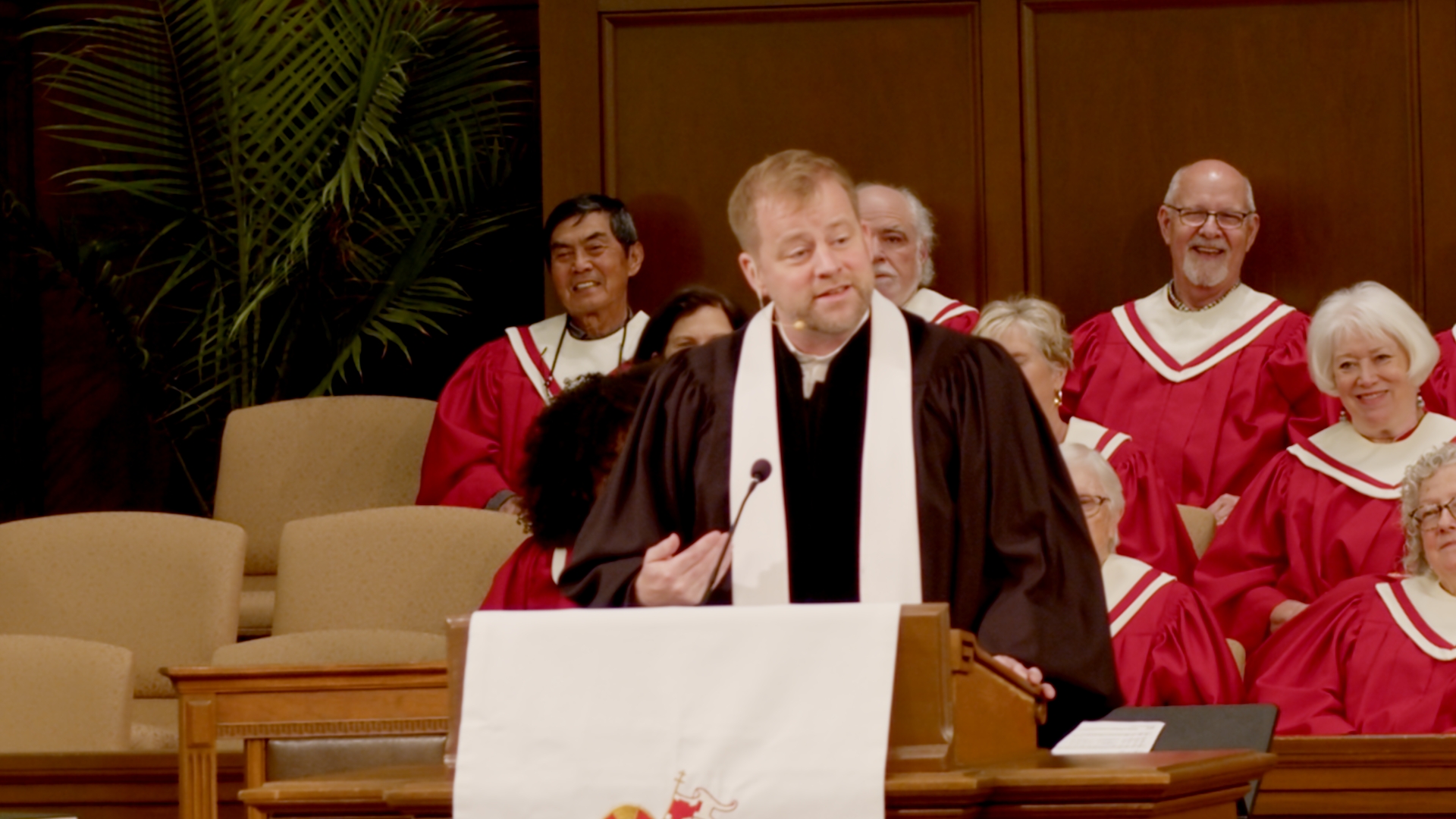
Today, I stand before you with two feet firmly planted here in Camel City as we all prepare for the gospel of Matthew to take us on our own pilgrimage, across the sands of place and time for a RIDE ALONG with the Magi.
And who are our traveling companions? It turns out we just don’t know a lot about the Magi. Matthew is the only gospel that mentions them; and we have just 12 verses, not even a full chapter. Even the term Magi can mean a few things: possibly King but more likely a priest, dream interpreter, astrologer, or a combination of the three. They probably came from Persia but other traditions have them coming from even farther. I like the First Nations Version, an Indigenous Translation of the New Testament, who calls the Magi, “seekers of wisdom.”
These seekers of wisdom will eventually be given names in the writings collected outside of the canon, and we will say there are 3 of them, although their actual number isn’t recorded nor are the others who traveled with them, such as their families or households OR ANIMALS OR EVEN CAMELS?
How did they act when they arrived at Herod’s court in Jerusalem? Were they fearFULor fearLESS to go before Herod, not offering their gifts to him but instead asking where is the true king of the Jews? That’s a pretty bold move, especially for Herod’s temperamental reputation. They must have had some really good diplomatic skills.
And then they were off, following the star further south to Bethlehem, where they were overcome with joy when they met Mary and her son, Jesus.
Did they also feel relief on their return journey, body weary having survived their encounter with a tyrannical king, but soul filled from having met infant Jesus? Was their divine warning about returning by a different route an easy interpretation, or, for that matter, did they all have the same dream, or did just one magi have the dream and tell or convince the others? So. Many. Questions. If only the writer of Matthew had given us just a bit more ….
But we do know a few things: they were strangers to the land, they were wealthy enough to bring 3 extraordinary gifts; they were in tune with nature and observed what God was using the cosmos to proclaim; and they knew not to trust FALSE power when DIVINE power offered another way.
Bad Kings
And in that moment, in the most devastingly evil ways, earthly power was in control. The Roman empire ruled vast territories, displacing, enslaving, and oppressing as they saw fit to expand their power and wealth.
In Judea, a province under Roman rule, Herod comes into power by way of Mark Antony and becomes a puppet for the Romans, a “king of earth,” as Matthew records (17:25). He is cunning, tyrannical, and self-serving, and when he doesn’t get his way with the Magi, he commits mass murder in remaining verses of this chapter in hopes of removing the threat that Jesus’ poses.
Historically, we have not yet found archaeological evidence for this slaughter of innocents, but we do know Herod to be a really bad guy. Because the empire places him on the throne as the representative of Rome, he is plagued by this claim that he is not the rightful JEWISH king. He even marries Mariamne I, a Hasmonean princess, who was part of the royal Jewish family that had been in power. He tries to placate the people by performing rituals and pretending to partake in Jewish customs. But when that doesn’t work, and he becomes paranoid about losing power back to the Hasmoneans, he has his wife and most of their children killed.
And the 1st century audience listening to the gospel of Matthew knows this, having lived within a generation or two of Herod’s rule. They would have known how Herod expanded the Second Temple in Jerusalem to his own glory, where it becomes known as Herod’s Temple. They would have paid taxes to Rome, had Roman soldiers stationed throughtout the provinces, and some may have even survived the fall of Jerusalem in 70 CE. Jews had lost everything at the hands of empire. It was a bleak and traumatic time.
And then they hear about the star that sent strangers to travel from afar, who navigated shifting sands and a perilous tyrant to be overwhelmed with joy when they meet divine incarnate who rests on his mother’s lap. These strangers give the family wealth, which is likely what funds the Holy Family’s flight as refugees to Egypt, and then they offer their protection by defying Herod’s orders and traveling a different way home.
Digital Ministry
As many of you know, I have a passion for digital ministry, and my social media feed is full of digital theologians who have found a way challenge the noise of harmful theology and focus on the good news for today’s believer in a liberating way. One such theologian, Erna Kim Hackett, runs the Liberated Together Community online and posted an Advent series this month exploring the Magi narrative as the antithesis of empire.
“If success under empire were the measure of success, Herod would stand at the center of the story as its hero. Instead, he becomes its warning, a mirror showing what happens to a soul distorted by empire. Herod reveals how power twists a person, how it turns faith into theater, and people into pawns.”
Hackett goes on to explain through weekly postings how Herod wanted to “take these authentic spiritual seekers and turn them into errand boys for empire,” and it would have been easier, simpler, safer for the Magi to do exactly what Herod commanded. They could have given him the gifts, bowed to his authority, and gave up the infant they had just met. But they don’t. They show another way, a way that butts up against the notion where “to believe that legality is the same thing as morality and that the commands of powerful men are the will of God.”
In the most Jewish of the gospels, where Matthew writes a lot about Jewish law, we have this incredible alternative narrative right at the beginning of the story. The laws of the land do not keep the divine safe. The ruler in charge will not keep the divine safe. No, it is the willingness of the stranger, the immigrant, the border crosser that takes a risk to their own safety to hold safe the divine power of otherness. Other ways of loving, of feeding the hungry, of helping the poor. This power will reach beyond borders, across languages, but not like any empire they have seen before. No. At the head of this heavenly kingdom is not a Roman general but a child who will grow up to teach the masses how to love their neighbor, to turn the other cheek, and to influence the world for the good of others.
This story — the story of Jesus — that begun on that hillside of Bethlehem will have a different ending than what is expected. That is the promise made by God and the protection offered by the Magi.
Psalm 146
This promise to put trust in divine power overly earthly empire is echoed in Psalm 146. Echoed might be a polite word, actually, because the Psalmist is bold in their language, saying: “Do not put your trust in princes, in mortals, in whom there is no help. When their breath departs, they return to the earth. On that very day, their plans perish.”
Thousands of years separate the psalmist from the time of Herod, and yet, how true those words ring true. Herod, who was placed on the throne by Rome, who had spent fortunes expanding the Second Temple and remaking it into his image, falsely worshipping to appease the populace, — this Herod didn’t last forever and his plans perished at the hands of the very empire he was propped up by. Rome destroys the Second Temple in 70 CE, just 10 years or so before this gospel is thought to be written. Even Herod is not immune to the violence of empire.
The Psalm continues “Happy are those whose help is in the God of Jacob, whose hope is in the Lord their God, who made heaven and earth, the sea, and all that is in them; who keeps faith forever; who executes justice for the oppressed; who gives food to the hungry. Who watches over the strangers.”
Do you hear where we are supposed to find our hope? Our sustenance? God made the heaven, the earth, the sea. God is the source of justice and sustenance. Not any mortal prince, no matter how many buildings he puts his name on or laws he commands.
Wrap it Up
The Herods of the world will fail us, as the Psalmist, the Gospel writer, and history all warn us, but with little acts of courage, grounded in the wisdom that God has sent us, we can follow the star of divine power already here. That light within each of us shines brightly when we chose to reject the false, the corrupt, the violence in order to bring God’s peace on earth. But this peace is not a passive peace. It requires us to act, to take the alternative road that leads to healing, not division; feeding, not starvation; and protecting the strangers and vulnerable, not abducting them or violating their human rights.
This peace requires us not to become the errand boys of empire, giving our money to corporations that prize capitalistic greed over the welfare of others, promoting agendas that seek to divide in order to conquer, spinning the narrative to protect ego rather than truth, making education unaffordable for many, or preventing medical access to be given to those in need. The empire is far reaching. And this peace is not an easy road but we are not alone on our travels.
We are in this camel train together, slowing plodding forward on a quest to see a bit more of the kingdom of God here on earth. There have been — and will continue to be — ups and downs, rocky gaits, moments of pure panic, and lots of praying … but the relief at the journey’s end when we choose to go a different route, the Holy Rebellious route, makes it all worth while. For it’s that road, where we encountered God along the way.
Amen.