I.Are we there yet? Is it time? Has my package arrived? Is my treatment almost over? Will we ever … get there?
Fill in the blank with any of the yearnings in our lives – that we reach toward, that we count down for, that we wish would hurry up and get here, that we think, “man, once this thing happens, then we’ll be ok,” – and we’ve tapped into the “not yet but near” spirit of Advent.
The season of Advent, in its waiting and preparation for the coming Christ, its darkness and quiet, its mystery and hiddenness, its signs and wonders offer us countless ways to resist the glitz and sparkle that define a commercialized Christmas that has already surrounded us for weeks. We’ll see “A Holly Jolly Christmas” and raise you an “O Come, O Come Emmanuel.” Take the endless stream of Christmas lights igniting the night sky, and give us a candle in the dark. Let’s trade the lies of perfection, happiness, endless youth, success, for the truth of good news in spite of it all.
Because Advent calls us not just to a different space, but a different time. Reenacting the past as if it’s present. Waiting for a birth that’s already happened. Preparing for a coming whose when is unknown. Feeling the wrinkle in time from one world to the next, chronos to kairos. And in the mystery of these darkening days, Advent invites us to awake to God’s presence here.
II.The Gospel writer named Matthew is who orients us to Advent as we begin. Scholars think that Matthew was writing to a congregation of faithful Jews trying to add their new faith in Jesus Christ to their existing heritage. Matthew understood this tension of what was, what is, and what will be, as he wrote to a community who knew it intimately, a community wholly Jewish by heritage and wholly Christian by conviction.
“But about that day and hour, no one knows.” Jesus’s apocalyptic words speak to a time yet to be, a time unknown even to him, a time “hidden within the folds of God.”1 Then he tells of a time that was – the days of Noah, when the floods unknowingly interrupted their living – and then the time that is – ordinary days filled with grinding meal or working in the field. What ties them all together? Uncertainty for the Lord’s return, that second Advent of our waiting. He’ll come like a thief in the night, “so that we do not have time to lock him out.”2So keep awake, Jesus says. Be ready.
It can feel threatening, this text, a fruitful source for bad apocalyptic movies with disappearing people and mournful music. It may sound to our ears that in this uncertain future, we better get our affairs in order and settle in to be scared for the long haul. And in the context of Advent, it’s certainly a dissonance with the lights and candles, warm scenes and fiery poinsettias of the season. Just a few verses prior, Jesus imagines the signs of that time: sun darkened, moon dimmed, stars falling from heaven, the powers of heaven shaken. The end of the world as we know it!
III.Some days, that description doesn’t seem too far off. For I don’t have to tell you that these times throb with suffering and cataclysm. A.I. ready to crash over us like a tsunami. Genocide and wars and rumors of wars. Disruption at a pace we can’t sustain, and breathless news of it all we can’t metabolize. Hardening of hatred and truth. Burnout that settles into our bones. A stopped heart. A positive test. An unraveling relationship. The center that does not hold.
Forty years ago, a pair of economists coined the term VUCA to describe the post-Cold War landscape: Volatile, pointing to the speed and magnitude of change; Uncertain, or times that lack predictability and reliable data; Complex, noting the tangled networks of interconnected and interdependent systems that power our daily life; and Ambiguous, or when situations lack clear rules or precedent. But these forces feel as real today as ever. Name a major event of the last decade – the pandemic, election outcomes, geopolitical conflict, wild economic swings and disruptions of the global supply chain, the domination of technology in our daily lives, and on and on – and we see the realities of VUCA at play. 3
Scientists tell us that in a VUCA world, it’s only human to respond to such turbulence with fear. Some of us manage our anxiety with comfort measures: pouring that nightly cocktail or making another round of mac and cheese, shopping yet again on Amazon or turning on a familiar TV show for the umpteenth time. (Please don’t make me admit to you just how many times I’ve rewatched The West Wing!) Others of us build up our fortification with more security cameras, more weapons, more cash, more stuff. Perhaps you go into productivity mode: cleaning out closets and getting your affairs in order, finding a different job or mapping out the next several years of your family’s life. Or maybe the most primal response is simply to curl into the fetal position, pull the covers up over your head, and shut it all out.
These are the times we wonder, “God, are you even there? When are you coming to make it all right again? How much longer must we wait? Are we there yet?”
IV.As the story goes, once upon a time, the three devils met to discuss their strategy to conquer the world. “The first devil went around proclaiming the message, ‘there is no God!’ But even though some people acted as if there were no God, they knew in their hearts that this message was not true. The second devil announced, ‘There is no sin!’ And again, although many people acted as if that message were true, they knew deep down that it wasn’t. The third devil was smarter than the other two. He didn’t attempt to change people’s beliefs. He made no attempt to argue against their deepest convictions. He simply said, ‘There is no hurry.”4
We remember Matthew’s call for readiness, but know that such an instruction feels disconnected from our daily lives, doesn’t it? For we’ve been waiting for that unknown day or hour forever it seems! As one theologian said, “it’s hard to stand on tiptoes for two thousand years.”5 And in that meantime, the urgency fades. Life moves on. Fear closes us in, or spins us up, or distracts us from what matters most.
On the eve of the Cold War back in 1952, the late pastor of The Riverside Church of the City of New York, Harry Emerson Fosdick, was speaking for students out at the Pacific School of Religion. In his address, he acknowledged how disorienting that era had been, the crises that punctuated it, the uncertainty that followed it. He could feel the fear in the room, these people whose understanding of the world had been utterly upended. And out of that time-bound talk came his timeless words: “The highest use of a shaken time is to discover the unshakable.”6
I’ve told you this story before, but it bears repeating as Advent begins once again with its new time to consider. Because the good news is that amidst volatility, God comes near. In uncertainty, God comes near. Within chaos and complexity, God comes near. Through ambiguity, God comes near. In all the darkness of the shaken times, then and now and soon, God comes near. In fact, the darkness is exactly where God dwells. Shadows are God’s specialty. Despair is precisely where God comes closest. In the darkness, in the chaos, in the deep freeze of anxiety and worry, in stagnation and isolation, in the dislocation and the depression, in blighted cities and run-down hamlets, in broken-up relationships and shame-filled souls, God tears open the heavens and comes right into the darkness to dwell, to nestle and take root, to be near.
Lest we feel the urge to simply comfort our anxieties and dwell in the fear that uncertainty brings, might we remember the promise that God’s new day is a time when we will beat our swords into plowshares and our spears into pruning hooks, when all the swords we take up against one another will lay down, like the lion with the lamb.
So we wait. We watch. We prepare. We stay awake. Because hope, as Jesus says, keeps us awake. It helps us to stay alert. It keeps our spirits attuned to what lies below the frostline, under what’s hard-packed and frozen, buried deep into the ground just waiting to come to life.
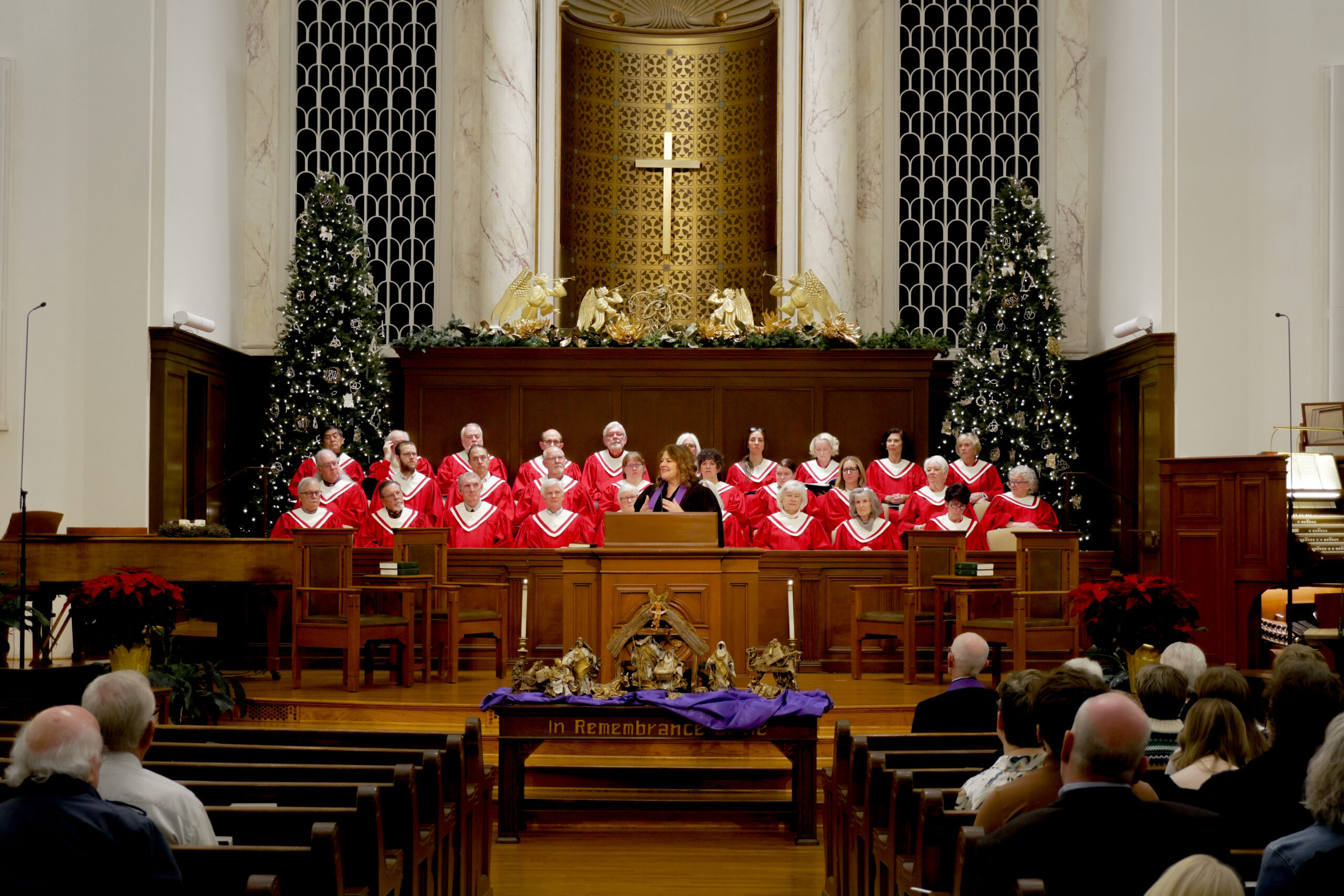
V.Friends, on this Hanging of the Green Sunday, let me invite you to an Advent practice to awaken you in the uncertainty, to practice to preparing him room in your life.
Every time you see greenery – instead of thinking back on all the years you and your family picked out the best tree in the forest, what if you wondered forward toward the day when destruction will cease and all creation will flourish like a tree, bright and full in the summer?
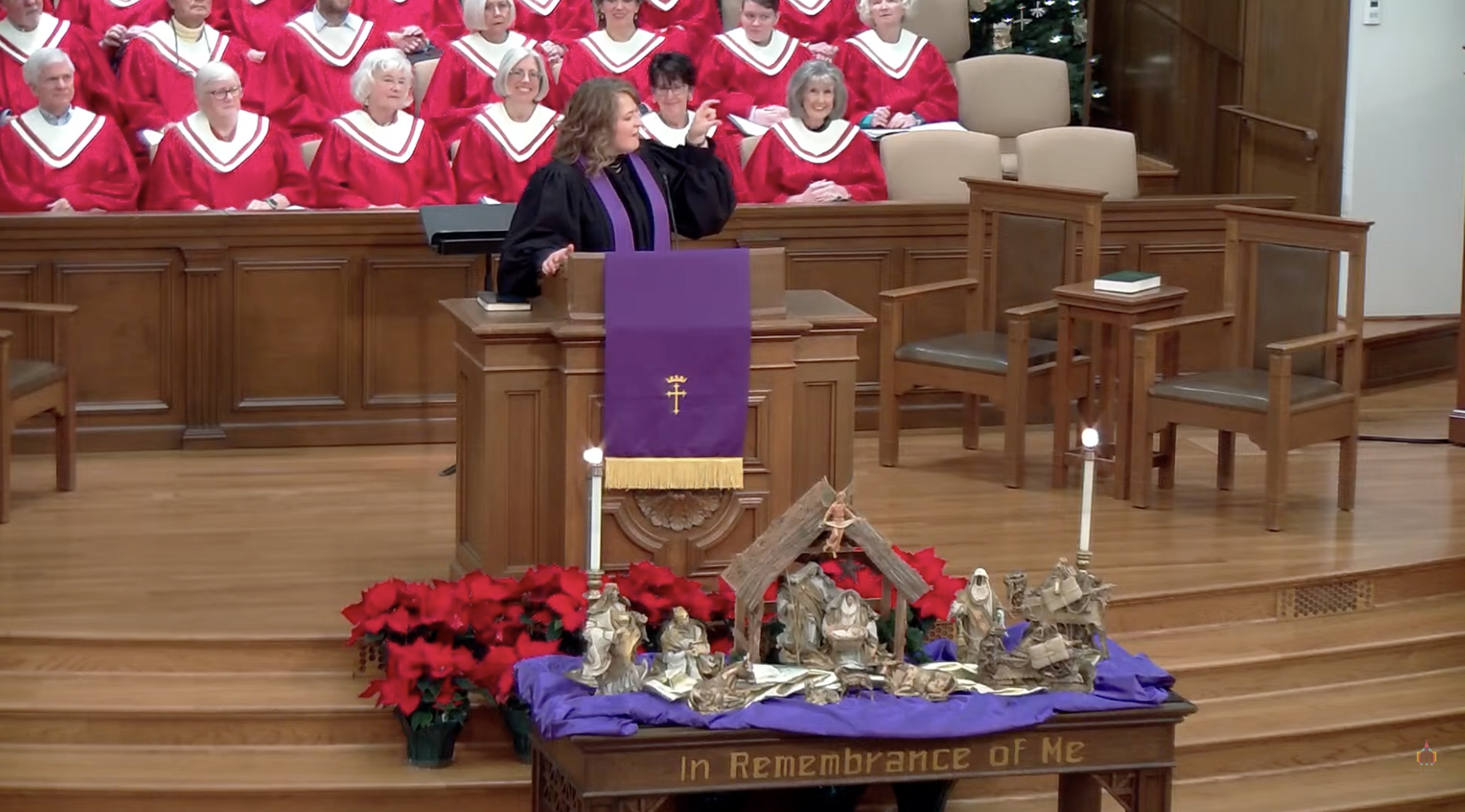
Every time you see a poinsettia – instead of thinking back on these roses e’er blooming over the years as cheerful reminders of the holiday season, what if you wondered forward toward the day when weeping and crying are no more and, as Jeremiah tells it, justice and righteousness springs forth like a branch?
Every time you see candles lit – instead of thinking back on the shiny spots in your life, what if you wondered forward to the day when there will be no darknesses to fumble through in order to find the light: no terrifying diagnoses, or listless living, or horrific violence, or perpetual pain?
Every time you see a nativity scene – instead of remembering the funny stories of your past when your little brother stole the baby Jesus from grandma’s nativity – what if you wondered forward to the day when safety and home and refuge aren’t reserved for the privileged, when every door is open to all and closed to none, when families are united without fracture or pain, when there is enough and no one goes without?
In the volatility, the uncertainty, the complexity, the ambiguity of this chronos time, what if you held fast to hope and readied yourself for God’s kairos time?
Well you might just catch a glimpse of the day when justice breaks forth like the dawn, a day when a baby is born so all may be whole and free, a day when God comes near once again.
So keep awake! Be ready! Amen.