

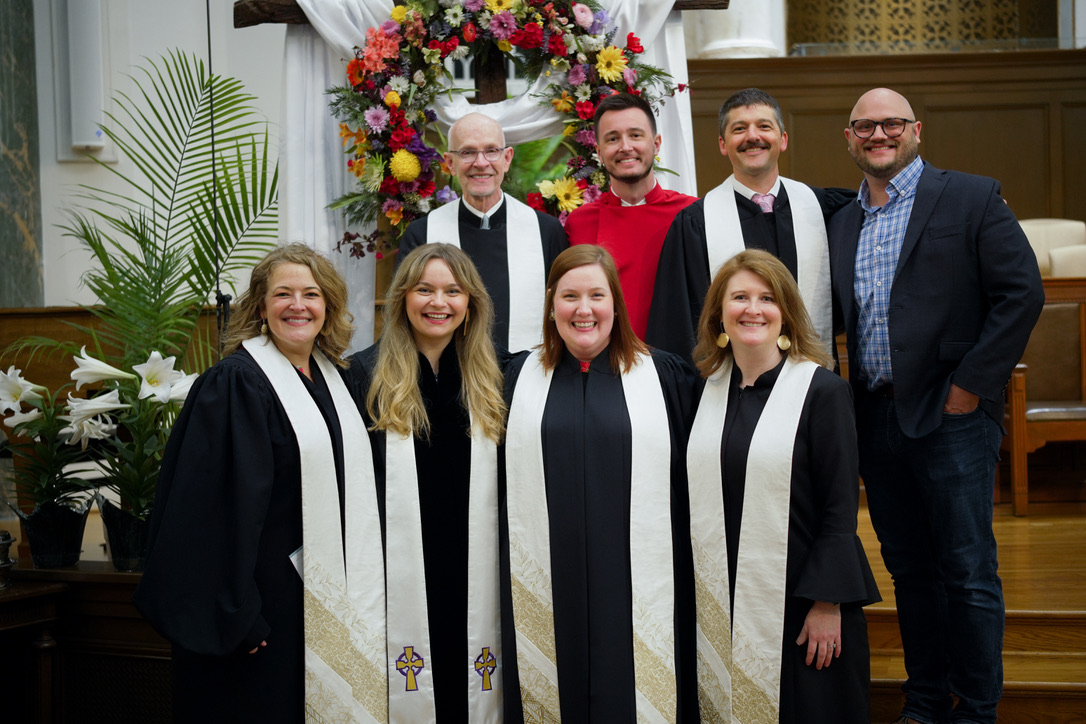
I.Are you surviving the celebratory days of May? I imagine there are parents of young ones here who’ve already prepared teacher appreciation gifts and rearranged your schedule to be at the final school performances. I see from your Facebook posts that a bunch of you have or will bounce from graduation to graduation – or graduated yourself, like our own Dr. Amy Mac did yesterday! Or maybe you’ve filled your calendar with the celebrations of this late spring season: a Derby party or a Cinco de Mayo fiesta, a Mother’s Day brunch or a Memorial Day cookout, spirit weeks or field days or awards banquets or the end of soccer or volleyball with trophies and pizza and pictures and all the ways to celebrate, or weddings, vacations, time away. Goodness knows around here, we’ve been celebrating! Last week, we wrapped our school year-long celebration of our 100 years in this place, complete with cake and drones and a group picture on the front steps. There’s just something about this doorway between spring and summer that seems to invite a pause for the festive, for all that is big and grand that will live on in pictures and memories for years.
But the big thing isn’t always the good thing. Sometimes the big thing is the hard thing. Sometimes the big, hard, terrible thing happens, and there’s nothing celebratory about it. The loss that shatters you. The change that upends everything. The ending that accompanies you every minute of every day afterwards. The suffering that you can never escape. Either way, what happens next? What happens in the after: after the new graduates are minted, after the happy couples are married, after the funeral mourners depart, after the divorce papers are signed, after the confetti falls, stepped on and brushed away, and ordinary life slips back in once more? Then what?
II.One of the lectionary’s gifts of Eastertide is to dwell in the post-resurrection appearances of Jesus to his disciples, giving us the opportunity to understand more fully the meaning of his resurrection. But then the mood shifts. The texts return us to the final days before his death, when Jesus is preparing his disciples for his impending departure, helping them know what to do in that yawning after.
That had been the topic of conversation, as earlier in the story, Simon Peter wanted to know where Jesus would be going, how he could follow Jesus to wherever that would be, what path he could take toward the place Jesus prepared for them.
And then the conversation turns plain. “If you love me,” Jesus says to his friends, “then keep my commandments.” What commandments? “Love one another. Just as I have loved you, you also should love one another. No one has greater love than this, to lay down one’s life for one’s friends.” That love that we’re to share with God and neighbor is muscular and full, resilient and persistent, unconditional and complete. It’s the love that Paul calls “patient and kind, not envious or boastful or arrogant or rude; love that bears all things, believes all things, hopes all things, endures all things. Love that never ends.” It’s the love we experience through God in Christ — love that lifts us when we are low, love that serves all, especially those that are too often overlooked or forgotten, love that shows up. The kind of love that prompted the late preacher William Sloane Coffin to say, “if we fail in love, we fail in all things else.”1
After he calls the disciples towards the commandment to love, Jesus says that even as he will soon go where they cannot, he won’t leave them alone and abandoned. The disciples will not be orphaned. No, God will give another presence — this one, the Spirit, the Advocate who will be with them forever. In the original Greek of the Gospel of John, the word for Spirit is parakletos — the Paraclete, literally translated “the one who comes alongside you,” or “the one who answers a cry.”2 So even as Jesus prepares his disciples for his leaving, for a time soon when they cannot look directly at him to see and hear and smell and touch and taste what that commandment of Love should entail, Jesus promises another Advocate, another comforter and counselor and helper and champion and defender and presence and guide. The Spirit will abide. She will “stay put” right here with you.3
So after I’m gone, Jesus says, after all seems to be over, my direction for you is straightforward: if you love me, keep my commandments. For love never fails. God will remain close. The Spirit will abide with you. Each and every day of the long future of the world, love. And know you’re never alone.
III.I think about the disciples in that moment, and feel such compassion for them. They couldn’t have imagined what the next few days would hold, what would come of the events at the cross and the tomb. They couldn’t have pictured crucifixion and resurrection, much less what one should do the morning after resurrection, and the day after that, and the day after that. Yet I hear in this text that Jesus is trying to give them direction about the long hereafter.
So too is it with us. And the direction is to keep Jesus’s commandments, most important of which are to love. Some days I wonder, surely he would have given us bigger instructions, something grander to do! Perhaps it sounds so small in comparison to the big thing you’ve marked. Perhaps it pales in insignificance from the grand story you’ve been part of. Perhaps it feels so ordinary against the extraordinary circumstances you’ve experienced.
I’ve told you before about my former church, Highland Baptist in Louisville, where I served as Minister to Young Adults – working with the fabulous 20- and 30-somethings in the congregation. Regardless of their location, 20- and 30-somethings are similar in many ways: yearning for meaning and for life to matter, moving through significant markers of life stage and wondering how this new job or that marriage will change the shape of their life. One of those young adults, we’ll call him Eric, fit the bill. An idealistic type. Well-read, thoughtful, earnest. Big thoughts about the big-C church. One such group conversation with him came in a season when our little-c church life was full and vibrant. We were undergoing a multi-million dollar renovation project for children and youth space, nurturing a new community partnership with refugee families in our neighborhood, dialoguing around Louisville through our pastor’s commitment to op-eds and public speaking, and sharing deep discernment about LGBTQ inclusion that was just on the brink of celebrating our first same-sex wedding – all while being community together in ordinary ways that churches do, through our worship, fellowship, faith formation, mission; marrying and burying and, well you know, being the church. As we talked about our church, about Highland’s commitments and energies, Eric’s face clouded over, as if he was pondering something deeply. And then he asked a question I’ll truly never forget.
With complete sincerity, Eric asked the group, “so when are we going to really do it?” “Do it?,” I asked quizzically. “Do what?,” chimed in another. “Yes, you know,” he responded. “Do the big thing. When is Highland going to really do it?”
I’m not often speechless, but in that moment I was! Highland was the “really doing it”-ist church I’d ever known until then, and I couldn’t help but to wonder: what exactly was Eric after here? Seated around me were some colleagues, who quickly jumped to the church’s defense, listing off all of the above actions that filled our days.
Perhaps that’s an impulse quieted with age, as looking back on it now, I imagine my response would be quite different. More reframing, less defending. I think Eric spoke for many, certainly many in our generation, in all generations for that matter, when he yearned for something grand, something much bigger than himself, something that would spiritually sweep him off his feet and plant them somewhere where every day felt full of purpose and direction and vibrancy. What I might say now is that the gospel work of “really doing it” is most often quiet. Small. Barely noticed. Behind the scenes. Unassuming. Downright ordinary! Because the gospel work of “really doing it” at its core is the work of love. Loving through a phone call at just the right time, a bag of groceries dropped off at a front door, a lingering conversation long enough to see and be seen. Loving through teaching 3rd grade Sunday School, making a platter of brownies for mourners at a funeral, volunteering at the local food pantry.
My mentor and coach calls these acts of love within the church things that are “small enough to do, and big enough to matter.”4 Church is where we practice loving like this, where we’re reminded the “why” behind the “what,” where we take the love we experience in here to a world out there. Then we learn about loving through giving our money where it counts, leaving voicemails of encouragement or correction to our elected leaders, finding a way to lead without being asked. Loving through caregiving for our elders, providing for our children, checking in on our neighbors, tending the ground beneath our feet. Loving through tending the dailiness of our living among the people and the creation right around us. Loving, as David Whyte says of routine-keeping, by “making a miracle out of simply turning up, at the same time to do the same good work, watching that work mature, slowly, with our daily visitations, into something we could not fully imagine.”5 Or, in the words of Annie Dilliard: “how we spend our days is, of course, how we spend our lives.”6
This kind of love requires us to get specific and regular, both in our efforts and in their recipient. Or we find ourselves like Barbara Brown Taylor did when she admitted, “I know that I have an easier time loving humankind than I do loving particular human beings.”7 (Can I get an amen in the room?) But that’s our call, that type of commandment-keeping, particular-loving, local and regular action that hardly ever feels grand, but has the power to change a life, a family, a neighborhood, a community, a people.
IV.The good news is that we don’t do this work alone. Sometimes after the big, the hard, the sweeping, doing the small, ordinary works of love can feel trite, or exhausting, or uninteresting. Certainly the strength to keep at it, one day after another after another, takes patience or courage that we may not think we have capacity for. But remember the promise of Jesus: “if you love me, keep my commandments. And God will give you another Advocate to be with you forever.” The Spirit remains by our side always – putting wind in our sails and breath in our squeezed lungs, accompanying us through blocked roads and wayward trails, encouraging us to keep at it again and again. For the work of Love is worth a life.
This picture of God as advocate and guide might feel distant for you. Why would God care about staying near when I’m about to lose my temper, or coming close when I’m ruminating about a past trauma or a broken relationship? Isn’t God judging me for all the ways I’ve failed to love? Isn’t God about to punish me for screwing it up? When folks came to Highland – people like my friend, Eric, lots with cynicism or church hurt or anger or despondency, so many in so much pain – often we’d hear, “I don’t really believe in God, so I’m not even sure why I’m here.” To which my former pastor Joe was known to say, “well tell me about the God you don’t believe in. I bet I don’t believe in that God either.”
Let me tell you about the God I do believe in. Perhaps this is the God you believe in too. It is the God who Jesus loved. The God who created and sustained and redeemed us. The God in whom we live and move and have our being. The God who reaches down into the graves of our lives and yanks us up toward resurrection again and again. That is the God who abides with us always. The God who will never leave us. The God who mothers us with the tenderest of care. The God whose love is small enough to experience and big enough to change us from the inside out. The God who will always be with us in the afters. The God who gifts us with love: love extended, love received, love shared, love that never ends.
Some might call that small. But to we who have been changed by love know it is to the One who by the power at work within us is able to accomplish abundantly far more than all we could ask or imagine, to God – Father and Mother of us all – be the glory in the church and in Christ Jesus to all generations, forever and ever. Amen!