




I.Everything looks different underwater. Distended, a bit. Shiny and blurry all at once. Scientists tell us “not only do underwater objects appear larger and closer to us, they can also appear further away and smaller than they actually are.”1 Visual reversal, it’s called: a phenomenon of the experience of refraction and light. No matter the body of water you’re looking under – a river or a creek, a puddle or an ocean, a bath or a pool – the experience can feel a bit like entering another world.
Underwater, you see unfamiliar things, and see familiar things differently. Creatures and rocks and plants that you’ve never discovered. Grains of sand that muddle into sludge. Colors, once vivid and clear, that fold into shades of blue. Lines and curves that distort into shapes unrecognizable from that above ground. Life underwater, you see, changes things.
II.You know that from the time you’ve felt underwater with your mortgage or your stocks. When you’ve been drowning in a sea of incomplete tasks or sinking in mounting debt. When you’re struggling to stay afloat with a never-ending stream of caregiving or finding out that your grief never fully dries. When you’re immersed in identities hard to sort out or understand, immersed in a story you can’t get out of, immersed in a trauma and a past you can’t seem to wipe away. For when you feel in over your head, life underwater changes things.
You know that too, when, over time, you realize that the landscape around you has shifted. When, over time, we realize that the landscape around us has shifted, and we’re not even sure who we are anymore. Concerning patterns, dismissed and laughed off, blur into a flooded zone of shock and horror. The law, muddled, and a common moral language, once vivid and clear, now so distorted that familiar spaces, rhythms, relationships, and a shared reality become utterly unrecognizable. Truth distends into opinion, and opinion refracts into narrative, and narrative blots into despair, and despair folds into moral exile and hopeless resignation. And “then another life is taken by the power of the state,” and you howl in lament and wonder2 : where even am I? What is happening here? And who have we become?
III.In the haze and hazards of the distorted places of our lives, both individual and shared, it might seem absurd to open again these old pages, and tell again these old stories, and hear once again the good news that spills forth. Could there be good news to hear?
Good news seemed to be his summons. Solidarity took him to the water. Faithfulness immersed him in clarity and conviction. And belovedness brought him up.
On that day, that dusty riverbank, that trip away from home – from Galilee to the Jordan, he came. Tradition will tell us he didn’t need to, as if salvation for the son of God was somehow waiting for him in the waters too. One gospel writer even leaves out part of the story, lest he appear any less divine. But this gospel writer places the story first – his first appearance, first words, first public act for all to see.
He came to those waters despite John’s protests. “John would have prevented him,” Matthew notes. Without sin, or need for repentance, or cleansing, or salvation, or getting right with God, what would baptism be for? Why would this man, this one John said was coming to baptize with Holy Spirit and fire, why would he enter those waters? “I need to be baptized by you, not the other way around!”
“Let it be so,” he says, for it “fulfills all righteousness.” It makes right the relationships. It completes the covenant. It establishes God’s will for justice to the oppressed, for liberation to those who are bound, for shalom to permeate all creation. It places him in solidarity with all humankind, right beside the sinners on the riverbanks throughout all of human history. It proclaims good news.
Scripture doesn’t tell us what happened to him underwater. We don’t know details of that moment, what he felt, what he saw, how it changed him. We don’t know how his Light refracted deep underwater too. But as he came up, the heavens were opened to him. God’s Spirit descended like a dove. And a voice rang out: “This is my Son, the Beloved, with whom I am well pleased.”
IV.Several months ago, a crowd of your pastors and dear, wonderful Gary Knight tucked up into the baptistery for baptism practice. We had a pastoral intern and resident on our staff, pastors who wanted a little extra practice, and willing participants! Gary had filled the baptistery to a warm 88 (you don’t want it much hotter or you’ll turn into a lobster up there), and in we went. You may not ever think about the technicalities of baptism, but there are some, let me tell you! What side the baptizer stands on. Which way they lower. What hand they use. How strong is their grip. What words they say. Where they place their feet. How low they want the one baptized to bend their knees. I’ll stop, but you get the gist. And yes, Gary got baptized the most. Six times! Don’t worry, he’s the most spiritual of all of us here.
That day, it was necessary to this task to dwell in the details, to get real practical and remain in the technicalities until each of us left with confidence and clarity. But I must say, baptism practice is about the only time that baptism needs to blur into technicalities. Because baptism isn’t about the water. It’s not about the grip. It’s not about the water temperature or the words pronounced or the robe chosen. Baptism is about good news. About solidarity. About faithfulness. About belovedness.
Like Jesus, for us, good news is our summons. Solidarity brings us to the water. Faithfulness immerses us in clarity and conviction. And belovedness brings us back up again.
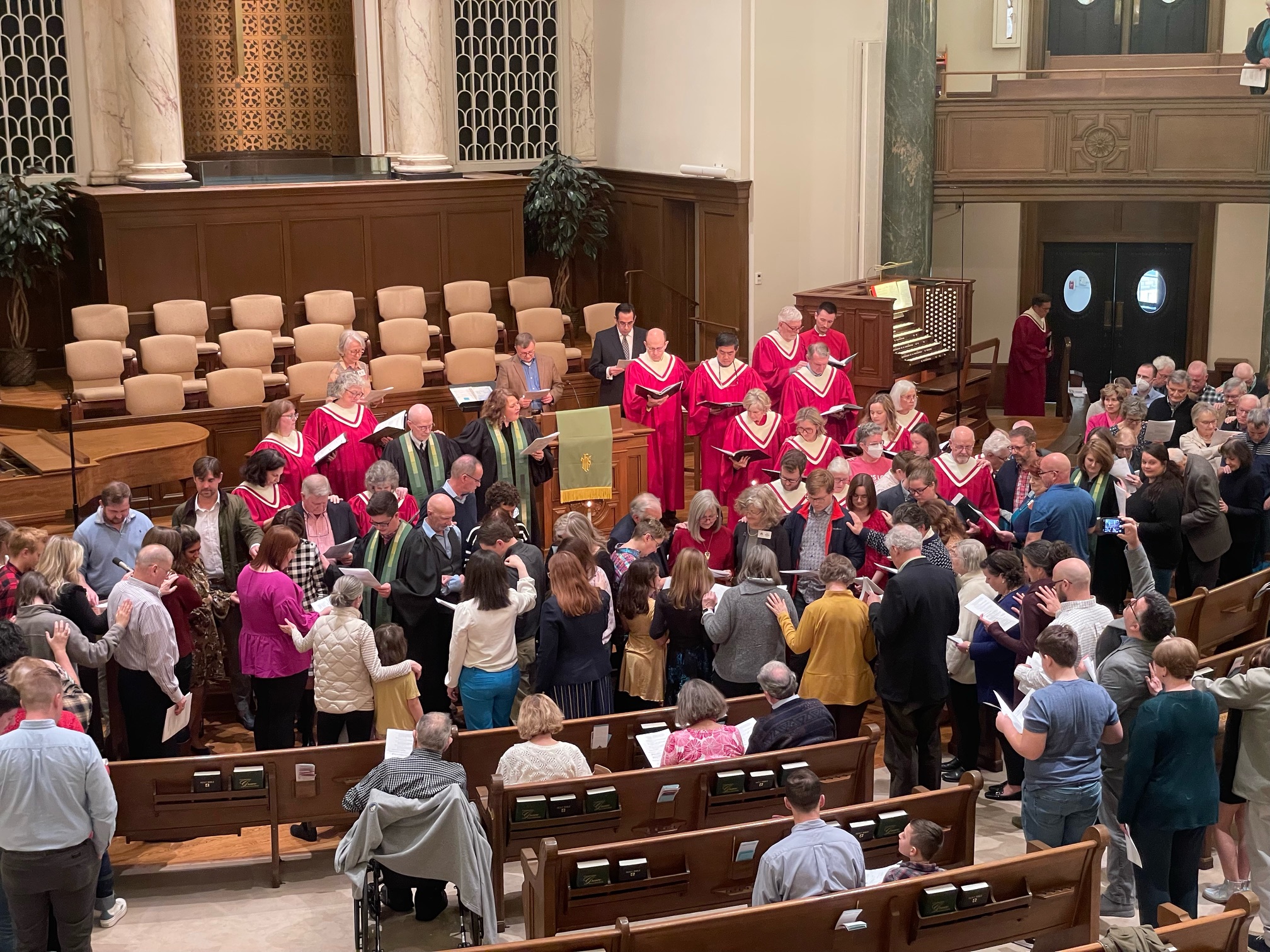
V.On this Baptism of the Lord Sunday, when we’ve borne witness to baptisms of Owen and Julie and Day, when we’ve remembered our own… and on this Deacon ordination and installation Sunday, when we commission our leaders for their year of service, let us all take our cue from Jesus. Good news, God’s good news that a new day of shalom is at hand, must summon us to the water. Solidarity with our fellow citizens and neighbors, particularly the most vulnerable and afraid, must bring us to the water. Faithfulness to Jesus, who calls us to take up our cross and follow him, must immerse us with clarity and conviction. Belovedness by a God who declares every life to be worthy and good must bring us up again and again.
This is no time to wallow and hide under these murky, distended waters of violence and fear. This is the time to be about good news. To be about solidarity. To be about faithfulness. To be about belovedness, even – especially – when it seems to be absent everywhere we turn. For in these waters of life, we find that the Light of Christ does refract in every corner, every shadow, every place where gloom has settled in. In these waters of life, we are birthed into new life once more. In these waters of life, the dust and dimness of our sin and separation washes away, and a particular kind of identity and hope and quiet resolve flows out.
And as we emerge again and again from these waters, we hear the voice of God saying to each of us: “This is my child, the beloved, with whom I am well pleased.” Amen.