
“God requireth not an uniformity of religion to be enacted and enforced in any civil state; which enforced uniformity, sooner or later, is the greatest occasion of civil war, ravishing of conscience, persecution of Christ Jesus in his servants, and of the hypocrisy and destruction of millions of souls.” Roger Williams, 17th Century proponent of religious liberty and early Baptist in New England
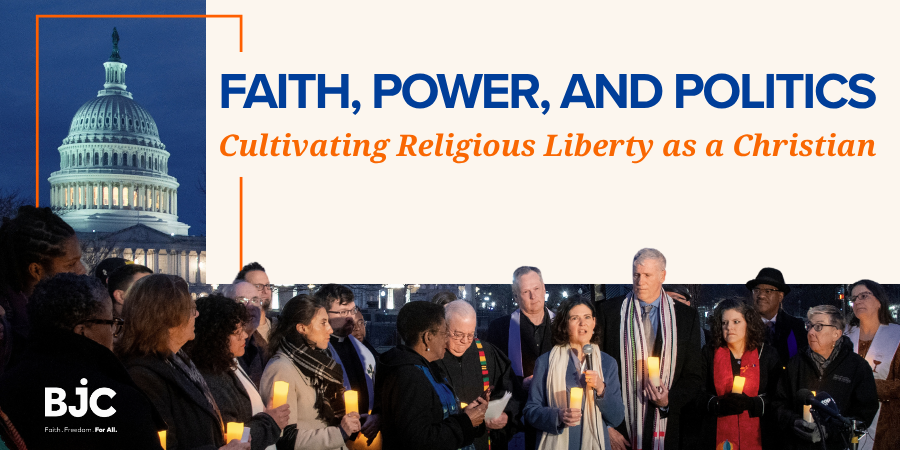
This past April, I led a small group of folks from First on Fifth in a series called “Faith, Power, and Politics.” This curriculum by the BJC (Baptist Joint Committee) invited us to consider the intersections of faith, power, and politics in US Society. This study was timely since many of us have witnessed a rise in Christian Nationalism among some groups of modern Christians—despite the many voices for religious liberty in the early American republic and the first amendment protections for separation of church and state.
By far the most powerful and impactful part of each gathering was the sharing of our own cultural autobiographies. Each participant was asked to write a narrative of their own racial, ethnic, and religious heritage and share with the group each week. Our religious and political upbringings ranged from conservative to progressive and everything in between. A common thread through each of our very different stories was how life experiences and faith commitments shape how we view and participate in public life.
One of the primary ways many of us participate in public life is by voting. Earlier this week we went to the polls, awaited results, and stayed up late watching the returns. Commentators, political wonks, and coworkers will all propose the reasons power shifted from one political party to the other.
Viewed from a religious and cultural perspective, this election cycle was historic in so many ways. There were many firsts. Georgians elected the first Black woman governor in US history. Michiganders elected the first Muslim to the US Senate. New Hampshirites elected the first openly gay male to the US Senate. New Mexicans elected the first Native American woman governor in US history. Minnesotans elected the first Native American woman to the US Senate. Kansans chose a Methodist pastor to represent them in the US Senate; Texans chose a Presbyterian seminarian to represent them. Texans also chose their first Hispanic. Ohioans chose their first woman governor in Ohio history. Californians elected their first Latino governor. Tennesseans elected their first female governor. Wisconsinites elected their first Black governor. Nevadans elected their first Black governor. North Carolina was among the first Senate races to be called. And this is only a partial list of all the firsts.
From a religious and cultural perspective, this election revealed a wide array of religious and cultural backgrounds in our country. Though our history of embracing diverse backgrounds and perspectives has often been spotty, the dream of early Baptist Roger Williams is still being realized. At First Baptist on Fifth we give thanks to God for being part of this inheritance of religious liberty and we continue seeking to live this commitment out in real time—honoring conscience, caring for souls, and striving to protect religious liberty for all people.
Pastor Kyle
